
Brief
Research Task: Slow Painting
Have a look online for examples of Tim Stoner’s drawings, watercolours and paintings (he has a very active instagram account: @StonerTim and at time of writing is represented by Vardaxoglou).

Also read the Slow Painting article by Derek Horton, about a Hayward gallery touring show Slow Painting that includes the work of Tim Stoner and other painters.

Do further research into the artists in the exhibition and consider different ways that ‘slowness’ might be revealed in a painting. Make notes in your learning log.
Tim Stoner
Tim Stoner is a London-based artist who “lives with” his paintings over several years. One example is a painting called Persian Red (2009-2024) which he took 15 years to complete, or more precisely, started in 2009 and completed in 2024 when he was invited to present a solo show at the Pace Gallery. In an article for the magazine Ocula published in 2025, Annabel Downes explains that the time distance between the inception and completion of a piece allows him to rediscover the artwork but also himself as an artist. His process is destructive or restorative: he is said to put his canvases in a swimming pool, pour dissolving chemicals and use scalpels, pressure hoses or palette knives to reveal the original colours, gestures and textures. The connection with his own younger self through the canvas is interesting. The process of layering is also intriguing. This reminded me of the Continuing Painting series of 6 by 4ft by Judy Tuwaletstiwa which also involves layers but only retain a photograph of each layer before it was concealed. She never returned but called the final painting a “a matrix, a womb that gives birth to a dream life of image, story and song.” She’s was burying the past, while Stoner was excavating it. I like both approaches although in terms of process, Tim Stoner’s is possibly the most difficult to get right as you need to know “how far back” to go.
Allison Katz
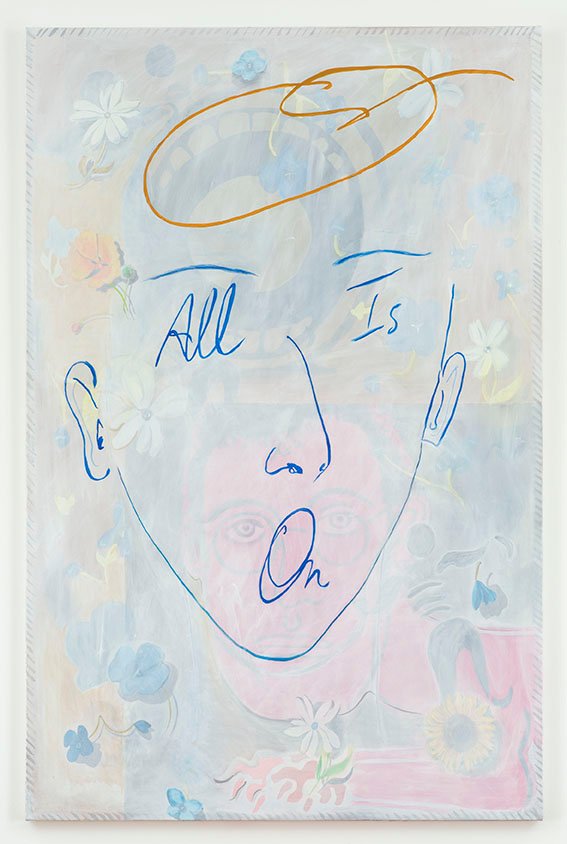
Another way to reveal slowness is to build it through a diaphonous use of paint, where the paint is translucent enough to show through previous layers. I discovered this is an approach used by Allison Katz in her painting AKgraph (Illuminated) which she also worked on over several years (from 2014 to 2016) and was part the 2019 Hayward Gallery Touring exhibition curated by Martin Herbert.

I found this the most impressive. There is a flickering between past and present, something like a veil which is more delicate than burying the past or aggressively resurrecting it. I imagine she used medium to dilute the acrylic paint or perhaps white to desaturate it. I find the blue-grey shadows which give a sense of dimensionality really interesting. It’s only after listening to her interview on the A Brush With… podcast that I realised that All is On is in fact her name Allison.
She also talks about how she used the reveal-and-conceal as something that happens through time but also through (body) movement and talked about how she likes to design her paintings for the space in which they will be exhibited rather than conceive of the exhibition once the paintings are complete. She says there is an “added energy to the perception” if she can make her painting mirror or rhyme with each other. I found this idea fascinating as it relates to the psychology of perception and, in particular, James Gibson’s ecological approach to perception (the idea that organisms perceive the environment directly, in terms of the action possibilities it offers, rather than by constructing internal representations from raw sensory data). In that sense, the viewer’s experience of the painting is slowed down if it is not simply presented but they have to walk through to see it. This is something I could explore when I work on my presentation at the end of this unit.
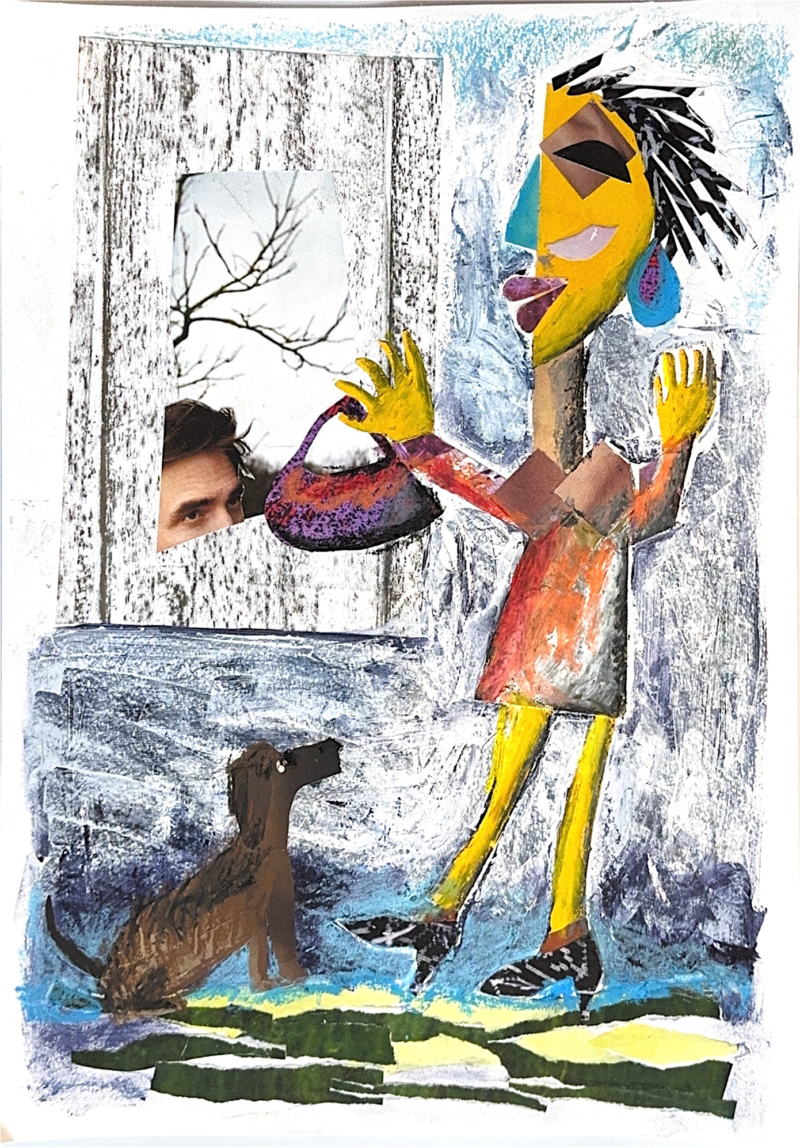
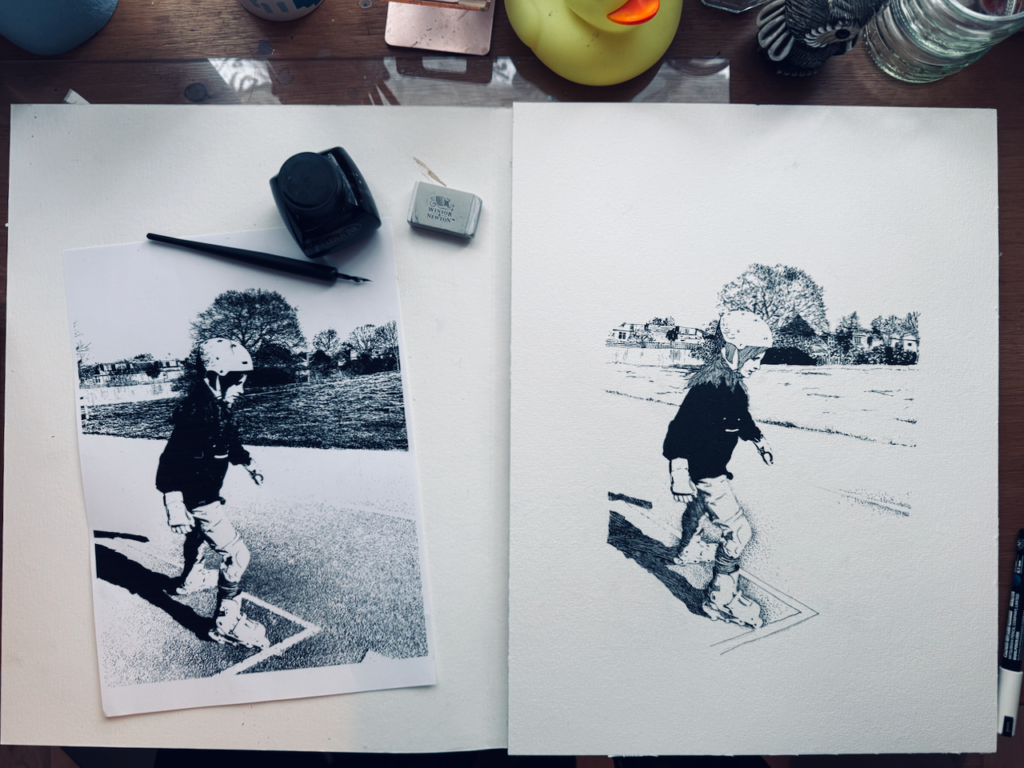
She talks about the kronos-kairos conceptions of time: the measurable, sequential, linear succession of moments (kronos) and the opportune moment for action, a discontinuous and context-dependent succession of significant moments (kairos). I think it’s an interesting way to think about how time may show in a painting and drawing. It made me reflect on my two drawings of my daughter skating in the park. The first perhaps could be said to convey time through kairos, the gestural and the mark-making suggested a brief but significant moment caught in a glimpse. The second, more detailed meticulous, ink-drawing conveyed a moment as a still shot, a frozen movement in a sequence (kronos).
I am reminded of my message in a bottle and my first drawing “Take your time” and see how this is perhaps a theme I could build upon this for the rest of this unit.



1 Comment
Add Yours →[…] of Kairos, the concept of opportune time, essential, unmeasurable (which I first heard mentioned by Allison Katz when researching slow painting). Notable is also the fact that this painting was actually completed […]