Brief
Toby Paterson uses collage and a collage-style approach so seamlessly that it is quite hard (and perhaps irrelevant) to work out which pieces of his are technically collage. Access the Modern Institute website, and view Toby Paterson’s work. If collage is about juxtaposition and layering, then is his Ludic Motif a kind of architectural collage?

The work of Cy Twombly (1928–2011) is renowned for its primal and urgent use of gestural marks, combined with wavering handwriting and simple fragments of collage. Spend some time seeking out Cy Twombly’s work online and look for collaged additions. How do they operate against the painting, drawing and text? Is the addition of a found object, or surface, fundamentally different from the parts of the work which are made from materials which have been more manipulated or constructed?

Do you have a clear preference when it comes to these very different artists? Make concise notes in your log about your discoveries and your own opinions.
Toby Paterson
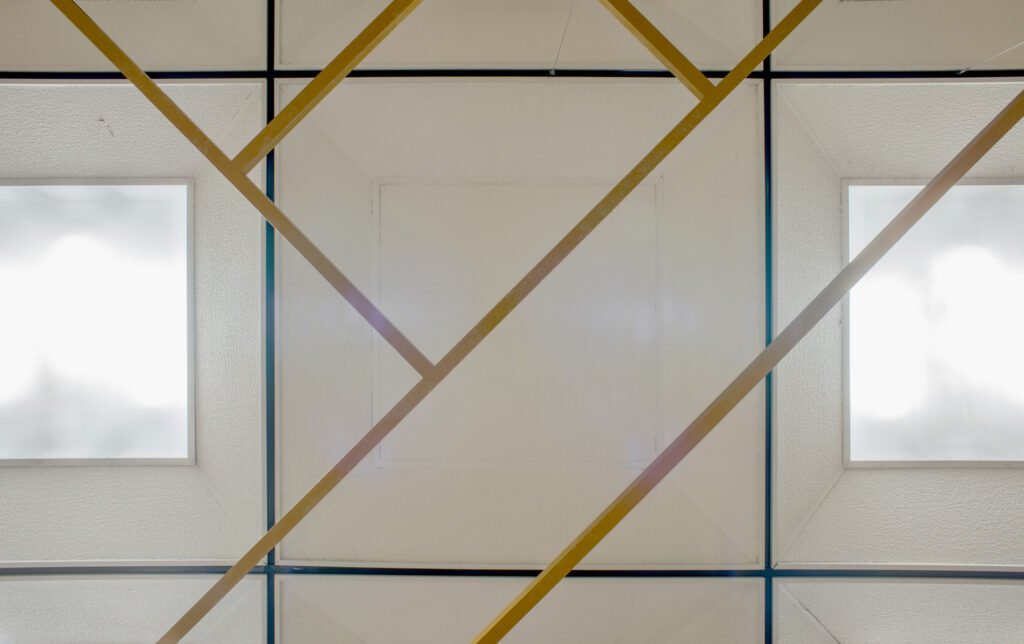
Toby Paterson’s Ludic Motif exhibition layers the space with structural frames which forces us to see the artwork in space and through openings in space. The metallic and wood structures go beyond the canvases but also echo the linear structures on the canvas. I found the idea of an “architectural collage” quite interesting. It makes me think about how I could engineer a viewing experience through space. Not merely placing my canvases outside of the white gallery walls but thinking about layering in space.
Cy Twombly
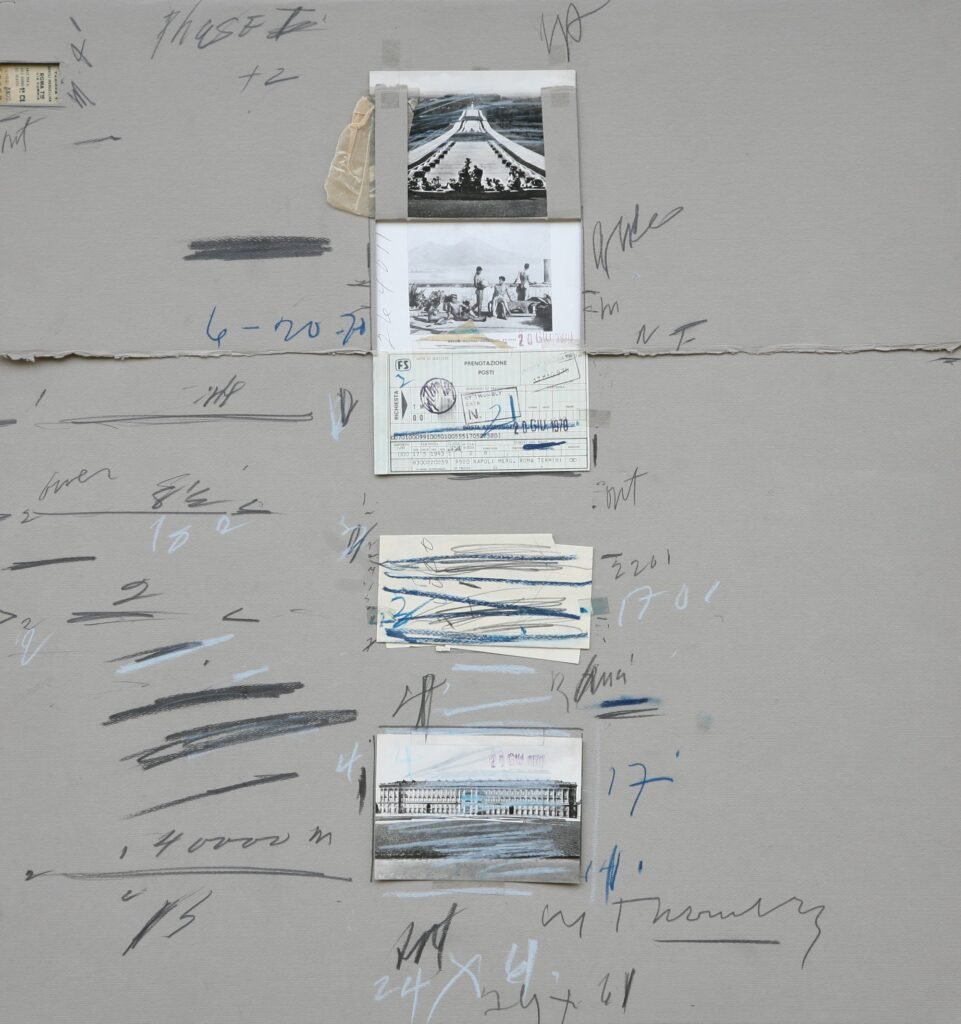
Cy Twombly’s drawings and collages have a nervous neurotic energy to them that I find irritating somehow. Compared to the calming architectural collage of Toby Paterson, his Untitled, Anacapri, Italy, 1970 collage recalling his travel to Naples, he brings together photographs, travel paraphernalia such as a postcard and a train ticket embedded on a piece of cardboard with a flap open and what looks like a wrapper. He also added stamped date and illegible writings. This really didn’t speak to me.
I know though that often when some artwork does not speak to me I need to dig further to better understand it. Doing so, I discovered Jenny Saville’s Lecture on Cy Twombly. I really admire Saville’s artwork. The talk description mentioned that Cy Twombly was a huge influence on her and I was curious to learn why.
Stay ignored for as long as possible.
Cy Twombly
I think Cy spent his whole life with one of his feet in a cave and the other one in a palace.
Jenny Saville
Saville’s lecture was amazing. It made me realise how there is so much more to art than meet the eye, that it is not possible to understand it by simply looking at it. Much of our culture is turning into a fast food of information whether it is visual or textual. We want to, or are being asked to understand at first sight, produce in a hand wave, and move on.
Saville explains there is a sort of mania in Cy’s work but above all there is tension, something to keep things in balance. He uses space as a void to create this tension but also plays with the notion of time. Time which passes through life, through history. He documents present moments, forever freezing them in time.
Every line is the the actual experience with its unique story. It is what it is and it’s nothing else. It is of itself.
Cy Twombly qtd. by Jenny Saville
She talks mostly about Say Goodbye, Catullud, to the Shores of Asia Minor, a painting that evokes an elegiac voyage across the sea, which is meant to be read from right to left.
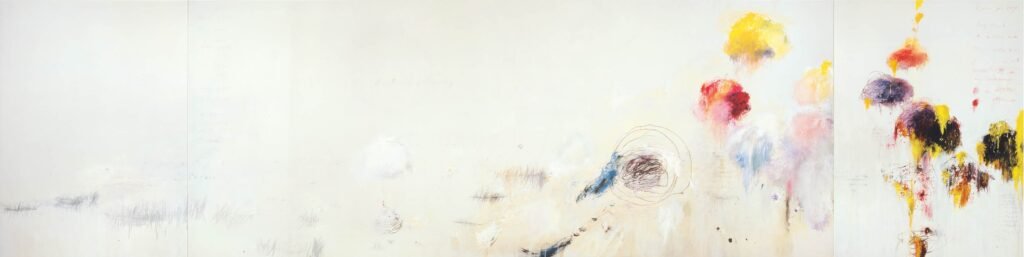
She zooms in and guide us through the different sections of the painting in terms of the mark making and techniques that Cy used: the blossoms, the drippings, the mistiness and the play on distance. She explains these are all vocabulary to describe Nature and life, the immediate black, the distance created by the diluted white and purple. They are things of nature sampled and distilled through their essence and end up taking us on a sort of Odyssey, a passage through life, whether at the scale of a season, a lifetime, or millennia.
As I return to the Untitled collage, I now see more somehow. I see how he used space to depict a timeline and did so, once again, unconventionally (this time from top to bottom), to record his trip. The marks are perhaps also an attempt to get to the essence of what is a memory: fading notes capturing moments which punctuated his journey. I’m reminded of Kairos, the concept of opportune time, essential, unmeasurable (which I first heard mentioned by Allison Katz when researching slow painting). Notable also, is the fact that this painting was actually completed over 22 years.
It now feels as if I can see something that eluded me before and have gained a new appreciation of the intellectual, historical, and processual depth behind the seemingly neurotic artwork. I now understand how this work is a continuation from Turner, Degas, and Monet, all artists whom I know and greatly admire and how it also relates to Basquiat, whose work I also enjoy.
I’m writing this and thinking I have absolutely changed my mind! I’m in the Cy Twombly camp! I am interested in nature and this tension seeking to keep things in balance. I look again at Paterson’s architectural layering and I think this is too safe, almost like a prison. Twombly in contrast is wild and full of tensed contradictions: it is alive and free.
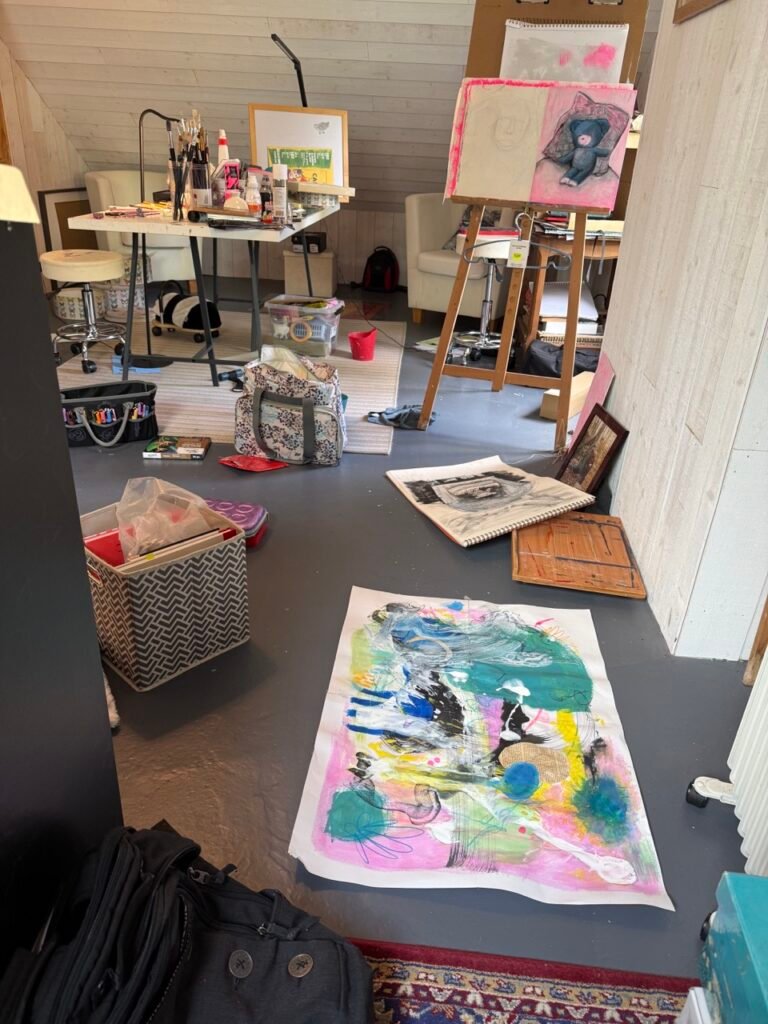
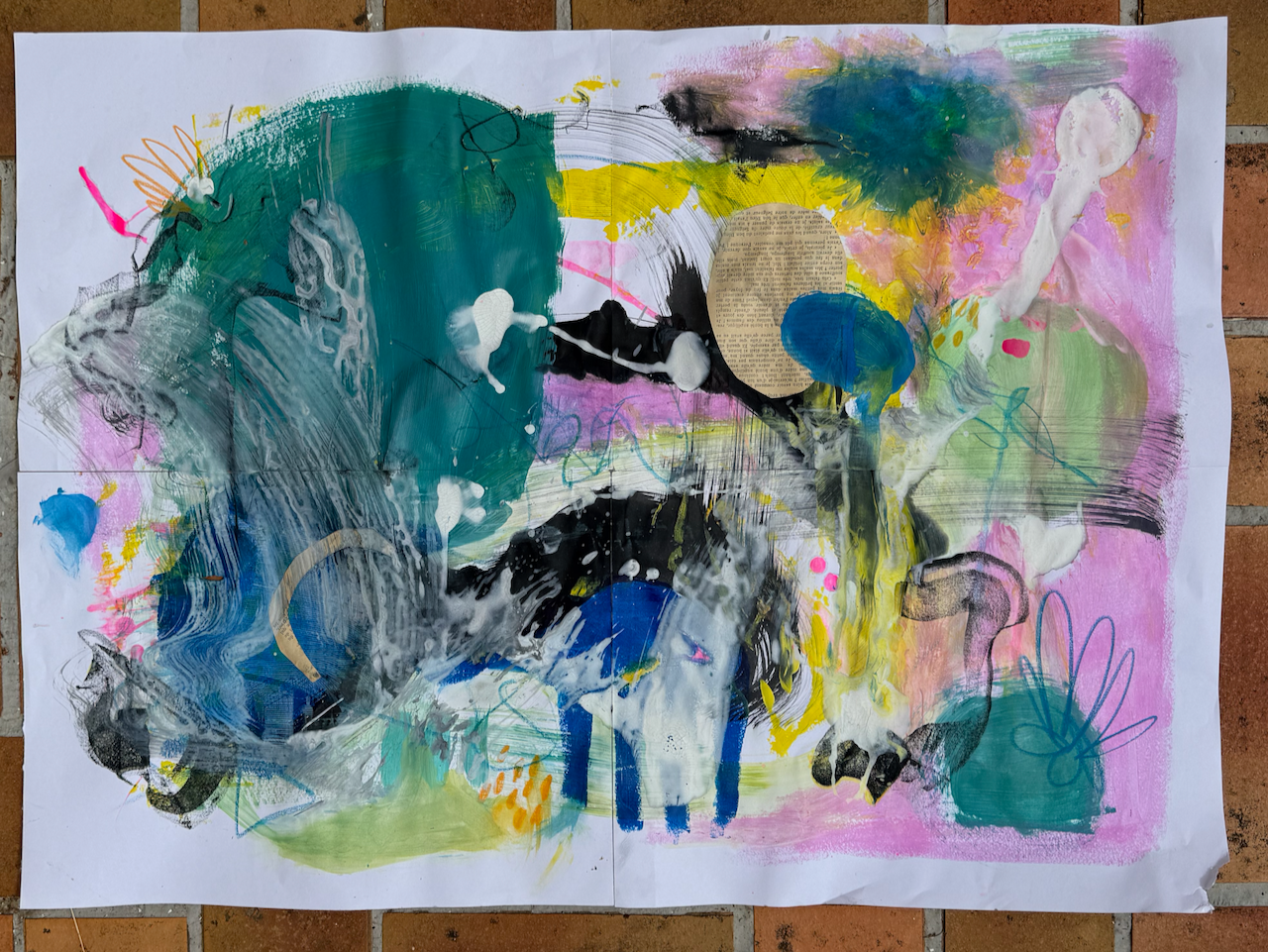
As I am writing this, I look to my side and there’s a study I made last Easter lying on the floor. It’s made on four pieces of thin A3 papers sellotaped together. It’s chaotic and overcrowded and it’s scrap paper with scrap materials. The dog even started to eat a corner of it but I can’t seem to get rid of it. Now I am starting to understand why.
I’m also reflecting on a comment from my tutor and how I tend to create a halo effect by not using the edges and limits the illusion of depth.
This makes me rethink that earlier piece in terms of space, distance, but also as a record of time, a collection of kairos moments. It’s too busy and I have to work at better balancing it next time but it is something I feel I need to continue explore.
(I also need to tidy up!).