Brief
You have been working hard on arranging compositions throughout this project, but for this exercise you are returning to making a series of quick studies in fluid media. Although there are steps that can be followed when planning a painting, it is also important to keep re-engaging with materiality and process. The way an idea for a composition is arrived at is rarely linear and it can be helpful to return to the more playful aspects of creativity. As you will have found in your sketchbook work, and some of the previous exercises, ideas often arise quite unexpectedly and often through the material itself.

For this exercise you will make a series of monochrome studies that explore tone and how this can enhance a composition.

Method
Make a few very quick preliminary studies for compositions in your sketchbook. Work from life - interior, still life, your garden - or you could try a few figure studies.

Working on A3 or A2, you are making a series of studies of your choice of subject matter, using fluid media such as acrylic, gouache or ink, in black and white - or just black. Aim to make between 3 - 6 pieces.

Using loose, gestural brush marks to suggest line and tone, avoid adding too much detail or working slowly - try limiting yourself to 30 or 40 minutes per piece to keep the mark making energetic.

You are ‘drawing with paint’ as a way of exploring tonal contrasts within a composition. This is another way of considering what you want to say about your subject or the atmosphere you want to create.

Reflection
One of the advantages of working in a series is that you can create a conversation between the pieces, as well as seeing your progress as you work through an idea, or process. What did you learn from working in this way? Did using a gestural mark give you more confidence, or was it challenging and did you find yourself wanting to add detail?

Make notes about anything you discovered in your learning log.
Study 1
Using “loose, gestural brush marks to suggest line and tone” is easier said than done. I feel I am not in control of my movements enough and I don’t see tones very well. I feel I have to build up my skills before I can achieve this kind of proficiency. I am also in France in my larger (hotter!) studio so I can revisit still life painting.
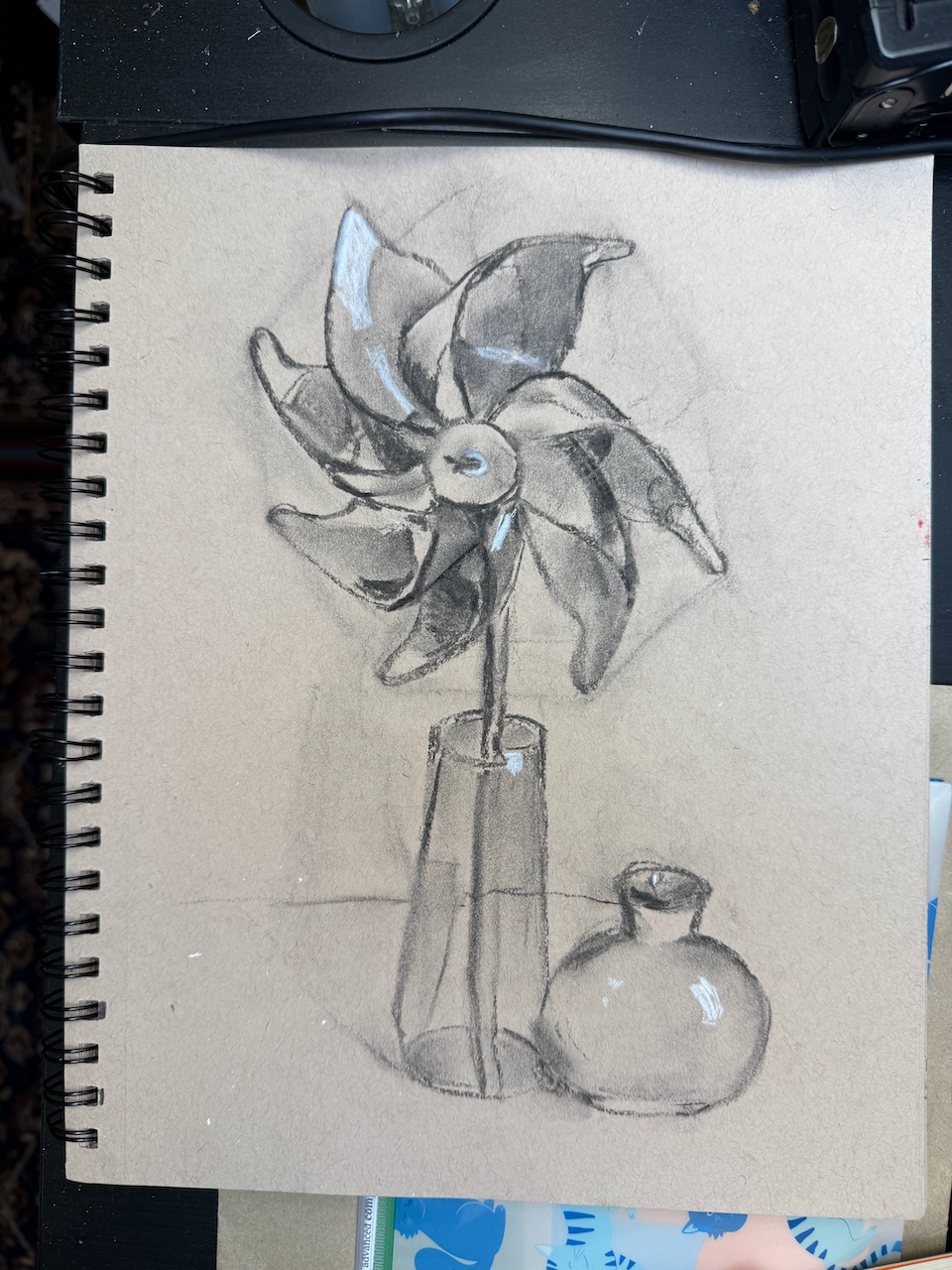
My first attempt was a warm up charcoal drawing where I focussed on tones. I tried to simplify and felt a little lost at time but I was happy to see the final drawing is fairly recognisable. I tried to block out the shape before I started and this seemed to help a little although the pin wheel kept rolling and so it was not a keeping still!
I’m struggling with the ellipses when I draw without scaffolding. I can tell they’re not “quite right” (which is a start) but I’m not sure how to fix them. I also notice the mark making is uneven, I feel a little bit random and clueless. I know how to render a much more technically “correct” drawing (e.g., using a transfer) but that’s not necessarily what I’m after. I also could use an app to make the picture black and white or create a “notan” version but I don’t feel I learn so much from doing that. So I’m happy struggling through the process even if the end result is not quite there yet.
Study 2
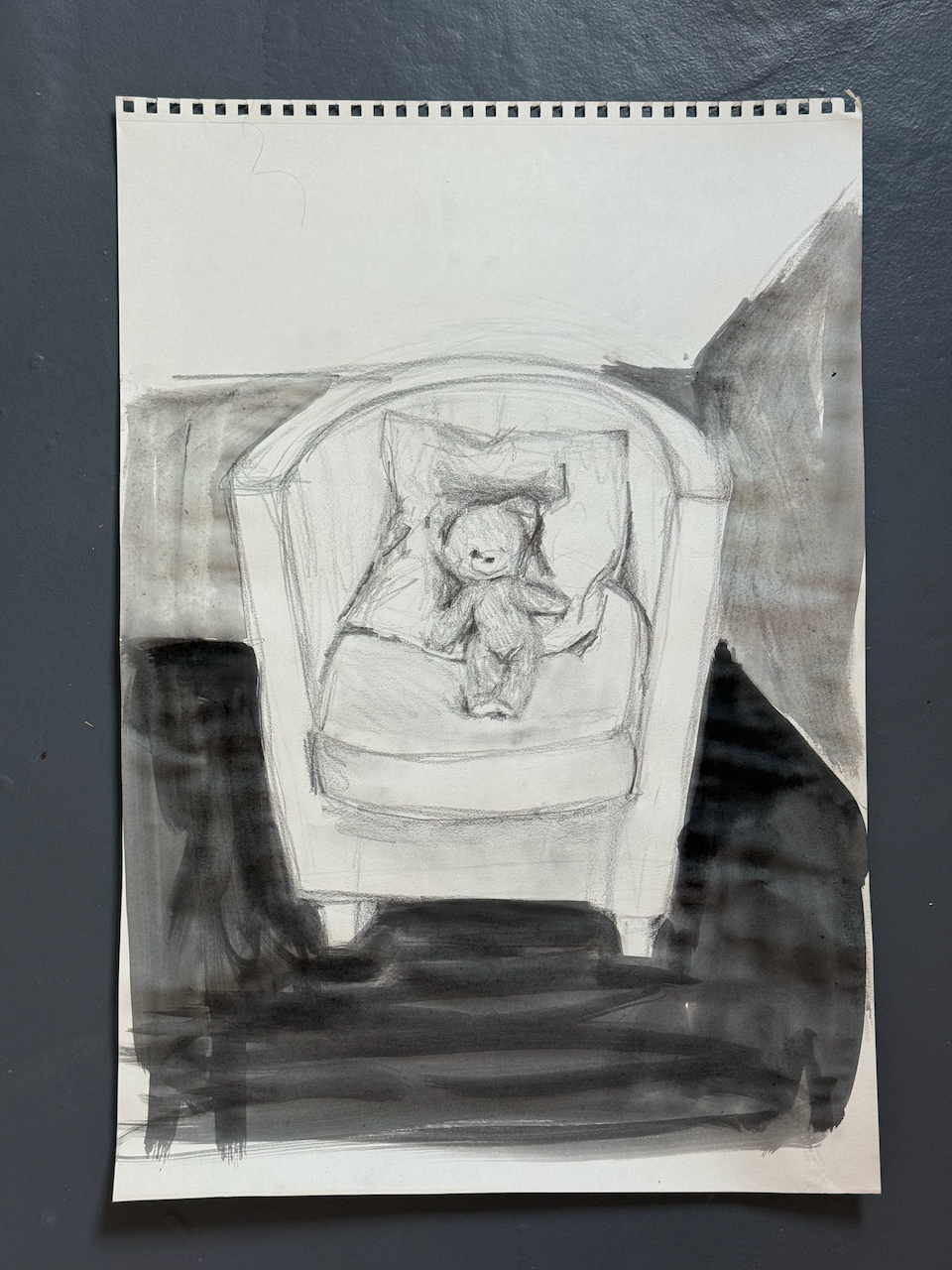
For study 2, I tried to draw with a graphite stick and chose a different composition: my first teddy, on a cushion on an armchair. I stood and worked on an A2 piece of paper. I noticed how difficult it was to get the lines and the proportions right. I struggled again with the ellipses (although the last one was not as bad as the first one!) and with drawing what I saw rather than what I knew about the armchair for instance. In the end, I tried to focus on the tonal values and was wondering how to make the teddy standout and realised I would do so by emphasising the dark areas around its shape rather than work on the teddy itself. I could see myself doing a series of paintings of that teddy, just for fun.


In the end I did pick up a brush and some Chinese ink to anchor the chair in context. I don’t think I succeeded, partly because the scale made it more difficult (and perhaps my 12 round brush was still too small). Still the study was useful. I like the simplicity of it, perhaps because I like declutterred images or perhaps because I like the skills to make more detailed one or perhaps again because the act of making studies makes me focus on the gist or the gestalt rather than the details.
Study 3
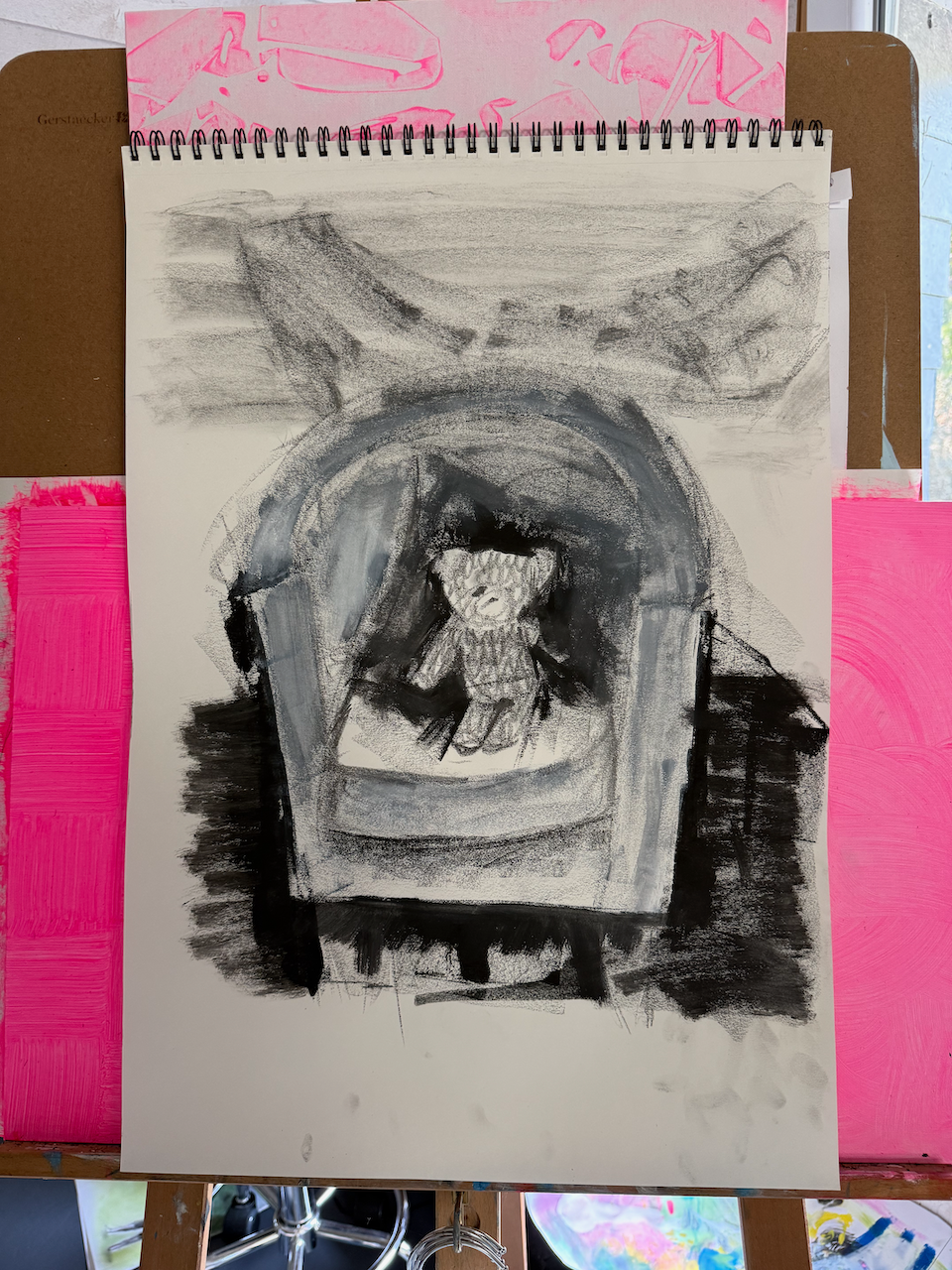
For this study, I decided to stick with the same reference but allow myself more freedom to render it. I returned to the Art Graf chalks which I enjoyed using earlier in the unit for the interior study. I liked this a lot better. Both in the process and the result. I felt freer and I think it shows in the image. I also realise that I like the proximity of the chalk with my hand. I used a tissue paper to blend some of the tones. I like this a lot (did I say that already?!). I also like a lot the contrast of the dark with the bright pink (the drawing is resting on canvases underpaintings I prepared for I don’t know what, just the pleasure of playing with paint!).
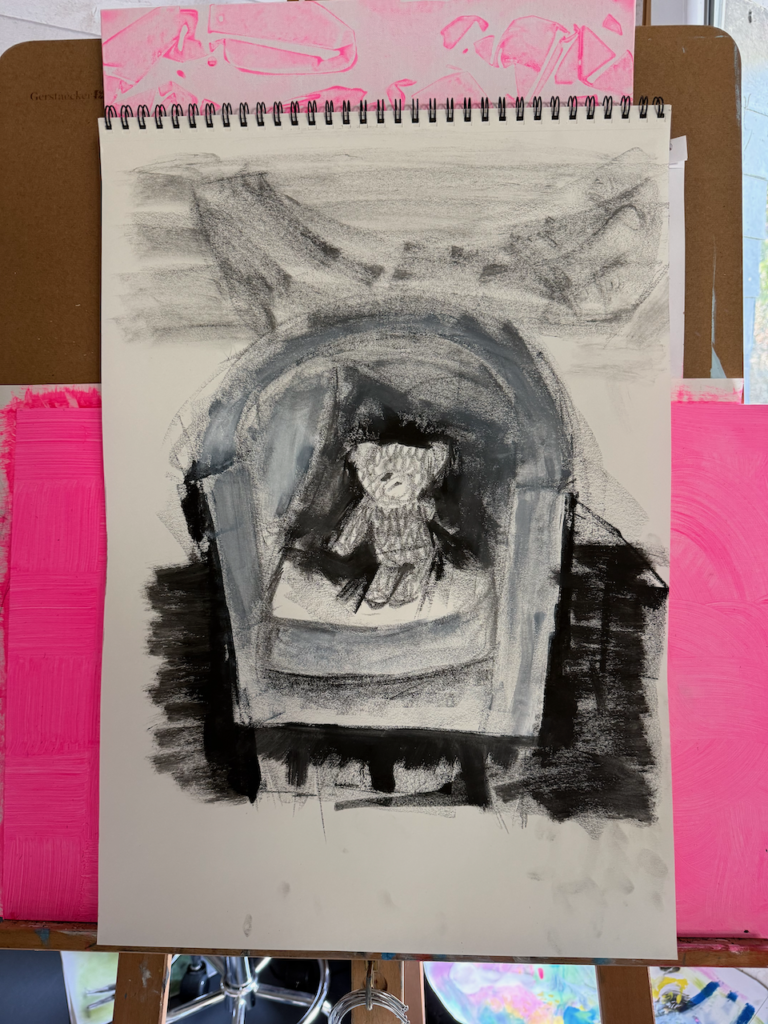
Another insight was my family’s reaction. Everyone preferred Resting Bear I as the second one was a little ‘dark’. I see what they mean but I also think that’s why I preferred Resting Bear II! It’s got more of a story to tell and more energy in it. It’s dark also because of the dark black surrounding. Still I found it interesting that I could render the same object in such different moods by changing my materials and my approach to mark making.
Studies 4-6
The last studies I completed during a sketchbook workshop at a local artist’s workshop. The workshop was open and free with lots of materials to pick from and focussed on drawing from sculptures. One insight I got from there was that I could prepare my sketchbook with a ground either an ink wash or a collage and then work from that rather than work from a blank page. It helped me loosen up. Looking at sculptures as live models was also very inspiring. I first felt a little bit of a fraud painting from sculptures from other artists but then what I produced was arguably very different from the sculpture which inspired my mark-making!
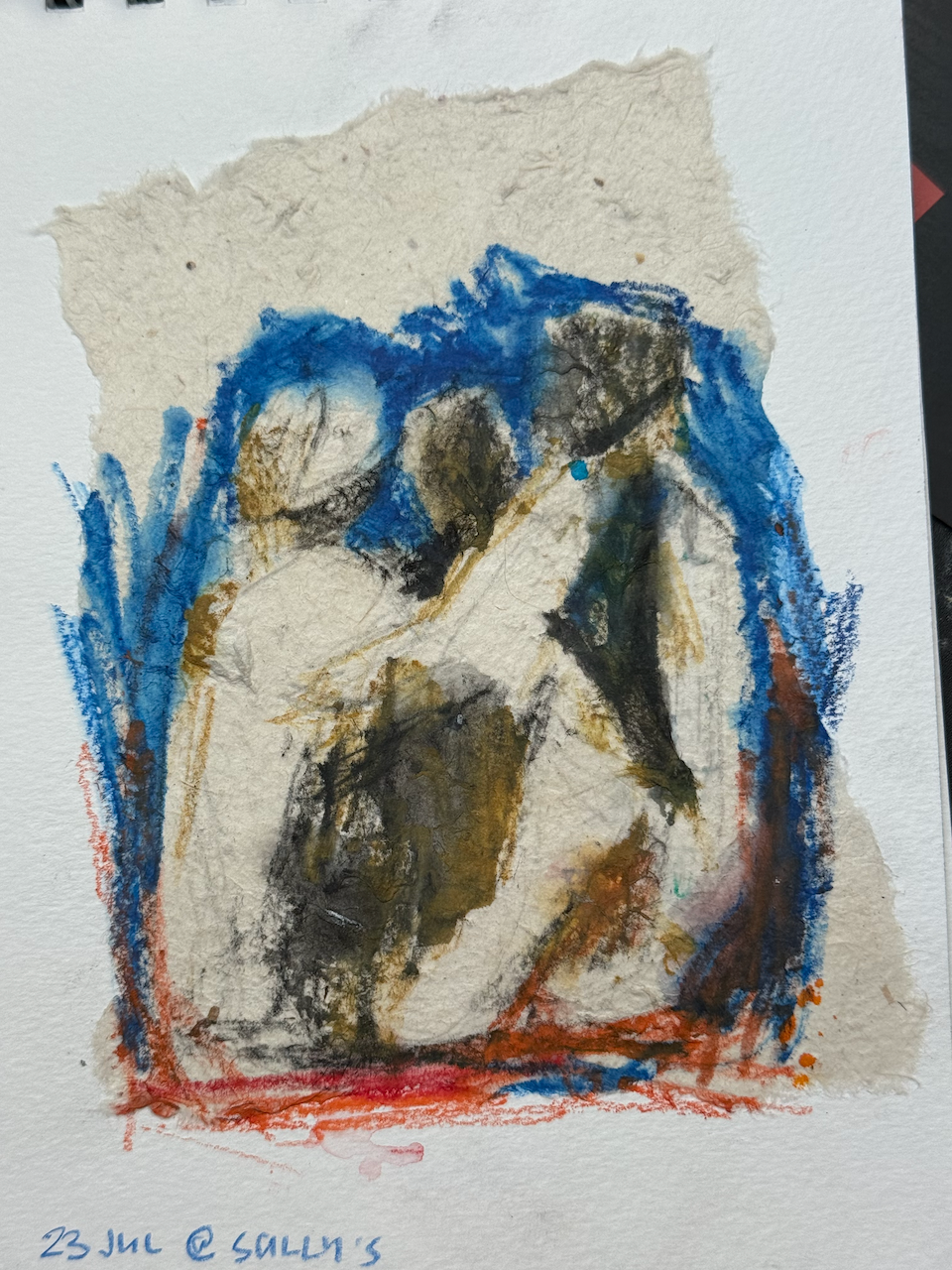
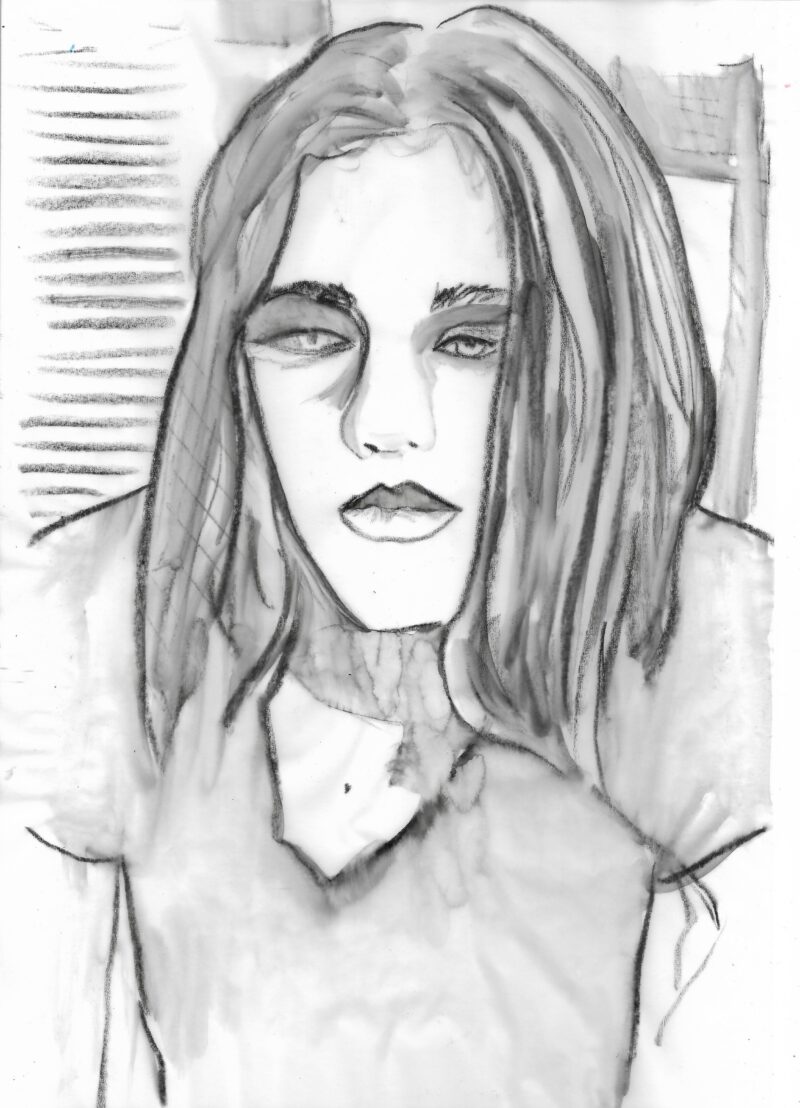
In Study 4, I tried to use the middle ground for the light. The background is less dark than the shadows on the figures and I’m not sure it works so well but I like the final image.
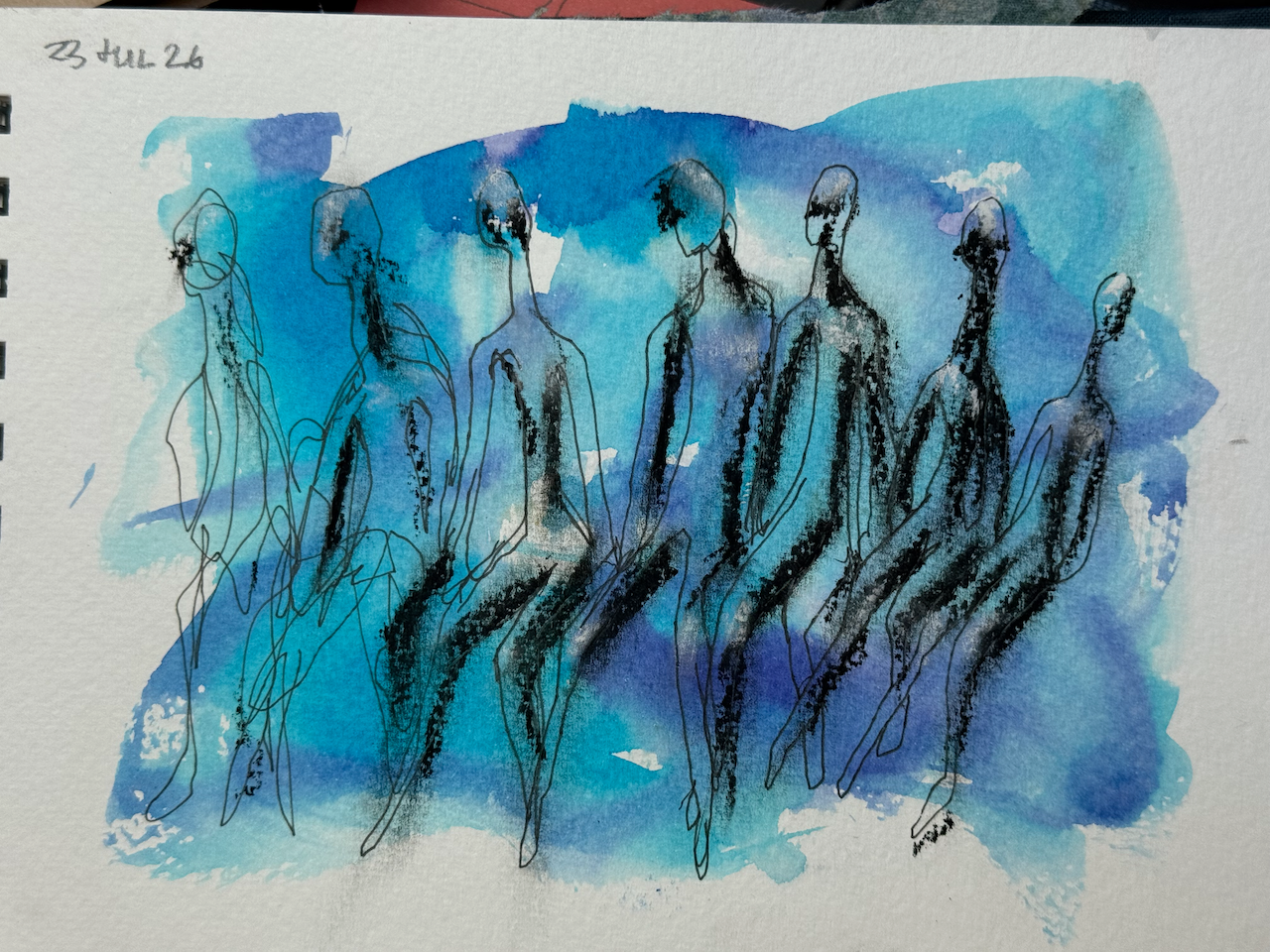
In Study 5, I was drawing from a Modigliani-like sculpture of several women sitting. I didn’t have much time to draw this so it was very gestural. I asked how I could improve sketches like this to the artist leading the workshop, and she said:
Ask yourself: What do I want to draw?
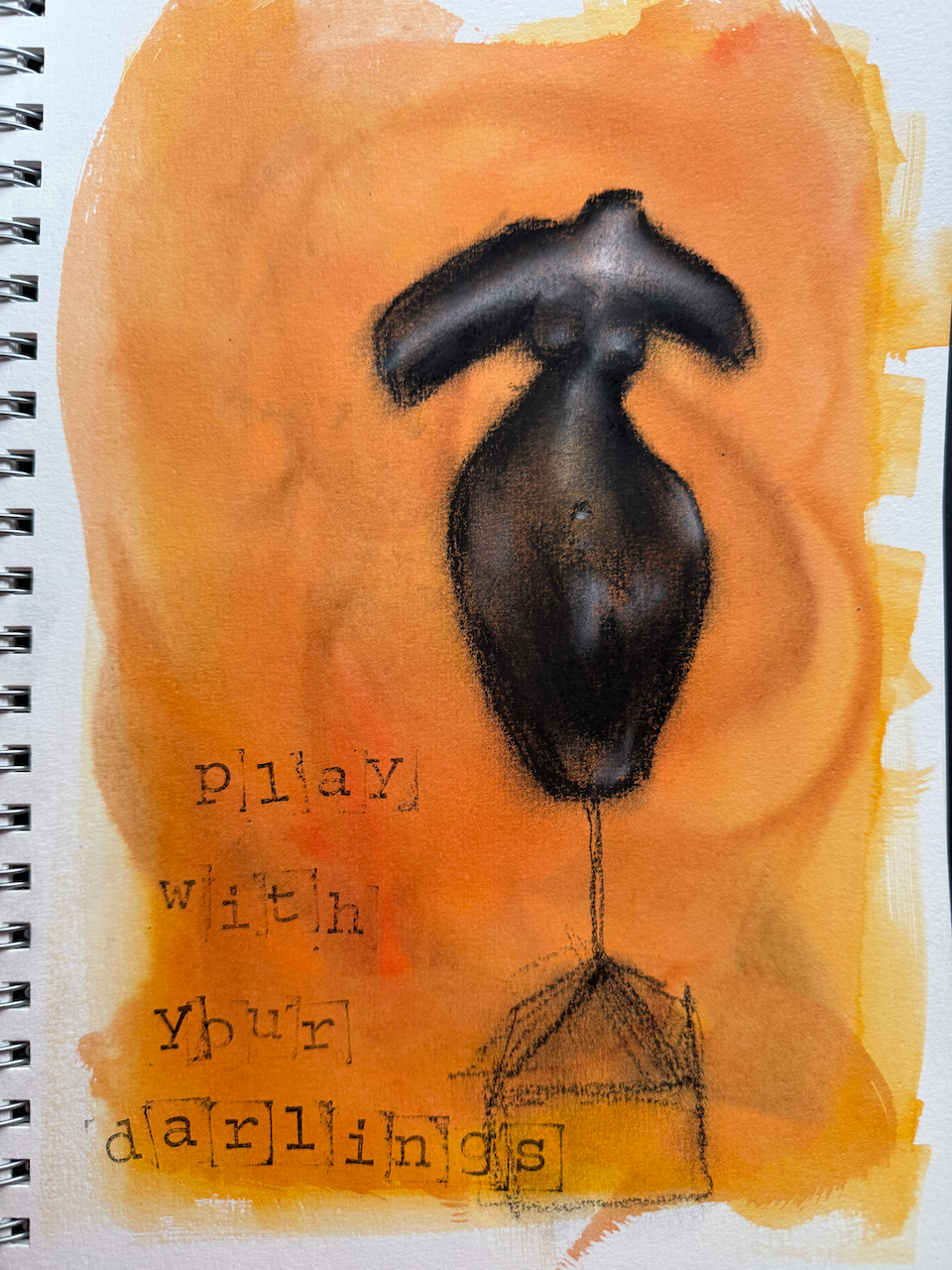
and added that it seems I was trying to draw the light. That outsight resonated because it helped me focus my attention (which tends to zoom all over the place like a wild horse!) and for my last study I picked another sculpture and simplified the task as “drawing the light”. It was the end of the workshop and we’d talked about approaching the sketchbook in a state of play as well as the famous advice to “kill your darlings”. I found some stamps (I love letter stamps!) and I stamped a twist on these two pieces of advice!
Final reflections
I enjoy these studies and starting to get used to this state of not knowing where I am going or why I going where I am going. I feel I still need to improve my technique as a backbone to my gestural drawings. My biggest hurdle is to have a regular practice. Work always ends up eating up my time with pressing deadlines although sometimes it is also me who is overthinking and frozen with negative talk until I finally overcome it, finally make something and feel so much happier as a result. I just came across the book Work of Art by Adam Moss, which apparently explains how tortuous great art is, so perhaps it’s OK that it does not come so easy!