Brief
Aim
For this exercise you have a choice.
You can produce either:
A large full length figure study (A1 size)
OR
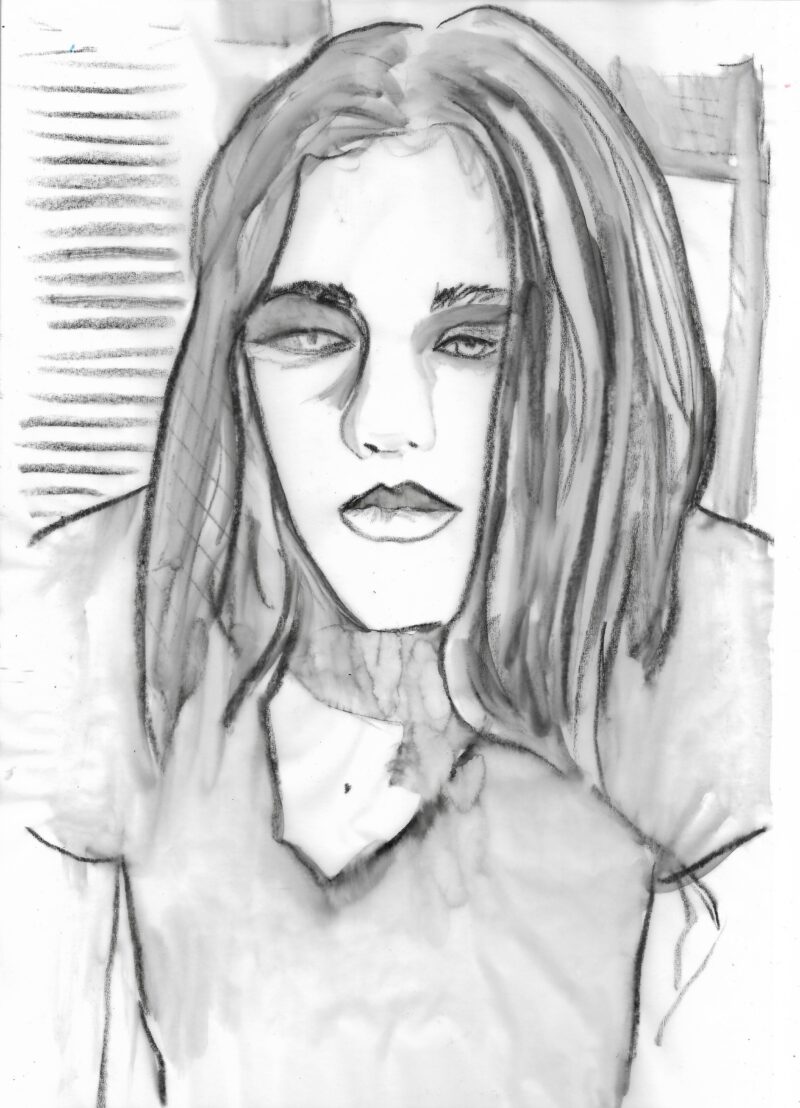
A portrait or self-portrait (A2 or A1)
You can, of course, produce both or more than one attempt at each and make a selection.
Preparation for either drawing:
From looking at the work made to date, make notes on what you plan to do. Think about composition, medium and approach. Write notes on the artists that have inspired you to work in a particular way. Be inventive in your approach and in the materials you use. You’re not restricted to working in black on white paper. You could focus on the highlights and use white on black, or consider using coloured monochrome, perhaps dark blue on pale blue paper, or ink and charcoal on newspaper, or on prepared coloured paper – the list is endless, so be inventive but don’t lose sight of the importance of the drawing. Allow around two hours for these drawings.
As with previous large drawings, make a series of ‘sketchbook’ studies to work out some of the decisions. Make as many as you feel necessary. Don’t settle for the first idea. Try to be as expressive and experimental with the large drawing as you were with the preparatory studies. Try not to tighten up, or lose the fluidity and spontaneity that should have evolved since the beginning of the course.
Option A: A large full length figure study (A1)
This study is about drawing a convincing three-dimensional figure.
Method
Take particular note of the proportions of the figure and any surroundings you think will contextualise the figure, without overwhelming it. As before, start generally by blocking the large masses in, taking care to show how and where the body turns and where its weight is.
Once you’re happy with this, start to hone in on the detail such as the hands and facial features, as well as the folds of any clothing using a single line, or combinations of lines: narrow and thick, curved and straight, fractured, expressive, gestural, dynamic, dramatic (and so on).
As with previous exercises, you may have to make specific studies of, for example, hands to understand them properly. Be prepared to step away from the large piece to make more studies as you work.
Option B: A portrait or self-portrait (A2/A1)
Method
Create a portrait, or self-portrait, where the features are believable and in proportion to the rest of the face, head, shoulders and chest. Try to find an interesting position rather than looking straight ahead. Use mirrors to view from different angles.
In your sketchbook, experiment with some of the ideas you’ve uncovered during your research into other contemporary artists’ work.
Work with variations of tone and expressive line to create an interesting and atmospheric image. For your main light source, you might try using a candle, small lamp or torch in a semi-darkened room to exaggerate the contrasting lights and darks, for example. You might also work very close up with the features filling the sheet. Be experimental and ambitious in this drawing.
Reflection
What did you find interesting or challenging about drawing the figure on this scale? Were the techniques and media you chose able to enhance the form and add an expressive quality? What did you learn that you could use to develop your figure drawing skills?
Initial planning
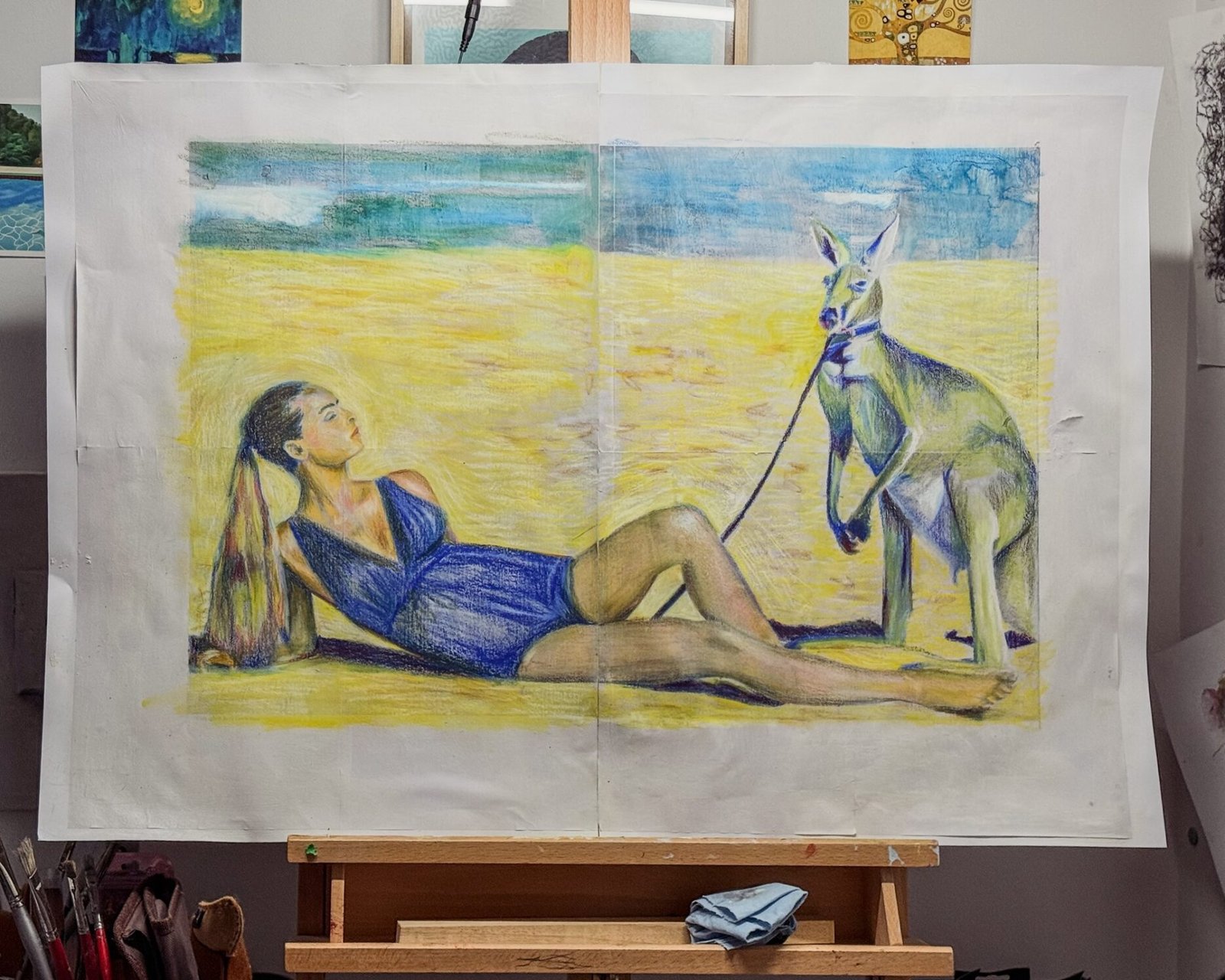
I have decided to challenge myself to draw a large full length figure study, building upon the lounging figure with the kangaroo.
I reviewed my notes and felt lots of inspiration from my past research in the form of prompts such as “use layering to convey multiplicity” or “leave ambiguity in the drawing which the viewer can resolve”, “use the photographic element as only one part of the composition” (Peter Doig), and “build something slowly through transparent build-ups (Alison Katz)… and more.
I wrote them down in my journal and decided to build on a process I came back to several times during my painting foundation course, which was to use collage as a ground.
Process
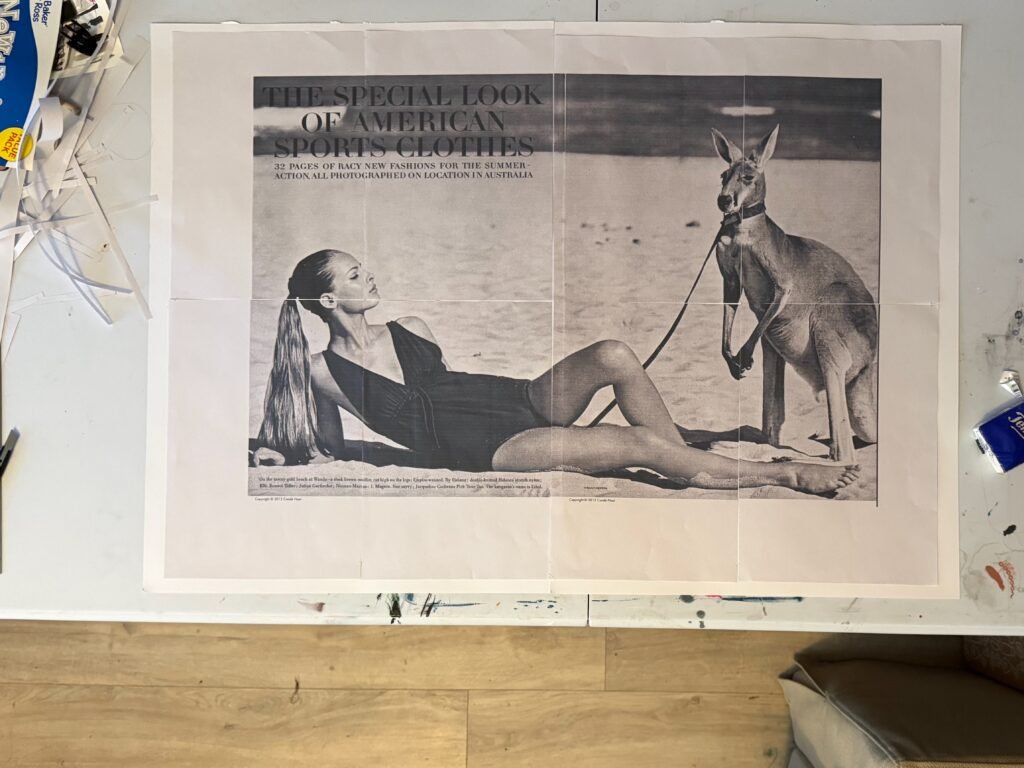
I figured out a way to print my source image as a series of A4 papers with marks to cut to make a jigsaw puzzle. I use newsprint paper which is slightly grey and very thin. I glued it on the paper and then applied a layer of white and titanium paint mixed with gloss medium to create a transparent layer on top. I then used the small printout and a limited palette of neocolour II crayons to work on the drawing.
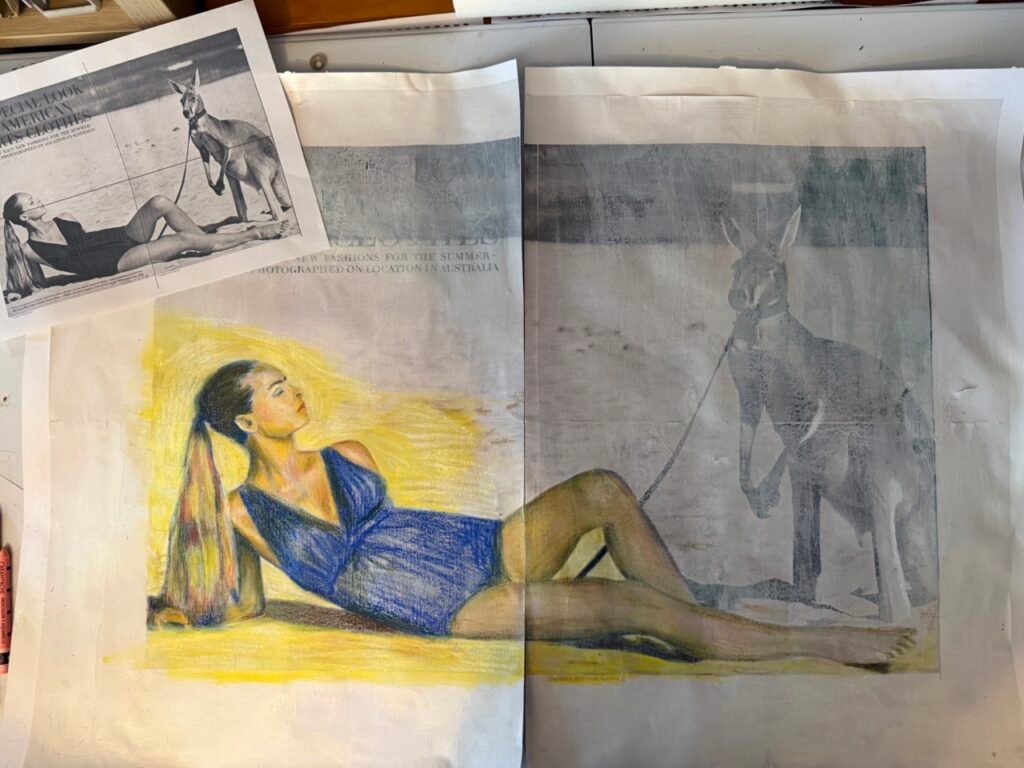
I realised I didn’t have A1 paper at home, only A2. But I thought this is a study so I might as well not be too precious (and also thought this was a nod to David Hockney’s Bigger Trees Near Warter (2007) who famously painted is largest work using 50 smaller canvases!).
Final piece
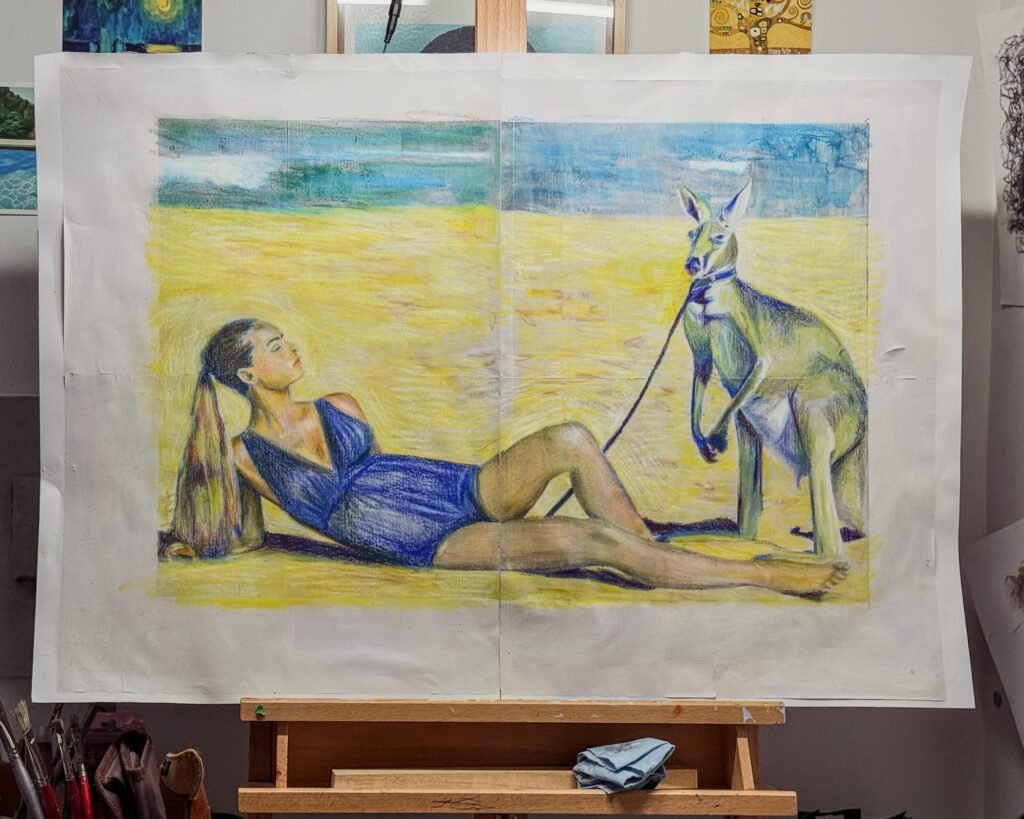
Reflections
I love this drawing for so many reasons. The process of construction made it fun and interesting. Working on the collage ground was liberating and allowed me to focus on tonal values in a way that felt satisfying. The limited palette helped me create a cohesive image.
I also like that the collaged paper is showing through, making this a constructed image in more than one level: The model lying on the beach holding a wild animal on the leash is already not natural!
On the more challenging side, I did feel tethered to the image but also wanted to comment on it. A challenge perhaps would be to use the photo more as a starting point than a guide unless I use my own photographs…
I am not sure deviating from the photograph is something I feel I should do rather than what I want to do…
I think I picked this image and the others for the same reason: I found they provide an interesting starting point for reflecting on how women are represented: did this model really want to lie down on the beach next to that kangaroo? Whose decision was it to create that composition? Whose audience is this really for?
On a more practical aspect, I am also wondering whether this process would create copyright issues for my work if I were to stay too close to the original visual (ie using images from old editions of Vogue magazine as a substrate collage)…