Exercise prompt
# Aim
Gather together four pairs of objects that you can hold in your hand. They could be from a walk, or your home - a mixture of organic and man made should provide some interesting variations.

Look carefully at your chosen objects and consider the relationship between them - their form, surface pattern, colour and texture. You will be making a series of studies that consider this relationship and how best to describe it.

# Method
Working on A4 or A3, you will be making four drawings in your choice of media. Each study will be of two of your objects.

Consider how your two objects relate to each other in terms of scale. For example, you might place a small shell next to a coffee pot, or have two similar sized objects with very different shapes and textures.

Look at any shadows and reflections across the objects or the surface they are sitting on. Consider the distance between the objects - how important is this to the overall effect of the drawing? Would having more space reduce or enhance the impact?

Aim to spend approximately an hour on each study, but you may want to spend longer and suggest more detail. Think about the kind of media and mark making that would be appropriate. For instance, broad sweeps of charcoal or pastel might enhance the strong contrasts of the metallic surface of a simple form, while a soft pencil might effectively describe the linear detail of a flower petal.

If you are enjoying it and would like to make more drawings, you could make some still life studies of all of the objects together.

# Reflection
Pin your drawings up or place them on the floor so you can see them all together. Which combination of objects worked best and why? How did your use of materials enhance the results? Reflect on the outcomes and make notes in your learning log.
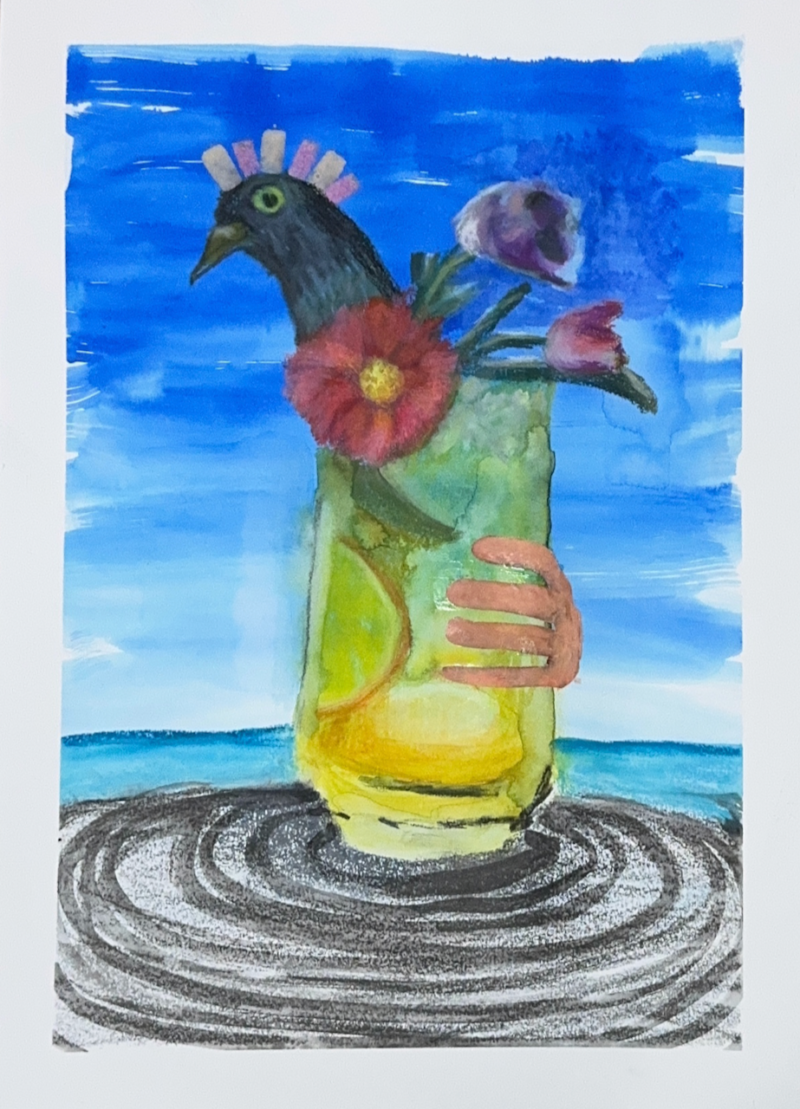
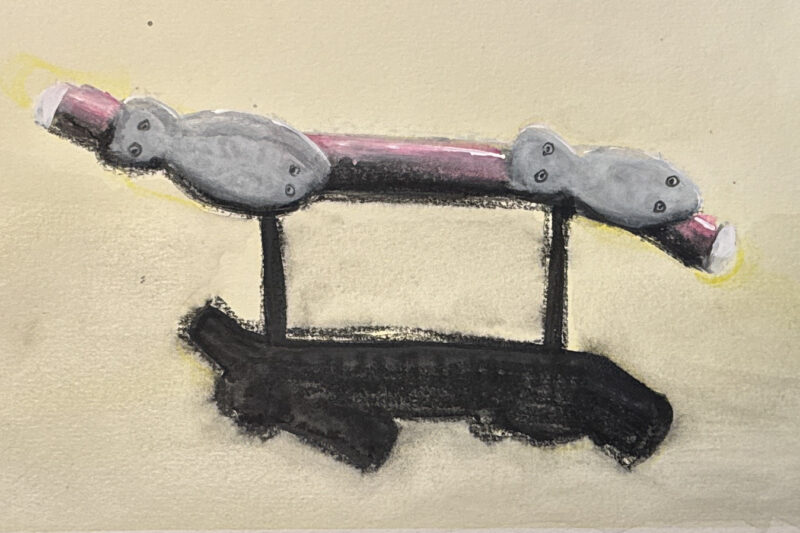
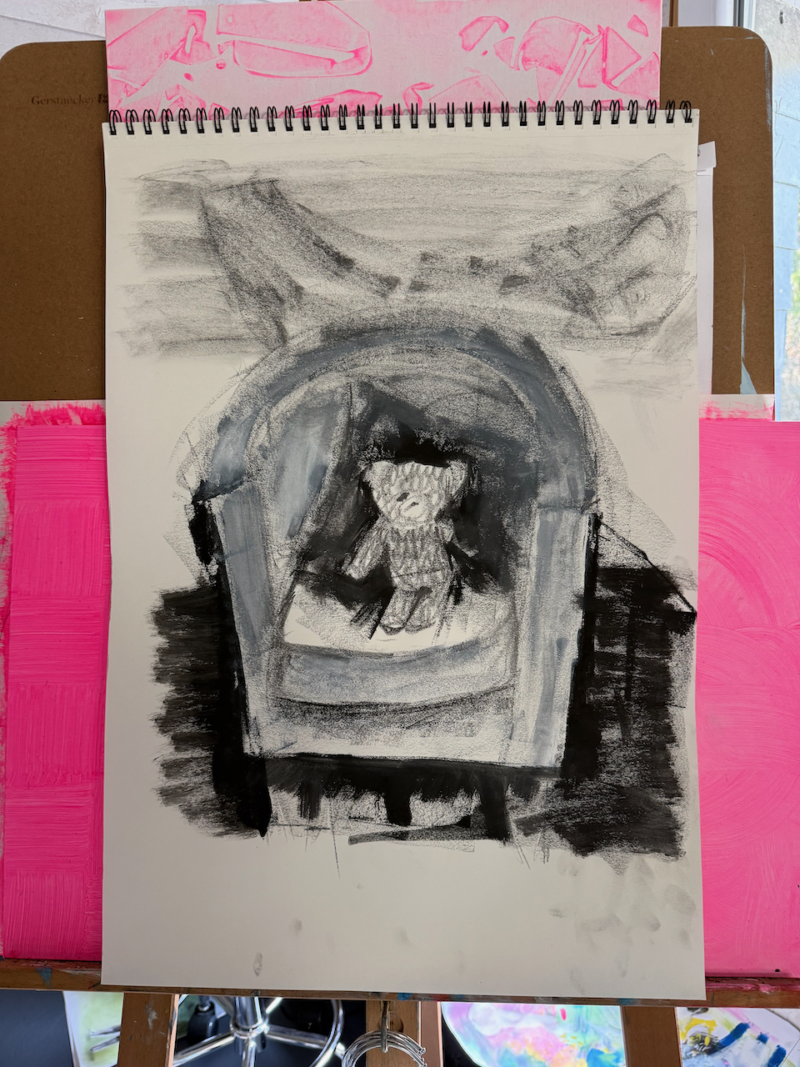
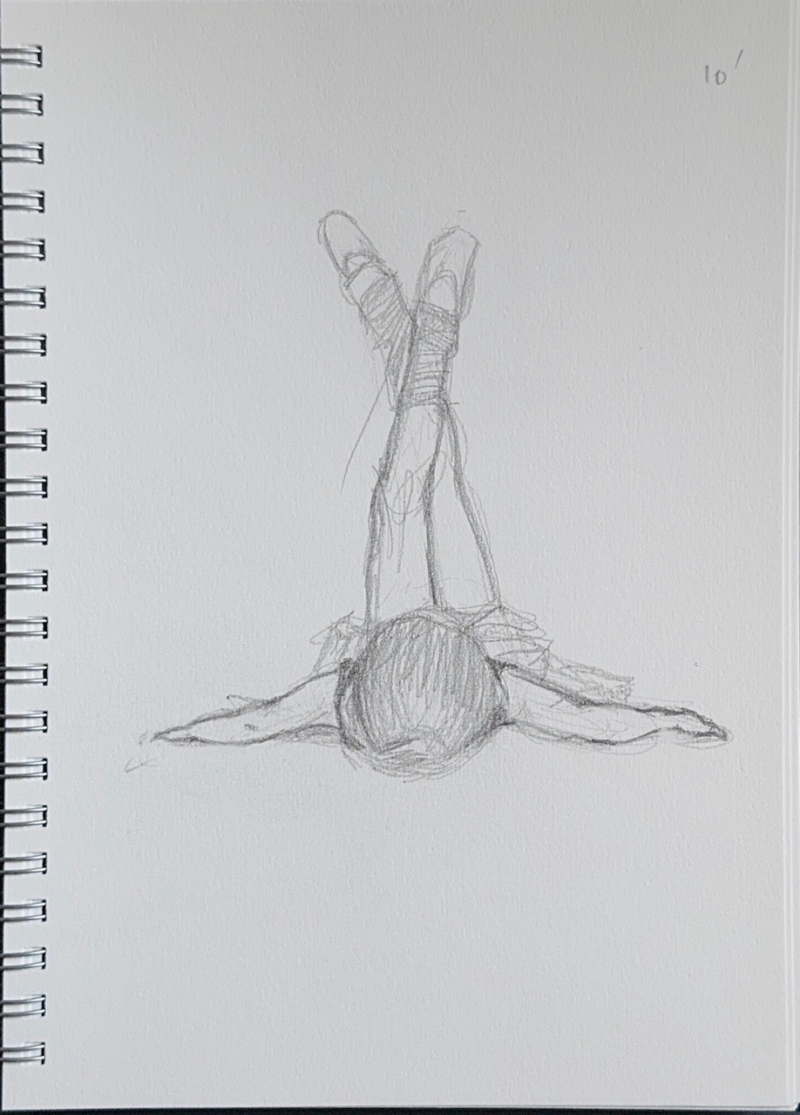
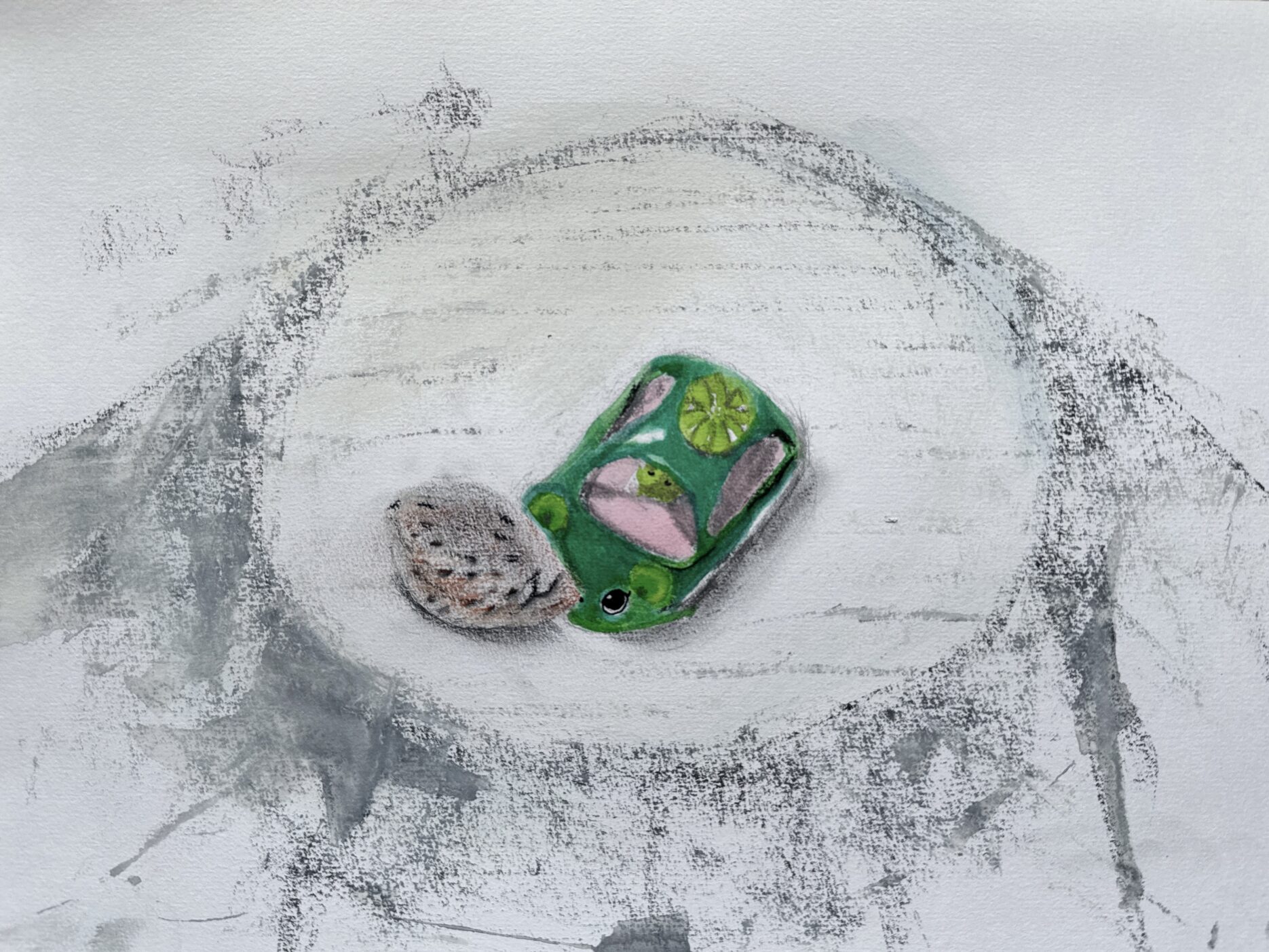
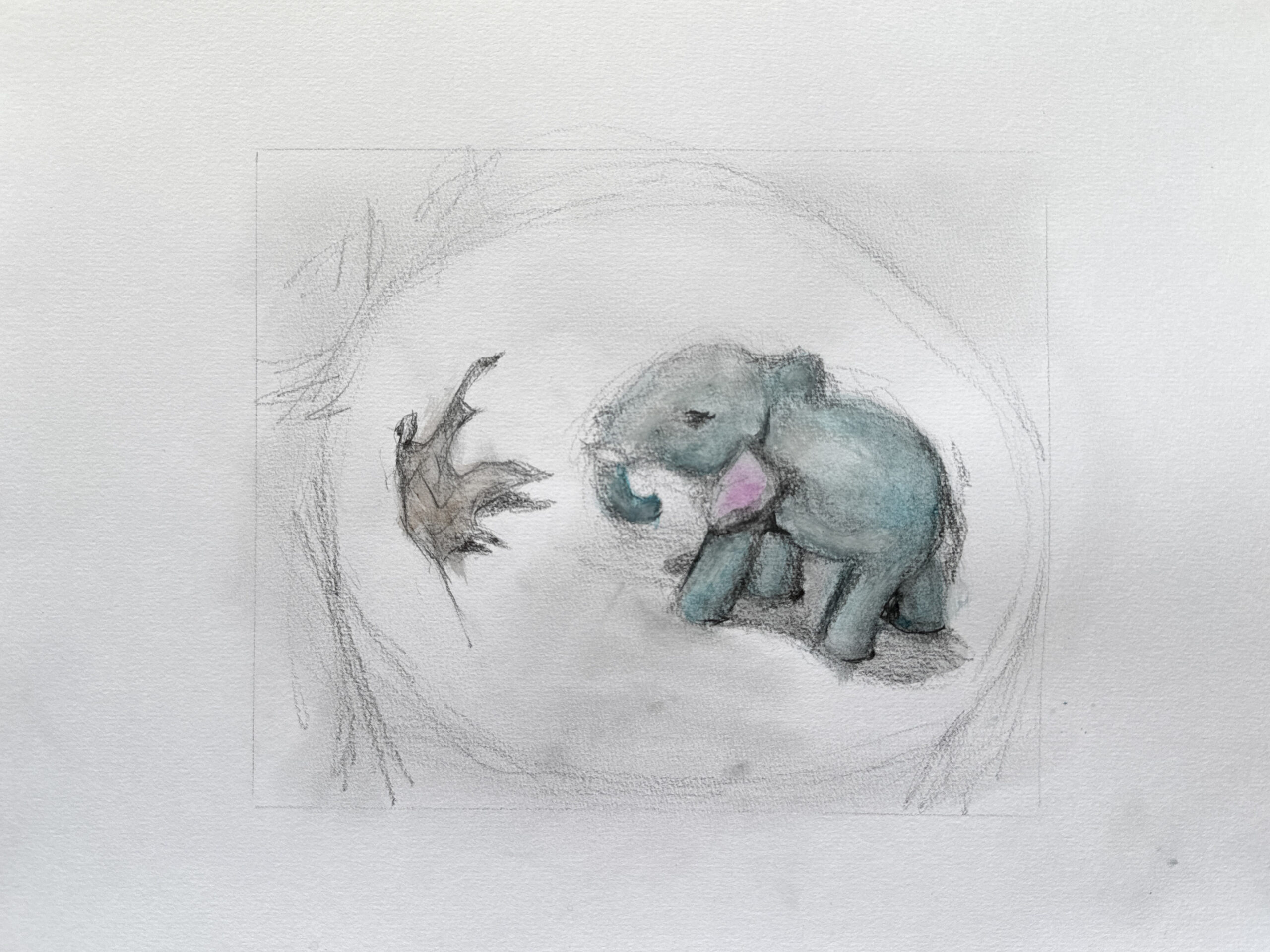
For this exercise I picked four handheld objects from a walk in the park, and four objects at home. I spent a long time thinking about what I could use for this and in the end, decided to pair a toy with an object from nature. I was inspired by Kenny II, a painting by Tory Day, a contemporary painter who paints ‘overlooked objects’ she finds in flea markets. I also think of toys as ephemeral, they are bright and new shiny plastic but quickly discarded as our children grow and end up as waste in nature. I often ponder about how we are caught in a vicious circle where toys make our children happy but also contribute to the plastic pollution that is ruining their planet. In terms of the approach, I was a little stumped by the idea of going into details versus keeping more gestural and freer in my mark-making. In the end, I opted to stay loose and explore materials in a more playful approach, using bright watercolour inks for the toys and graphite and Conté crayons for the objects from nature. I set the objects up on a round box covered with a white cloth.
Study 1
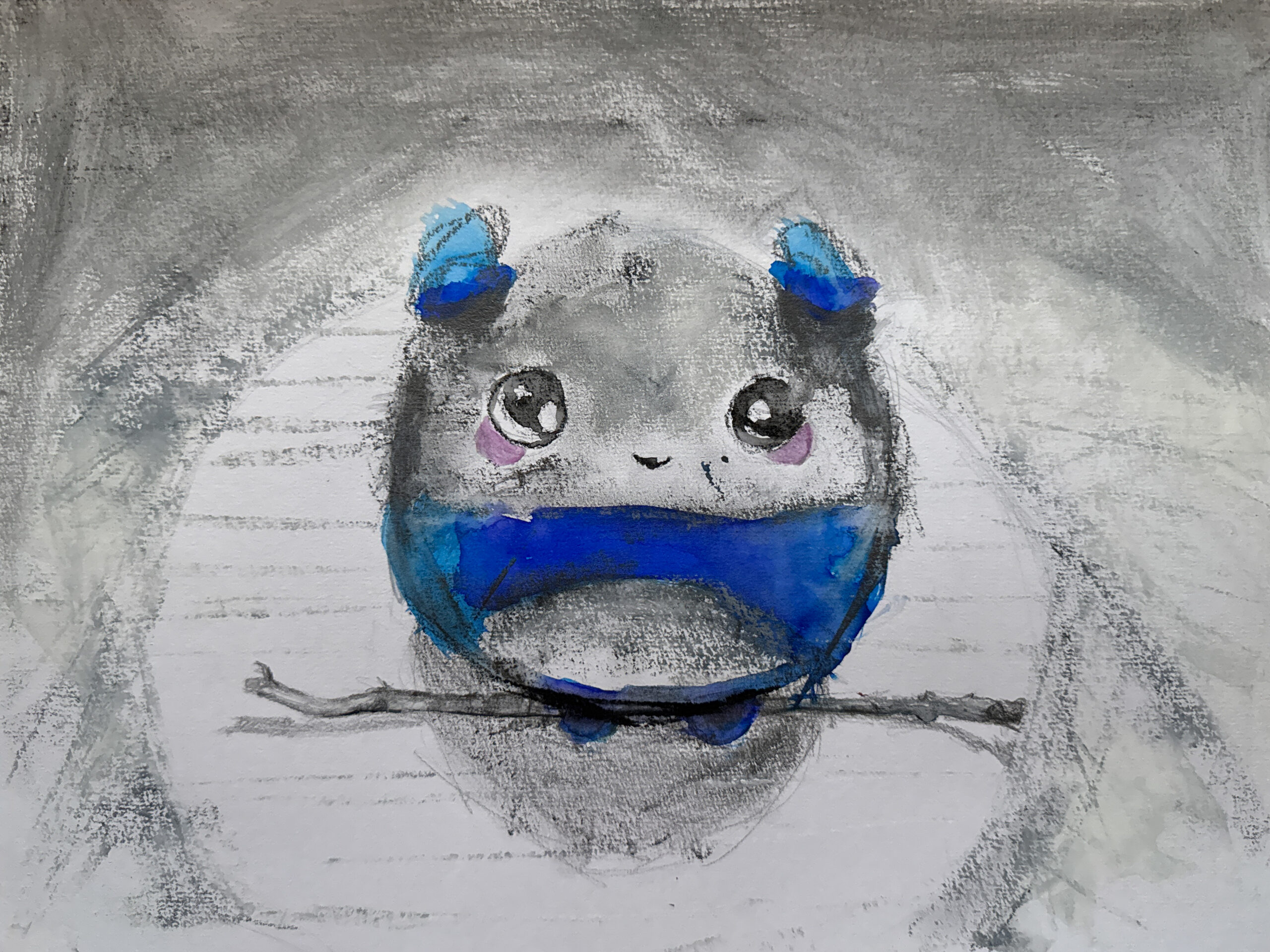
Study 2
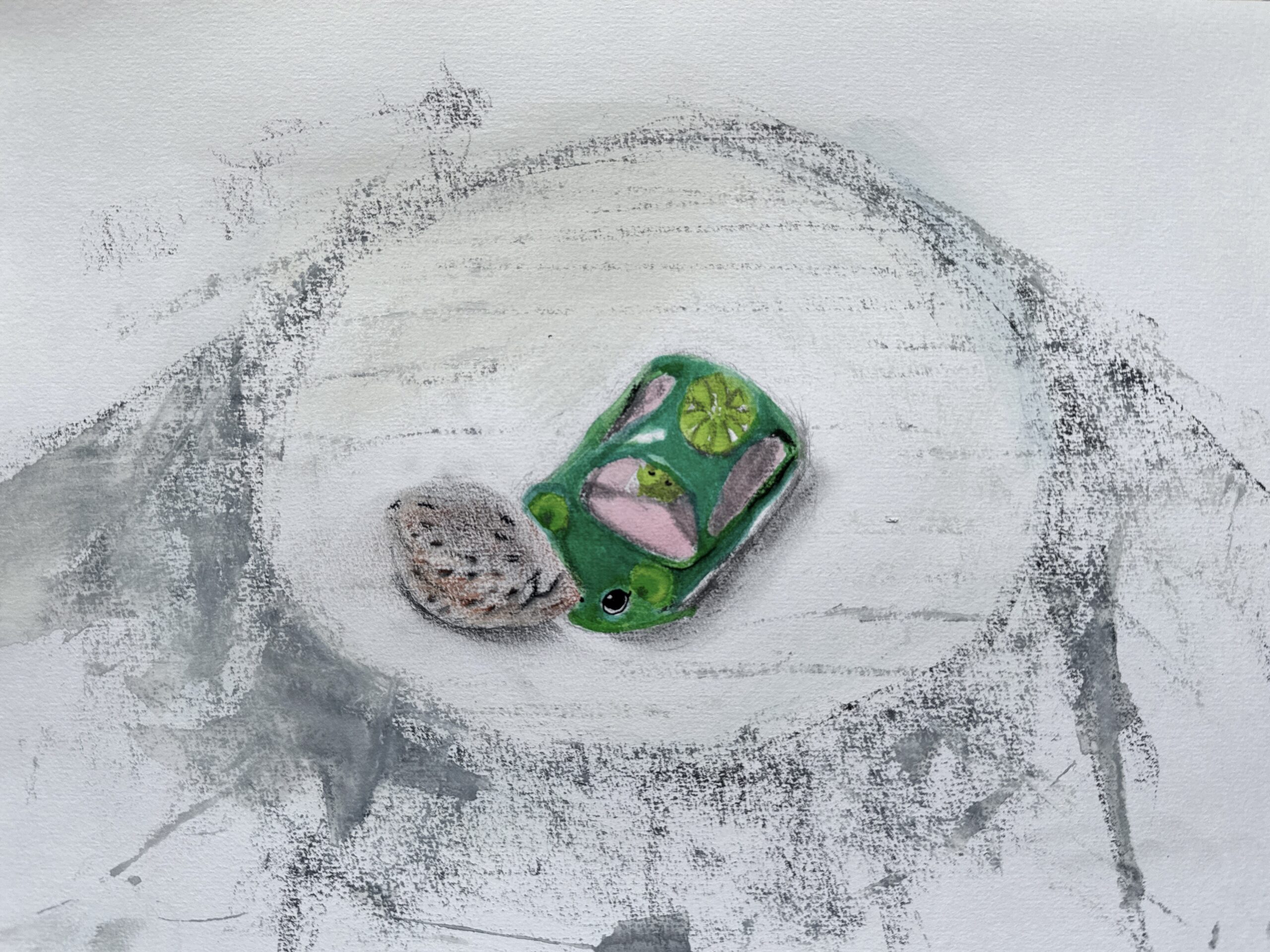
Study 3
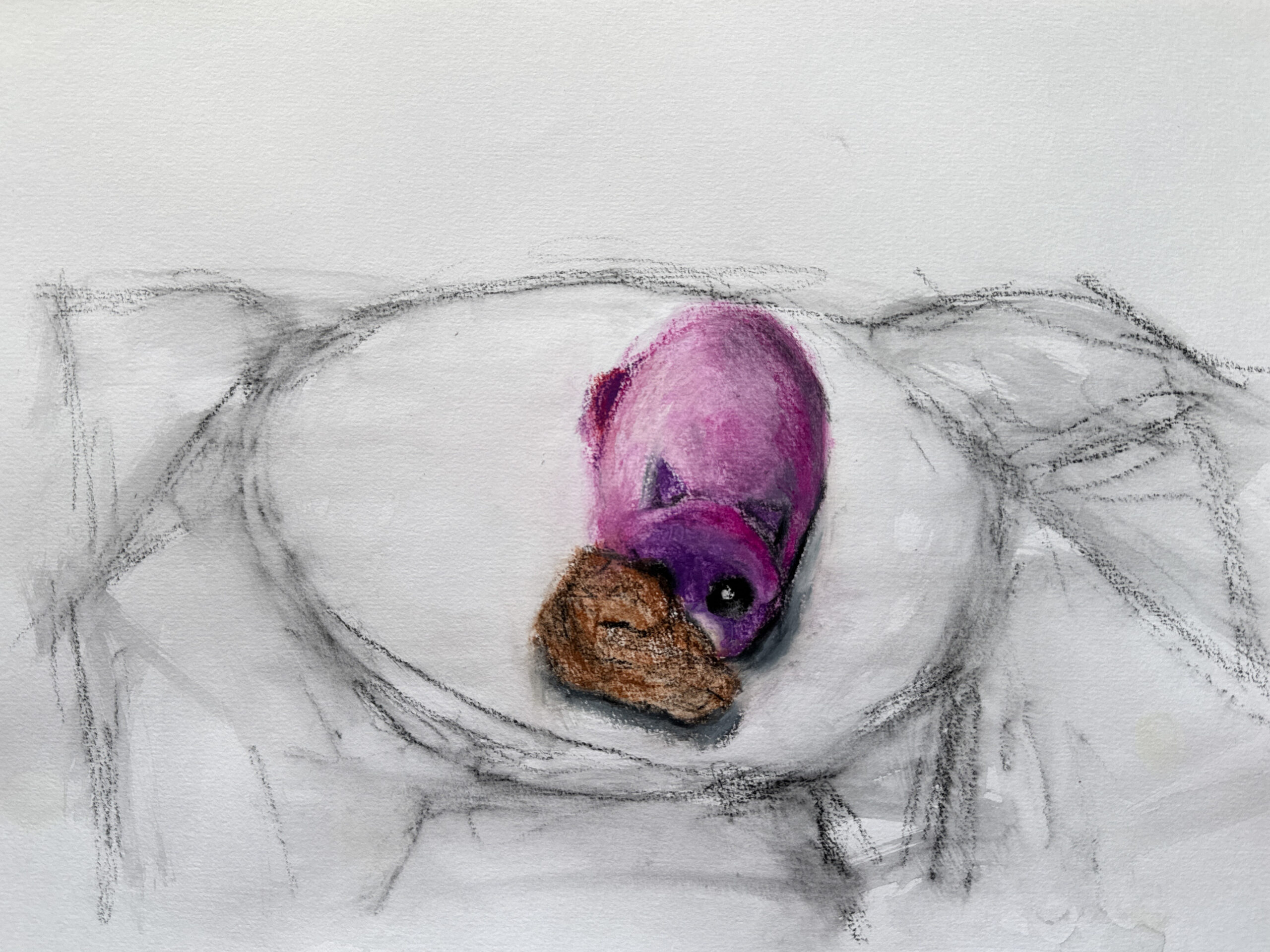
Study no. 4
Reflections
Looking at all the drawings at once, I feel the combinations of studies 2 and 3 worked best possibly because the interaction was more interesting as the juxtaposition makes a playful nod to the “hide and seek” game. In study 1, the owl on the branch comes together as a typical image even though the branch is a small stick. So on the one hand, it works, but on the other hand, it’s not such an interesting image. In study 4, the fact that the elephant is placed by the leaf is also an interesting contrast since we are wondering if the leaf is huge or the elephant tiny but the tension is not very effective and the two objects end up feeling separate drawings.
I aimed to use materials to enhance the contrast between the plastic, manufactured toys and natural materials. I think I was most successful at doing this in study 2 where the highlight and the bright natural green contrasts with the earth tones of the peach stone.
I can’t make my mind whether I should practice drawing use a “loose” approach like here or whether I should stick to practicing using a more “classical” approach to drawing, like I did in Project 2. One the one hand, I find these drawings more interesting, on the other hand, I feel they are not as accomplished as the tree. Perhaps the answer is to keep doing both as each practice will feed each other…