Larger Observational Study of an Individual Tree
The aim of this exercise was to spend time looking at a tree in detail and at least an hour on the drawing, using media which would suit the individual characteristics of ‘my’ tree, such as A3 cartridge paper and a fine drawing medium (drawing pen, pencil, or ballpoint).
I decided to work from a photograph of a tree I know well and in fact one that I have photographed many times already.
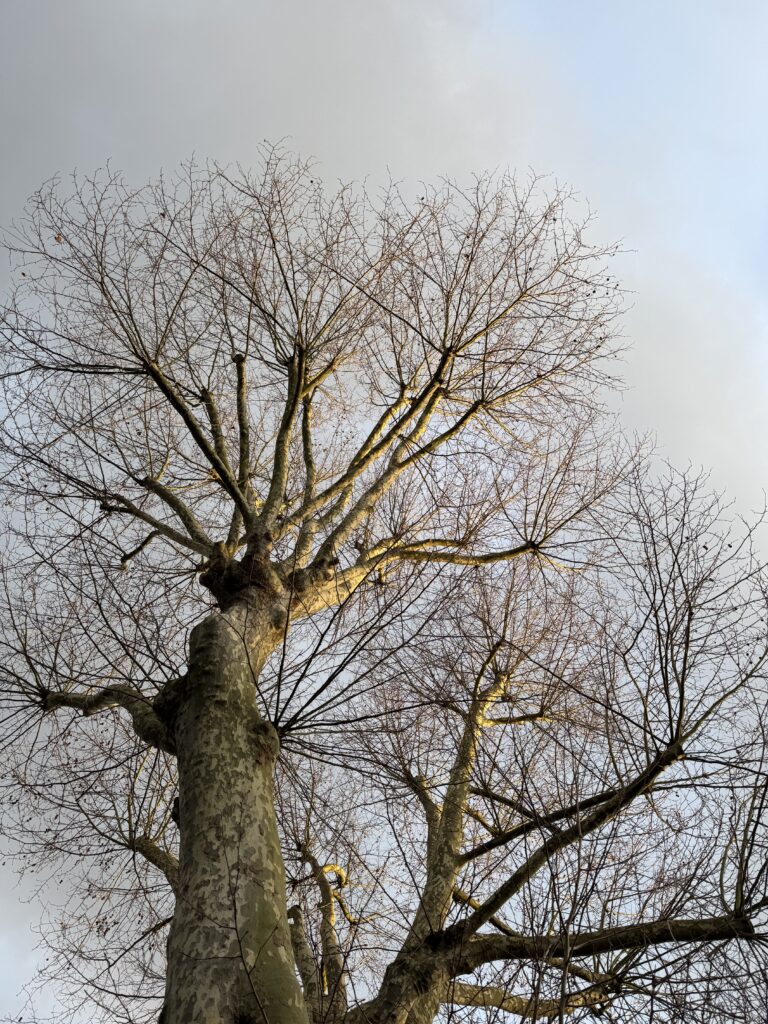
It towers over my daughter’s school and I see it every morning when I take her in. We often look at the bark which is shedding. I love the way it is bursting on all sides, with rounded knuckles and massive spreading crowns, it reminds me of a giant octopus! I gather it is a London Plane tree (Platanus × acerifolia) and is common in London because it “self-cleans” itself and can withstand pollution.
Planning
I need to decide on how I will approach the drawing. I’m tempted to use colours but I want to learn to handle tones first so I will limit myself to a two-tone drawing. I could use graphite powder to tone my paper and then draw in the trunk and the bulkier branches. I want to showcase the light. I took the photograph on an evening when the sun was setting down from the right. I’m looking at the picture and wondering if I should crop it further but none of the crops seem to improve the balance, so I decided to stick with the original frame.
Try to keep a free and flowing hand to follow the fluid lines and forms of the tree. What makes the tree distinctive? Its solid massive presence, its airiness and delicacy, or its bent windblown form? You don’t need to draw twigs and branches in detail, but try to capture a sense of directionality. Notice the light source; see where the deepest shadows are and the strongest light (these are usually next to each other). Hint at texture by fluid use of shading or lines.
I can’t decide which tool to use so I will experiment and do three studies instead to see what feels most satisfying. I’ll start with a sketch in my sketchbook using graphite to study the shadows. I might use carbon paper to transfer the main lines and then do another one simply sighting the shapes. I might try a loose one with Chinese ink as well. Then I will make the A3 final drawing!
The plan vs. the work
Initial sketch
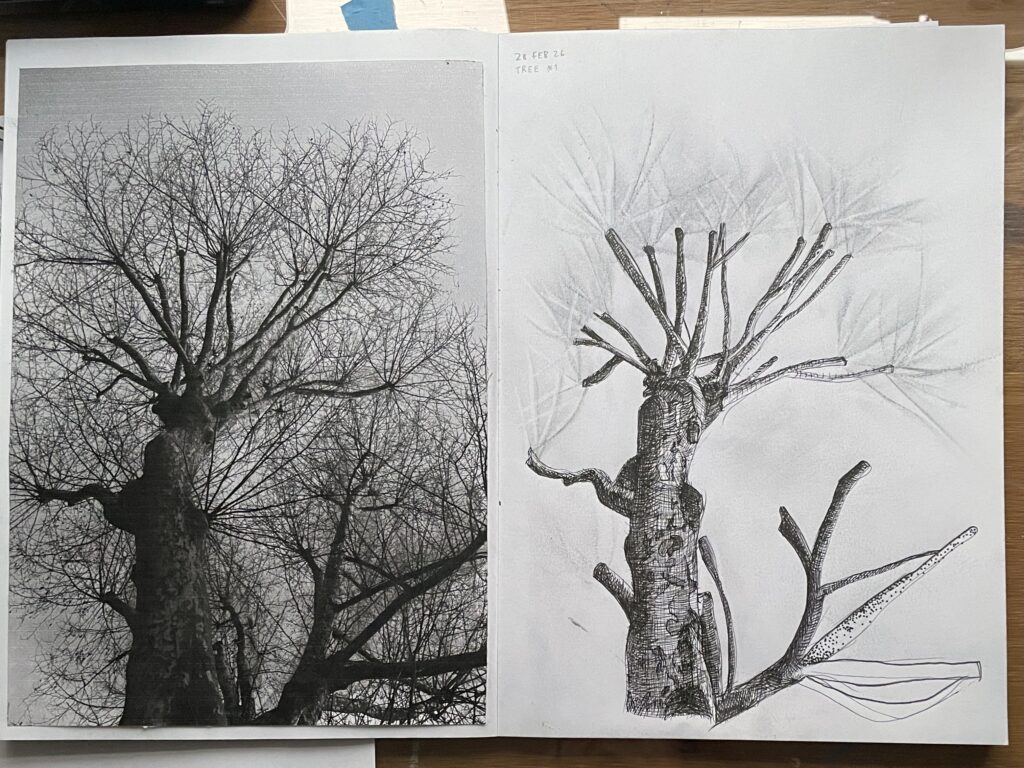
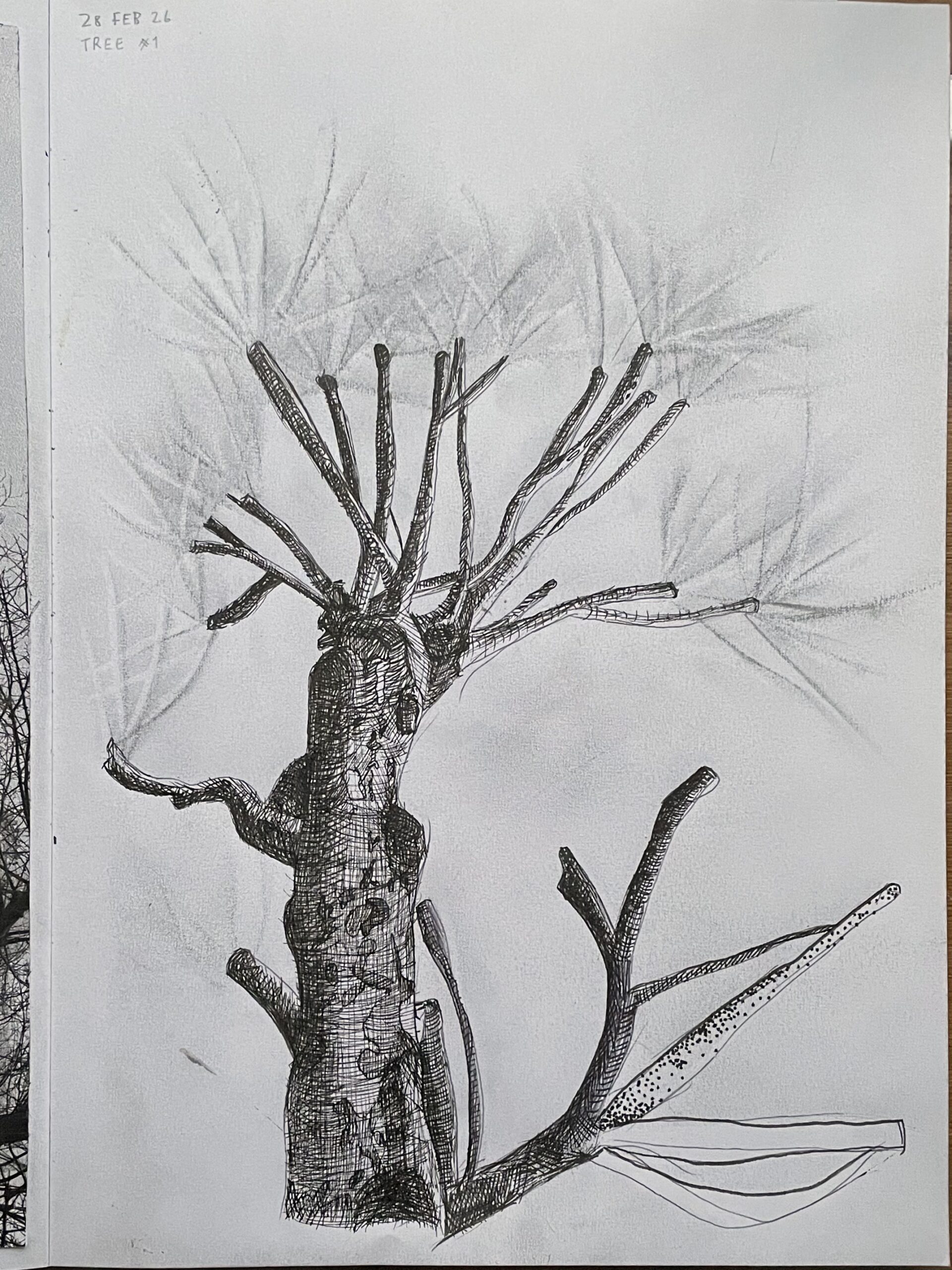
The plan was ambitious but time is of the essence. I started with a sketch in my sketchbook. I started by using charcoal on the back of a printed photo to transfer the shape on my sketchbook and then sketched the tree with pigment liners and cross-hatching. This was a rough study which took approximately one hour to complete.
Final drawing
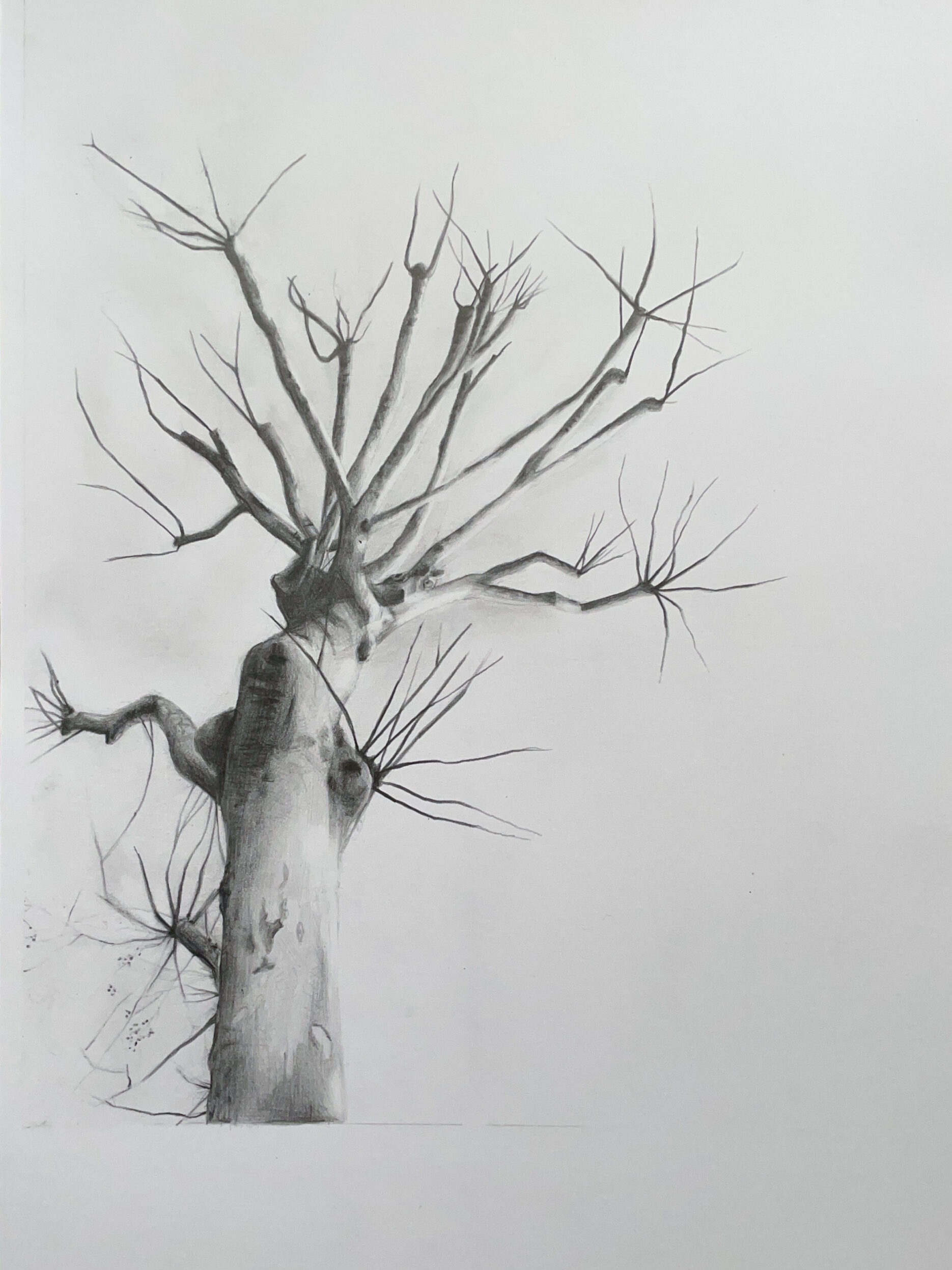
Next I decided to take my time to complete a careful drawing but also did not have time to scale this up to an A3 size. Instead I used an A4 sheet of Bristol paper. I like the smooth feeling as I am building up the layers of graphite. I worked with a fine (F) and a 6B lumograph pencil.
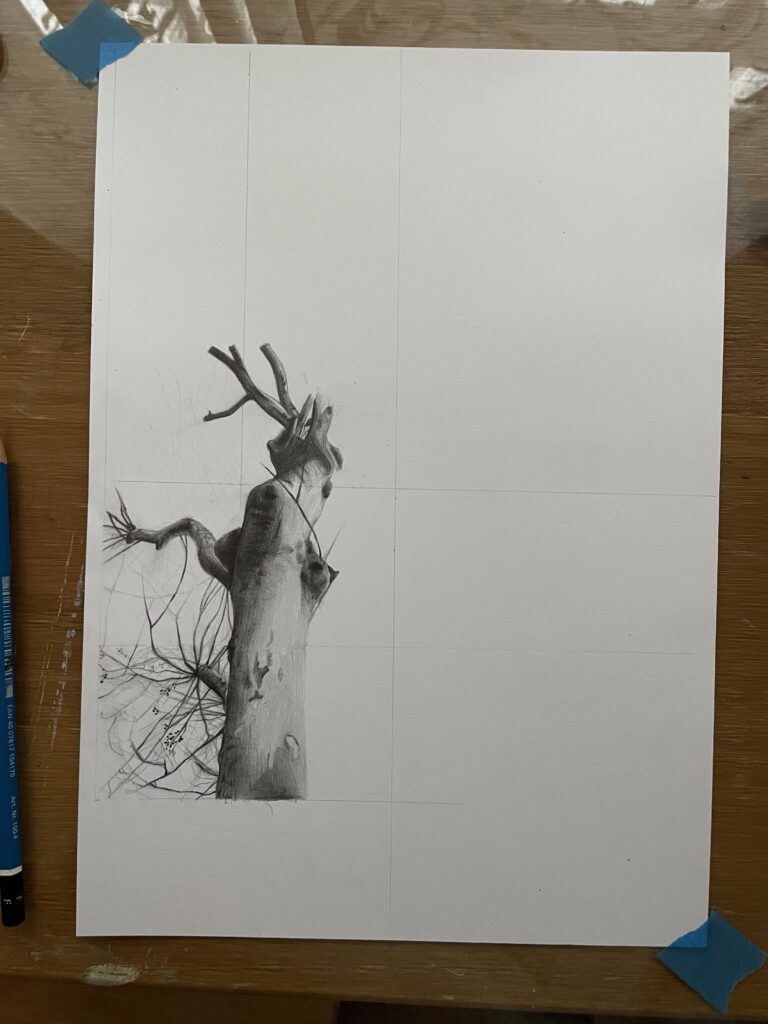
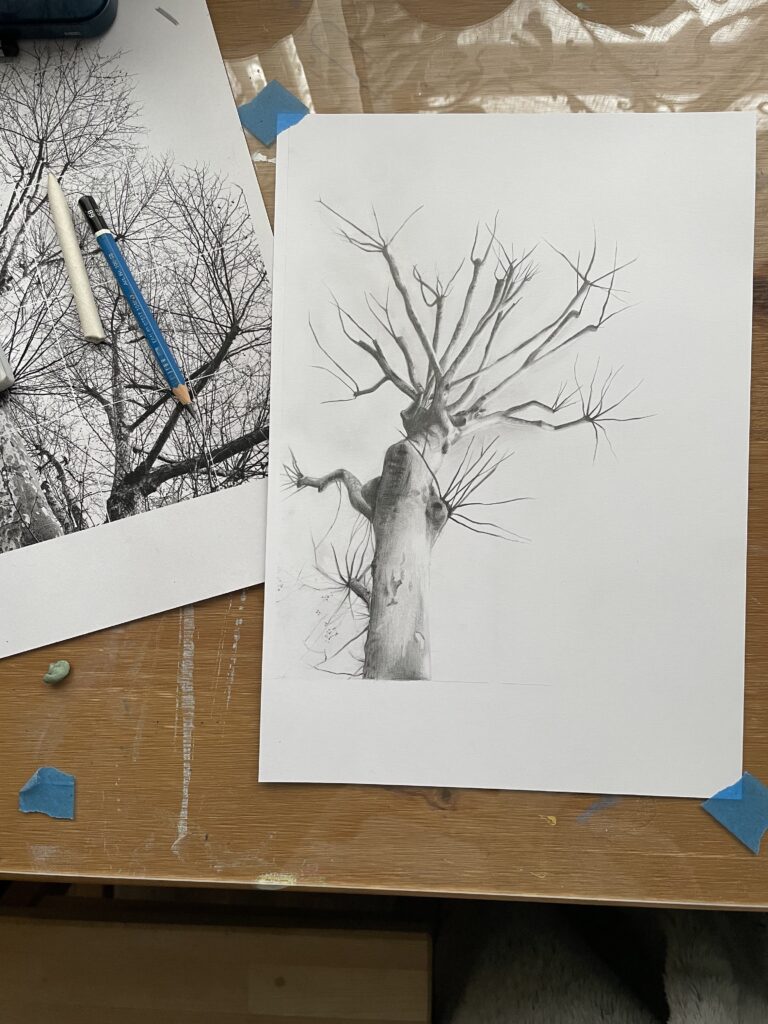
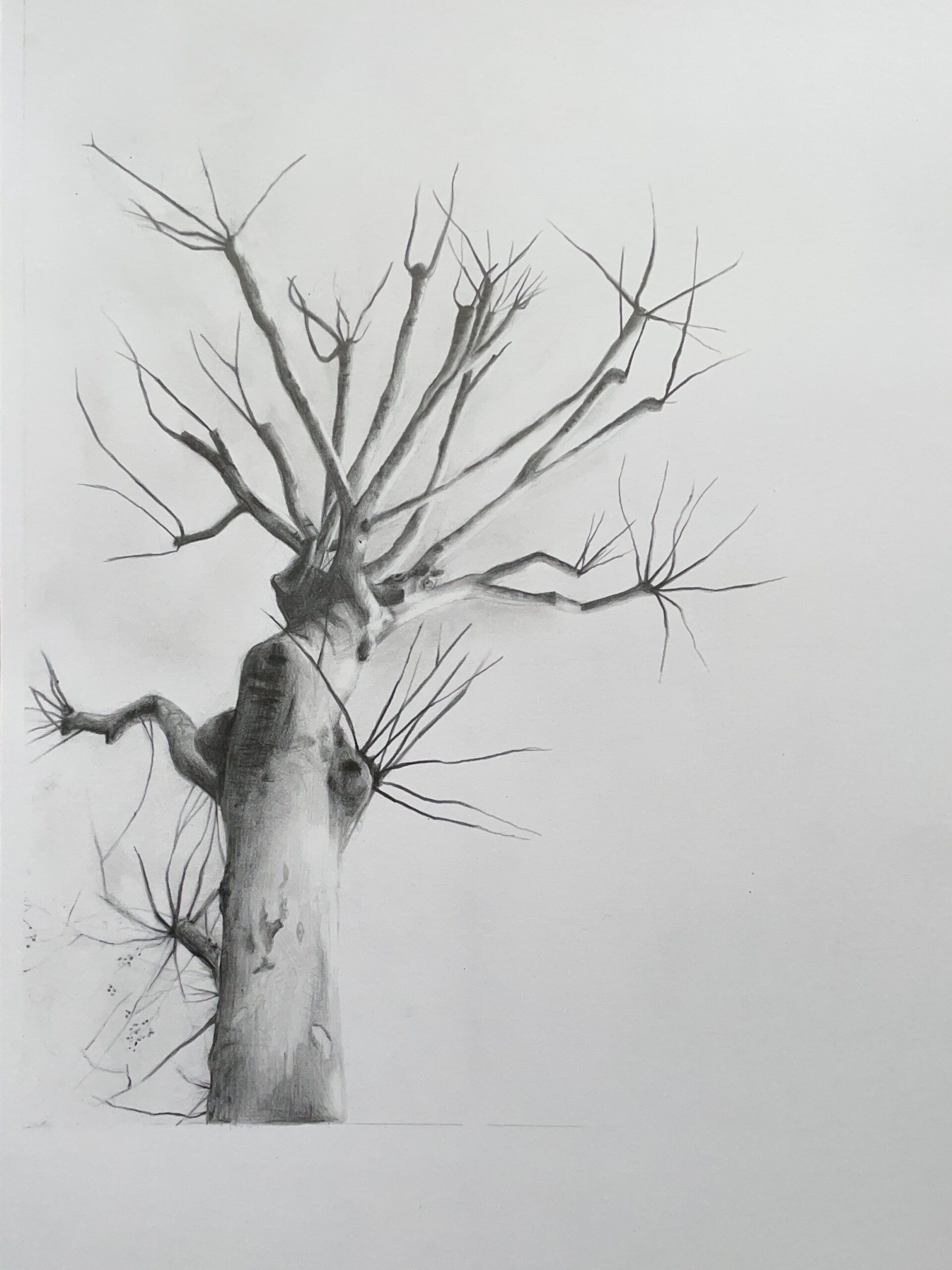
I simplified the picture but still was inspired by the shapes of the branches. Unlike the sketch, I tried to render the large and small branches. I find this very meditative. I did this over two days at the weekend, so possibly spent about 6 hours on it in total. I forgot to time myself but I need to remember: I enjoyed doing the 30 minutes snapshots to record my progress in the previous exercise.
Final thoughts
I was quite happy with the final drawing. I guess one can always improve and perhaps the trunk is not round enough. I’m not sure why; something to do with the light tones on the right, not darkening in an homogeneous way the illusion of a cylindrical shape. This being said, I liked the final result and felt satisfied with the conclusion. I particularly enjoyed “drawing the light” which was at a low angle when I took the picture. By the end, I felt connected to that tree, like it was a character!
Future plans
I must progress on the next exercise for this project but I’m saving this here as I’d like to return to it later on.
Option B: Study of Several Trees
Spend time really looking at a tree in detail. Spend at least an hour on this drawing.
Aim
This drawing demonstrates the artist’s ability to be selective and simplify the scene. It captures the most striking feature – the fall of light on the trees – by simply leaving white areas free of marks. Note the very simple use of perspective where the more distant forms are not only smaller, but also less defined.
Method
- Spend one to two hours on this exercise. Work in a wood, or study a group of trees. You might decide to work using a variety of media and introduce colour with crayon, oil pastel, or watercolour pencils. Look for a point of interest; this could be a path to introduce an element of perspective, or strong contrasts in light and shade, or the dynamic forms of the trees themselves. A bank of rocks could form part of your study.
- Your drawing should suggest form and mass, but don’t get stuck with detail. If you use watercolour pencils, use a wet brush to develop some simple watercolour washes so that you can map out areas of tone. Through autumn and winter leaf litter often makes for vivid and complementary colour and tonal interest.
Reflection
What techniques did you use to distinguish one species of tree from another? How did you convey the mass of foliage and the spaces between? How did you handle light on the different parts of the tree?