Exercise brief
Aim
For some artists, collage is their primary means of expression and an opportunity to create a unique language, for others it is a means to an end and even though the results can still be interesting, the purpose is to find a way of arriving at ideas for paintings or other art works.

Collage can be a fun and effective way of working out compositions and the essentially non-precious process of tearing and layering found papers can open up possibilities.

For this exercise, you are playing with the way the elements of a composition are organised but you don’t need to make the collage representational, or the narrative linear. You could try disrupting the sense of scale and experiment with overlapping some of the found images.

Method
Look through your folder of images, photocopies and tracings. Start by placing different pages on the floor, seeing how images sit next to each other. You might see a narrative emerging, or you might respond to colours and textures that work well together.

With 2 or 3 sheets of A3 paper and a pot of PVA glue, put together the different elements to form a collage. Don’t be afraid to cover the whole page - layering images can create an interesting  dynamic. You might also decide to add some text. When you have finished your first one, make one or two more, exploring different ideas.

If you have a scanner, make black and white copies of your collages - or you could use your phone camera. How does monochrome affect the reading of the image?

Select one of your collages, or a black and white copy to develop further.

Method
Use dilute acrylic or ink and a selection of brushes to include a small, round and a medium sized flat brush. Limit your palette to one or two colours.

Add your colour to sections of the collage in a way that alters the emphasis and the reading of the image. For instance, you might block out a photograph of a house with flat, black acrylic so it becomes an ambiguous void. Alternatively, you could extend areas of pattern or detail with a fine brush mark that extends across the other collaged elements to create some layering. Play around with it, thinking about the relationship between the found image and the painted mark. If you decide you have applied too much paint, you could always try sticking more collaged images down on top.

Do another one if you are enjoying the process and want to explore it further.

Reflection
Did arranging your collages lead to any ideas about compositions that could be developed in painting? How did adding paint alter the reading of the image? Make note in your learning log.
Exploring composition through collage
Arranging and responding to images
I find collage take me to different places than drawings. It brings about my Dada side and I’m reminded of Hannah Höch‘s works. For the first collage, I started by laying down images from my folder on the table without really knowing where or what I could do with it.
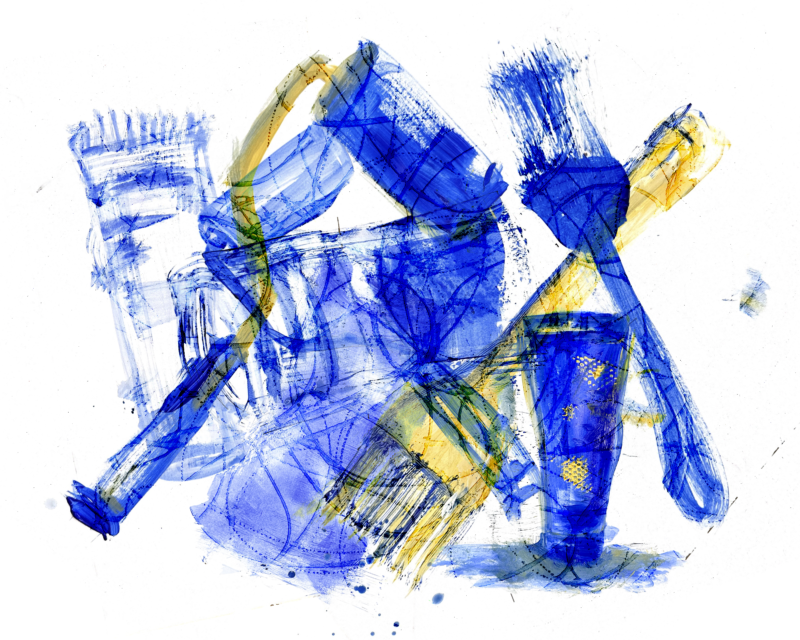
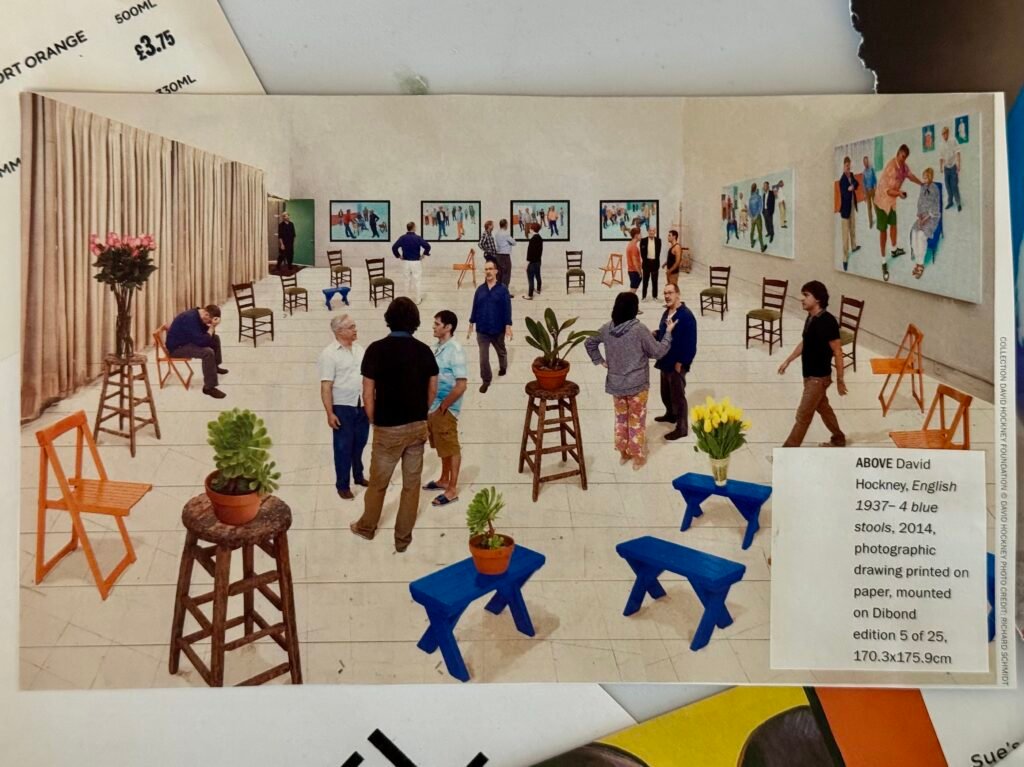
I was attracted by David Hockney’s 4 blue stools (2014). I liked the way he’s brought together the same figures and objects in the same image, creating a sense of perspective but also a sense of time passing.
Collage no. 1
I used the idea of repetition as a starting point and thought it would be easier to play on my iPad. I photographed a few of the images I had laid out and imported them in Procreate. Then I started to play with the sense of scale. The narrative behind all the images I collected was about consumption and the image of women in selling luxuries and the damage this creates to our planet. I find the way the models are looking straight at the camera… annoying on many levels. I find it demeaning for the women who are on the photo, manipulating for the viewer. I know this is about making the product desirable but it also is done through a very masculine lens. I look at these images and cannot help but thinking they embody many things that are wrong about our modern societies, including how our fetishisation of products and possessions is destroying our planet. The gaze reminded me of the “watching eyes” effect in psychology which show that the feeling of being watched, even simply by seeing a pair of printed eyes, can impact our actions and decisions.
I played with these ideas on my iPad, “cutting away” with my stylus and playing with layering. It’s easier and less sticky than glue! This is not the first time I make this kind of image. It is quite different from the other images I’ve created. I finished it by playing with effects in Procreate to make the image “pulsate”. I like those effects. They are quite unsettling and arresting.

Collage no. 2 and no. 3 – Exploring different ideas
For the second collage, I decided to get my hands dirty. I’ve done collages for the Foundation course and remembered the most difficult part was to layer and arrange the pieces as intended. Since then I got a crafting tool set for journaling and these have come very handy!
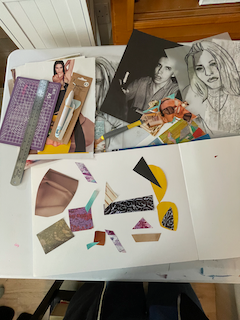
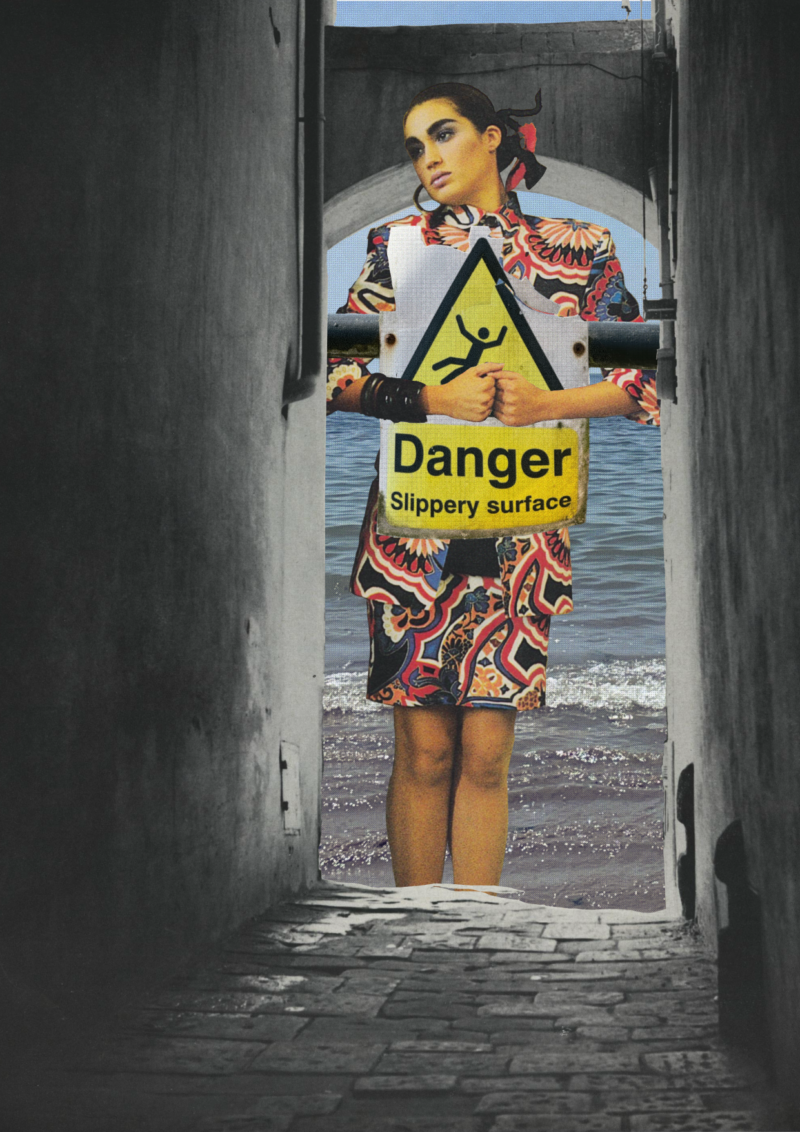
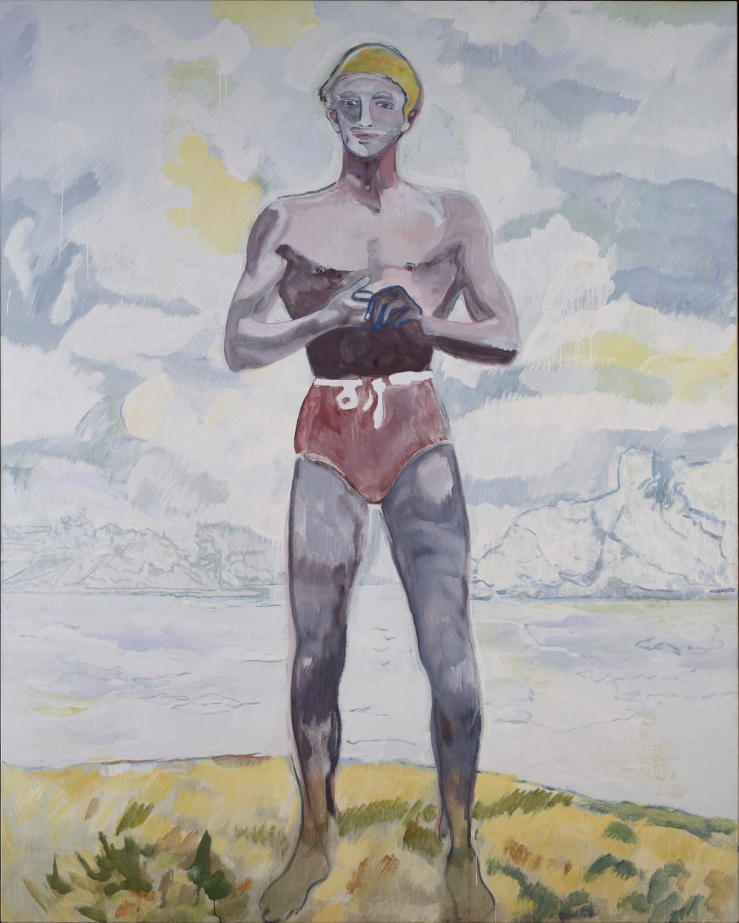
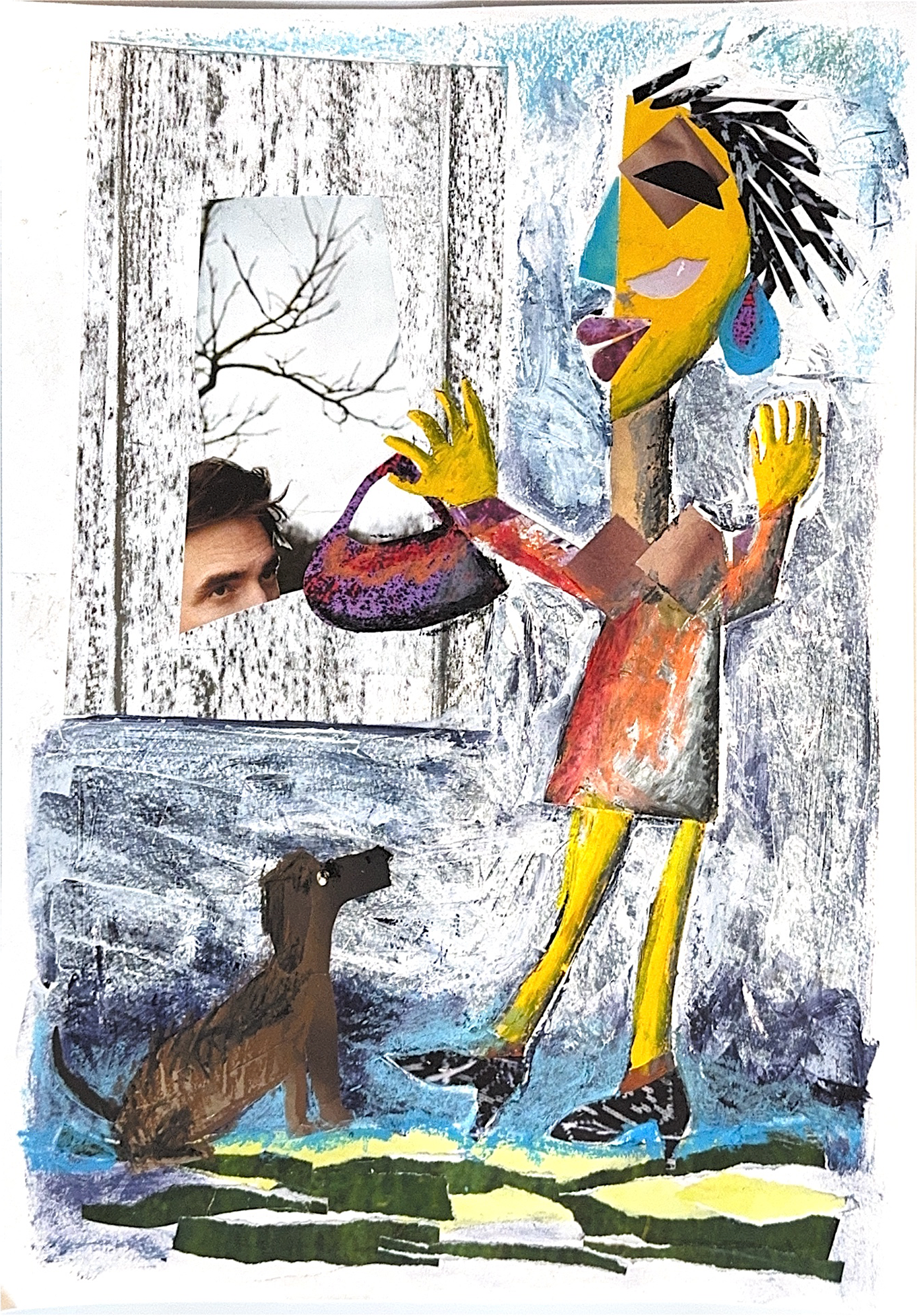
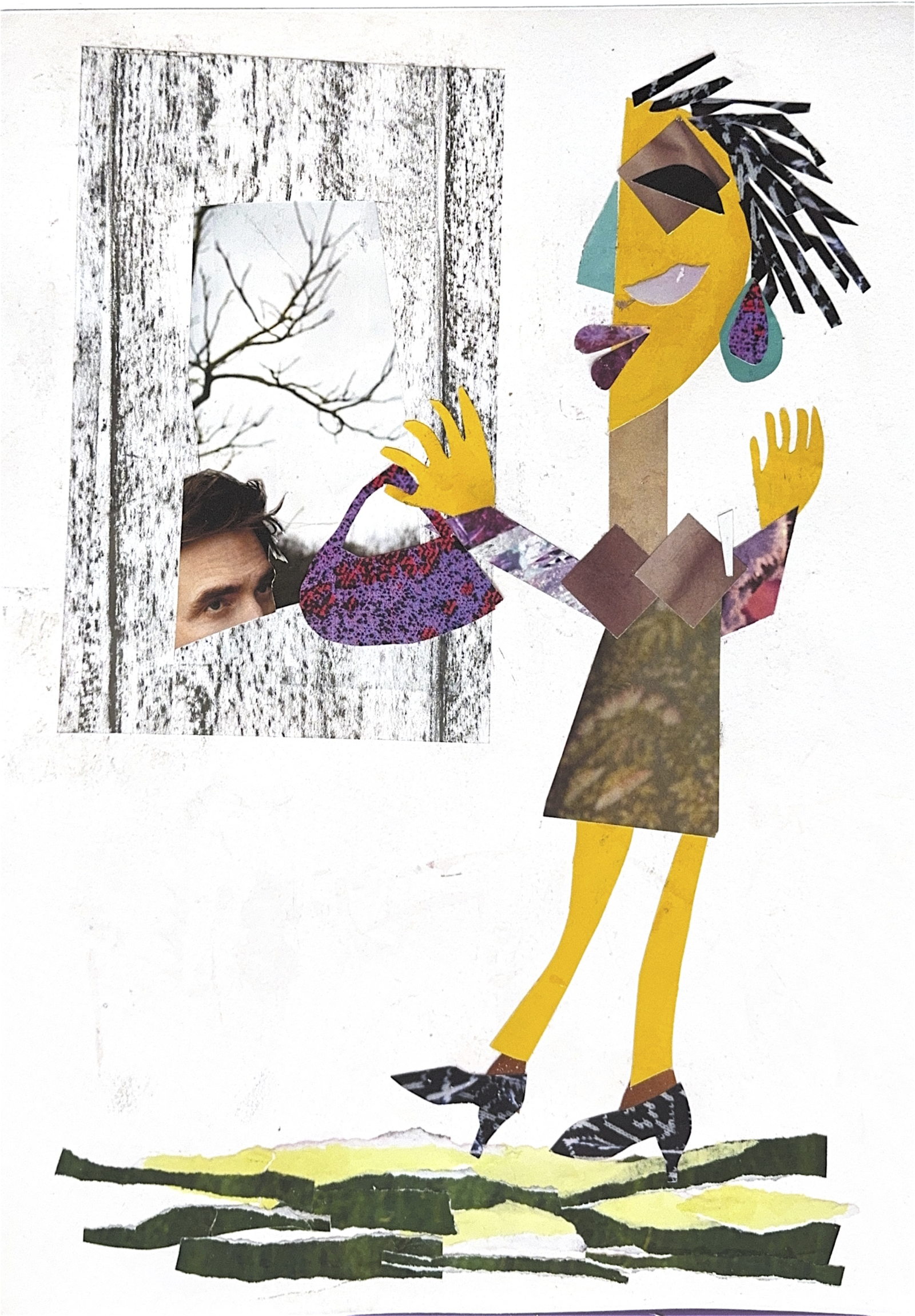
I didn’t really have a plan. So I started cutting shapes of textures, and colours I liked. I thought I might try an abstract composition… Although before I knew it, I was back getting the shapes together into a human face. Once I had gotten that anchor, I started to look for elements to complete the figure. Then I looked for something to anchor the figure on the ground. I found some grass but it was too dark against the fabric for the shoes. So I searched for lighter green. The left was a bit empty so I searched for some trees and background. I needed a frame and looking at the textured wood gave me the idea to cut out a square to make a window. Once I had all my collage bits ready, I filmed a quick video before I started to put the pieces together. Looking at the film, I saw the face of a man looking and that gave me the idea to add a “male look”.
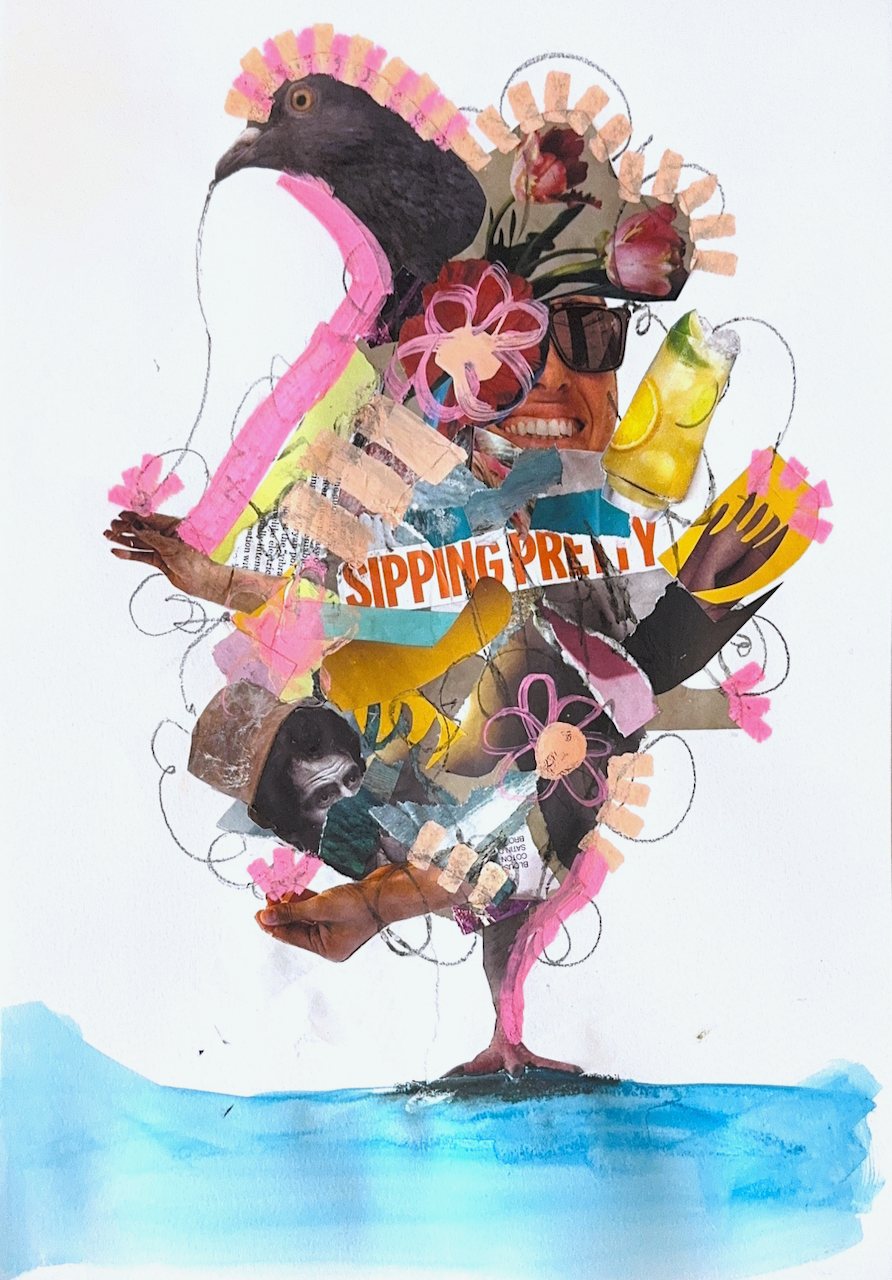
For the third collage, I didn’t know still where to go. I started by putting colours together and using what scraps were left from my previous cuttings. I went for another pile of journals and found a big photograph of a pigeon. This somehow attracted me so I cut the head and one leg. Then the collage seemed to begin to resemble a body, a sort of assemblage of shapes. There was a quote ” Sipping happy” from one of the magazine which I liked. So on it went. I was trying to pay attention to the scraps I was using to add contrasts and interest.
Unfortunately I forgot to take a picture at the collage stage and got carried away painting on it so it’s displayed in the next stage.
Painting on collage
Revisiting collage no.1
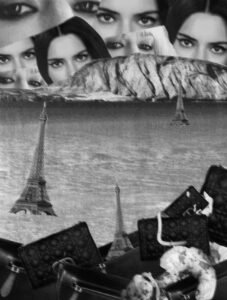
For this collage, I printed a black and white version on my inkjet printer. The print had lots of artefacts which would normally bug me but I decided that imperfect was part of the process and working through studies is about a journey, the study is a thinking artefact, not a finished artwork.
The black and white version made me think that I could emphasise the contrast between the human made and the natural elements of the picture. So I reached for my neocolor II crayons and proceeded to colour in the mountain and the sea and the cooked food on the bags.
The bags lost their figurative meaning in the print. In the final study, it is not clear that we are looking at handbags.
Revisiting collage no. 2
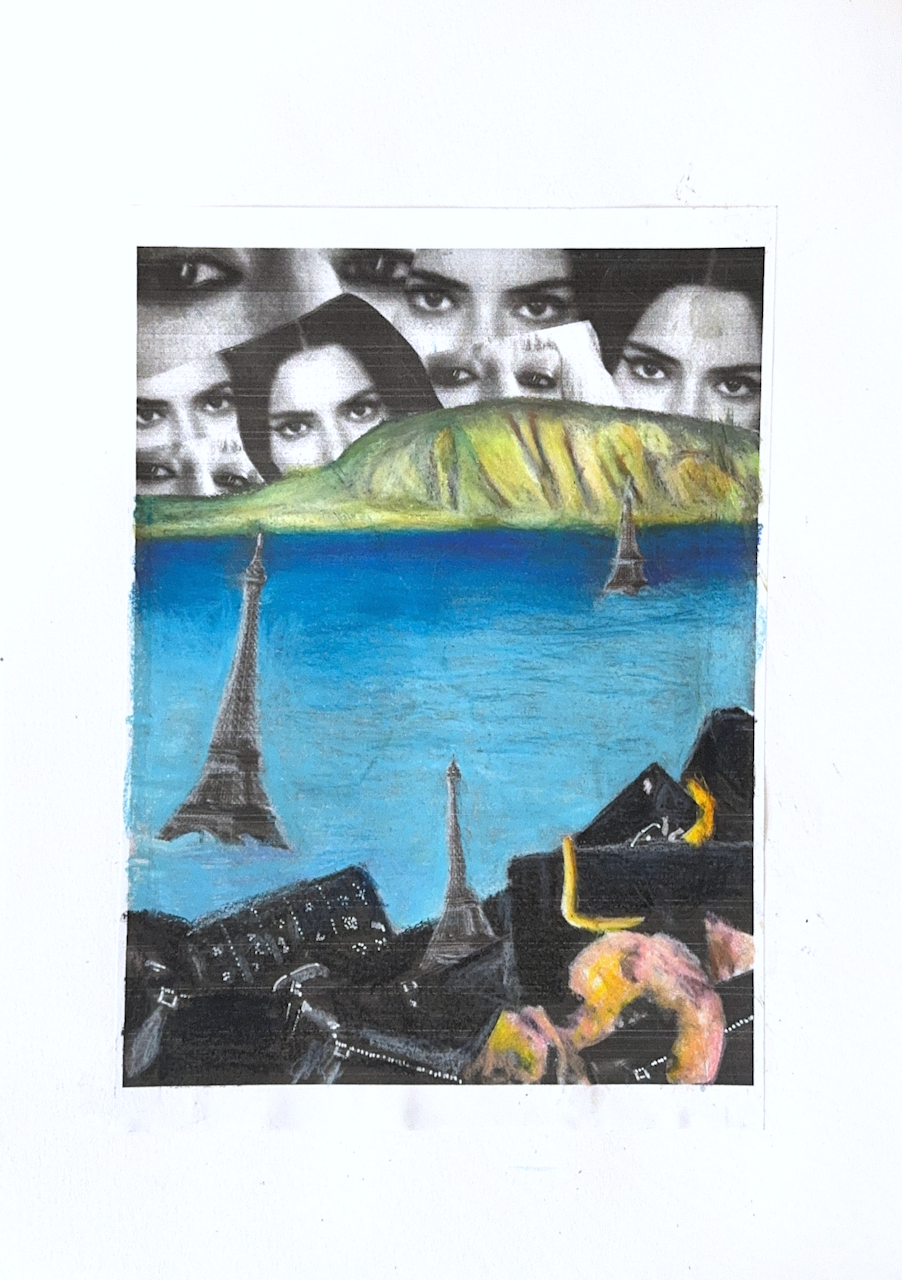
Following the second collage, I decided work with acrylic to fill the white on the page. I was aiming to create a textured background so I started with a mix of Prussian blue and magenta together with medium and then I applied white on top with a paint knife. I thought the figure looked a bit flat after that so I used oil pastels to add a bit of texture. The dog was a last minute addition (we just got a puppy last week!). I like the result and the contrast between the photographic image through the window and the collaged woman and dog.
Revisiting Collage no. 3
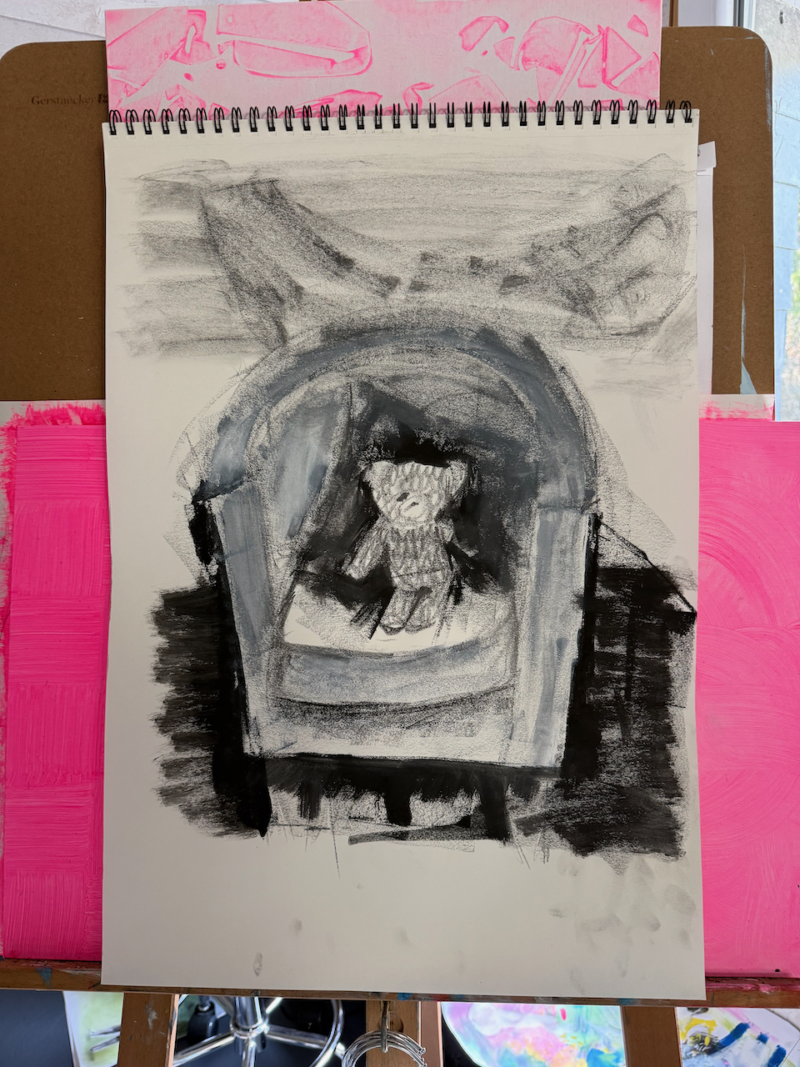
The last collage I reached out for my graphite stick and my acrylic markers before it was dry! I have a funny relationship with collage. On the one hand, it brings out a quirky side which I have buried inside (and that is fun), on the other hand, I feel like it’s too “out of line” and unrefined, and I don’t like that so much. But, I tell myself, these are all part of the process. I still feel a little blindfolded: I am making because making is better than thinking, I am quite happy with what I get but also don’t feel it is “strong”, I’m not sure what that means or how I figure it out.
Reflections
Did arranging lead to composition ideas? Yes and no, I think a composed collage emerged from the act of making a collage and I somehow used my intuition to create balance. I understand how collage can be used to “search for” a strong composition by moving things around but the process felt additive rather than comparative: I was liking things that go together and then looking at what I could “add” next and where, like decorating a Christmas tree. Sometimes the composition felt unbalanced and I was looking for something to balance it out.
How did paint alter the reading? In the first collage, I think it helped create a contrast between the human elements and the natural elements, which strengthen the composition. In Collage no. 2, it helped making the whole piece more cohesive and add depth and form to the collage. In Collage no. 3, it contributed mark making and lines with the collage, forming a different kind of cohesiveness through mixed-media.
I liked them all. Despite the process being painful and the result chaotic, the exercise generated three interesting images. On a more technical side, the images look more professional on screen than in reality because the paper warped and the collage was quite messy, with lots of speckles and smudges.
References
Dear, K., Dutton, K., & Fox, E. (2019). Do ‘watching eyes’ influence antisocial behavior? A systematic review & meta-analysis. Evolution and Human Behavior, 40(3), 269–280. https://doi.org/10.1016/j.evolhumbehav.2019.01.006