Task brief
There was no detailed guidance for this task but I found some from a GCSE guide (!), which suggested to look out for (1) facts about life and education to understand the context of their work, (2) Good quality pictures of their artwork, (3) find out what their process for making art was.

The presentation should include (1) a planned layout, (2) colours related to the artist, (3) neat writing or typed annotation, (4) a piece of artwork by the artist to analyse, (5) a response using similar materials, focussing on their use of colour or composition.
Franz Kline (1910-1962) is an American artist who grew up in Pennsylvania and studied at Boston University from 1931 to 1935 and spent a year in London to study illustration and draughtsmanship at the Heatherly School of Art. He began as a commercial artist, working as an illustrator and store designer before establishing himself as a fine artist.
His early work was realist and included portraiture. For example, he made several portraits of a renown Russian dancer, Nijinsky (e.g., Nijinsky, 1940). He is best known as an action painter, and a leading figure of the advent of the Abstract Expressionist movement, an original American school of painting.
His mature work is characterised by austere, raw, quick, rudimentary, spontaneous, and crude brushwork with tremendous energy which resulted in a “boldly simplified pictorial organisation” with a preference for Chiaroscuro and strong value contrasts. His best-known artworks show “wide slashing strokes” of black and white paint “colliding and diffusing” across very large canvases, such as in Monitor (1956) or Cardinal (1950).
A breakthrough is often mentioned to have occurred after de Kooning enlarged some of Kline’s small ink studies on paper using a projector which led Kline to realise he could create dramatic effects through magnifying those small sketches (Anfam, 2003).
Although his paintings may appear non-objective and purely informed by personal feelings or opinions, or influenced by oriential calligraphy, Kline insisted that his images where firmly rooted in the literal, reflecting tensions of opposing forces around him and the mechanics of the industrial world with its train engines and bridges made of steel. (Cohen, 2000; Benezit Dictionary of Artists, 2022).
Reflections
I enjoyed learning about Franz Kline’s intuitive, gestural process from small ink drawings blown up and transformed in huge canvas. It resonated with my own path to art making (I started drawing again as an adult using 0.05 fineliners!). I also felt intrigued by the process of projecting small drawings onto a canvas. I wanted to have a go to experience of magnifying a drawing.
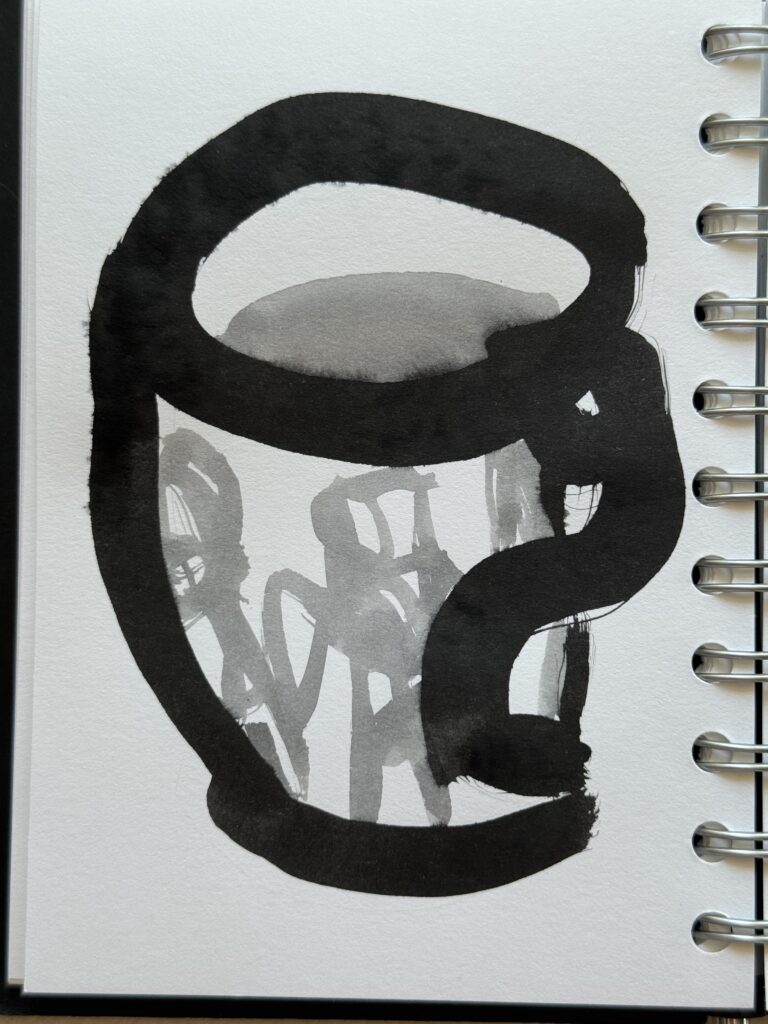
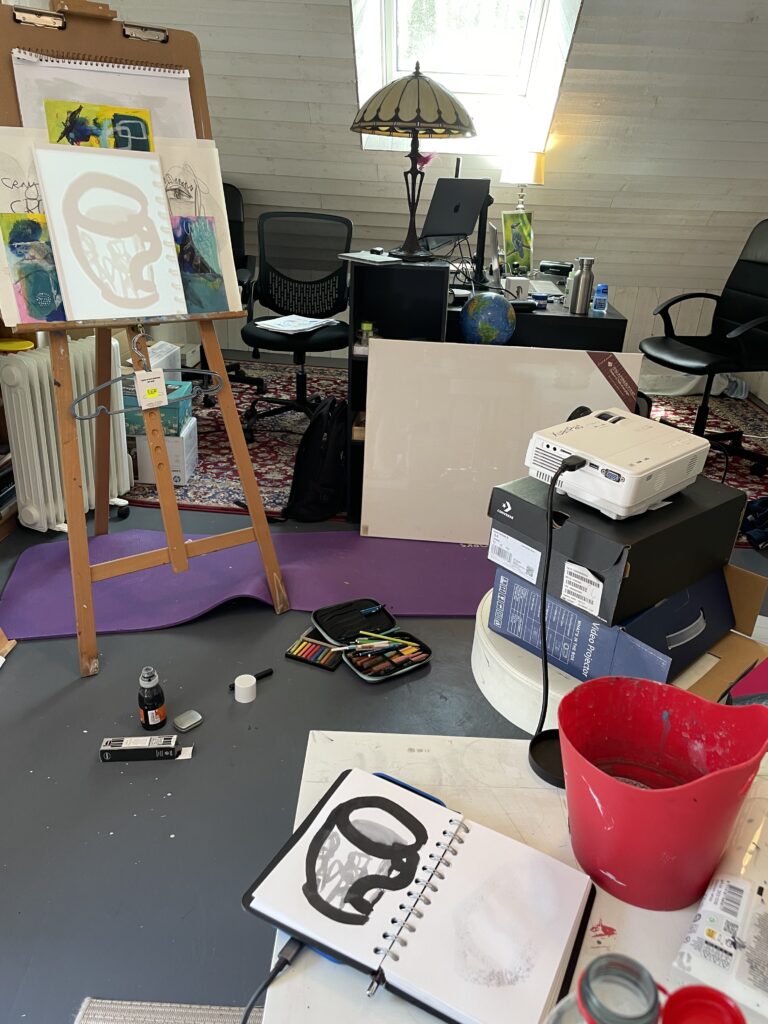
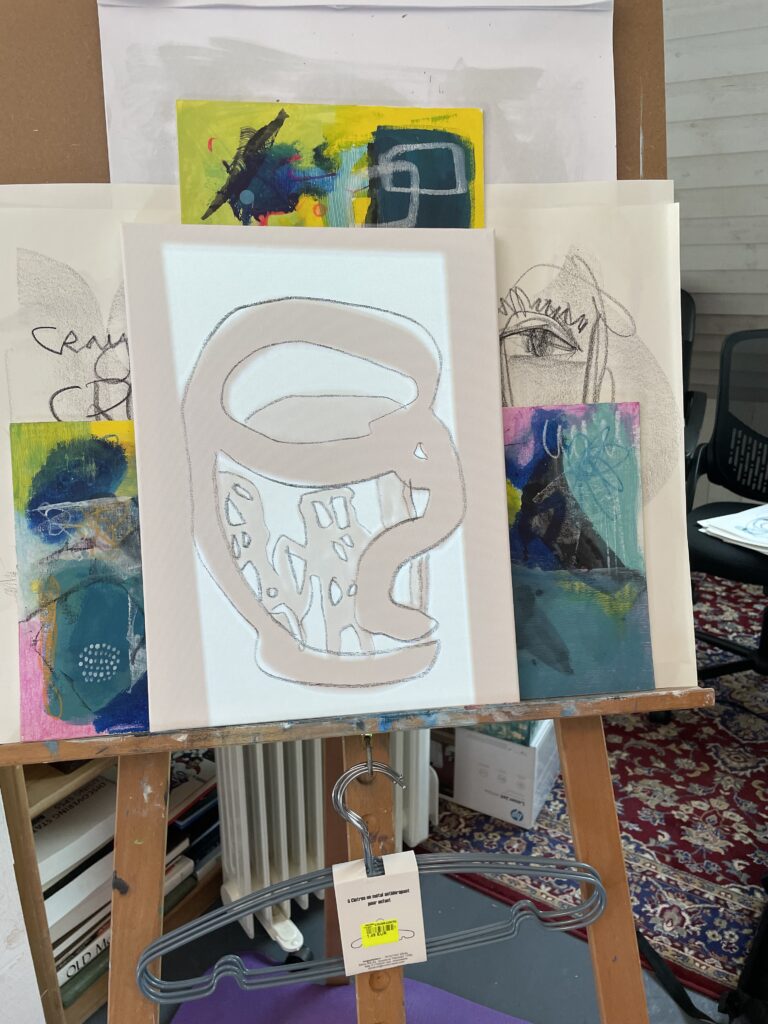
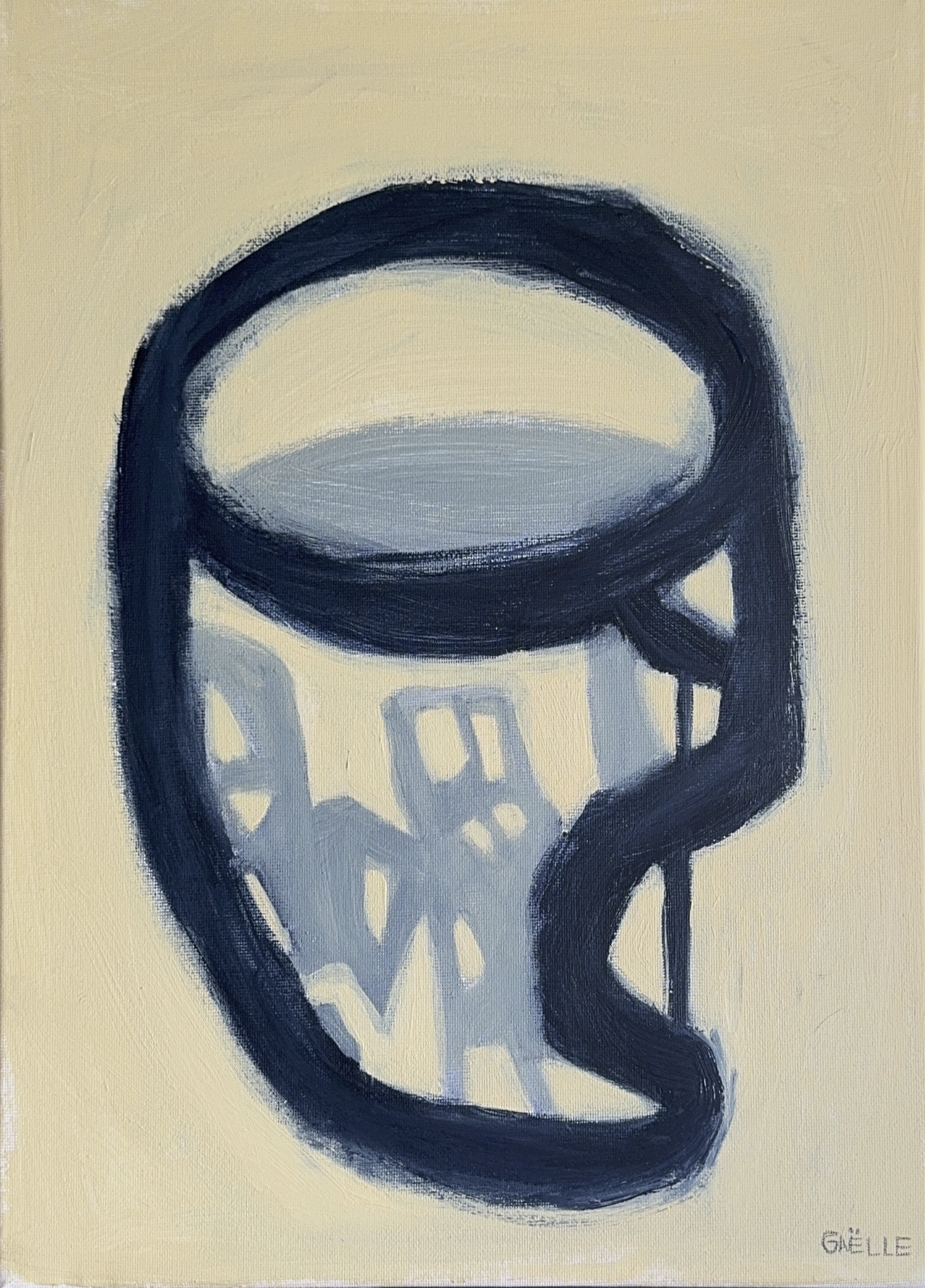
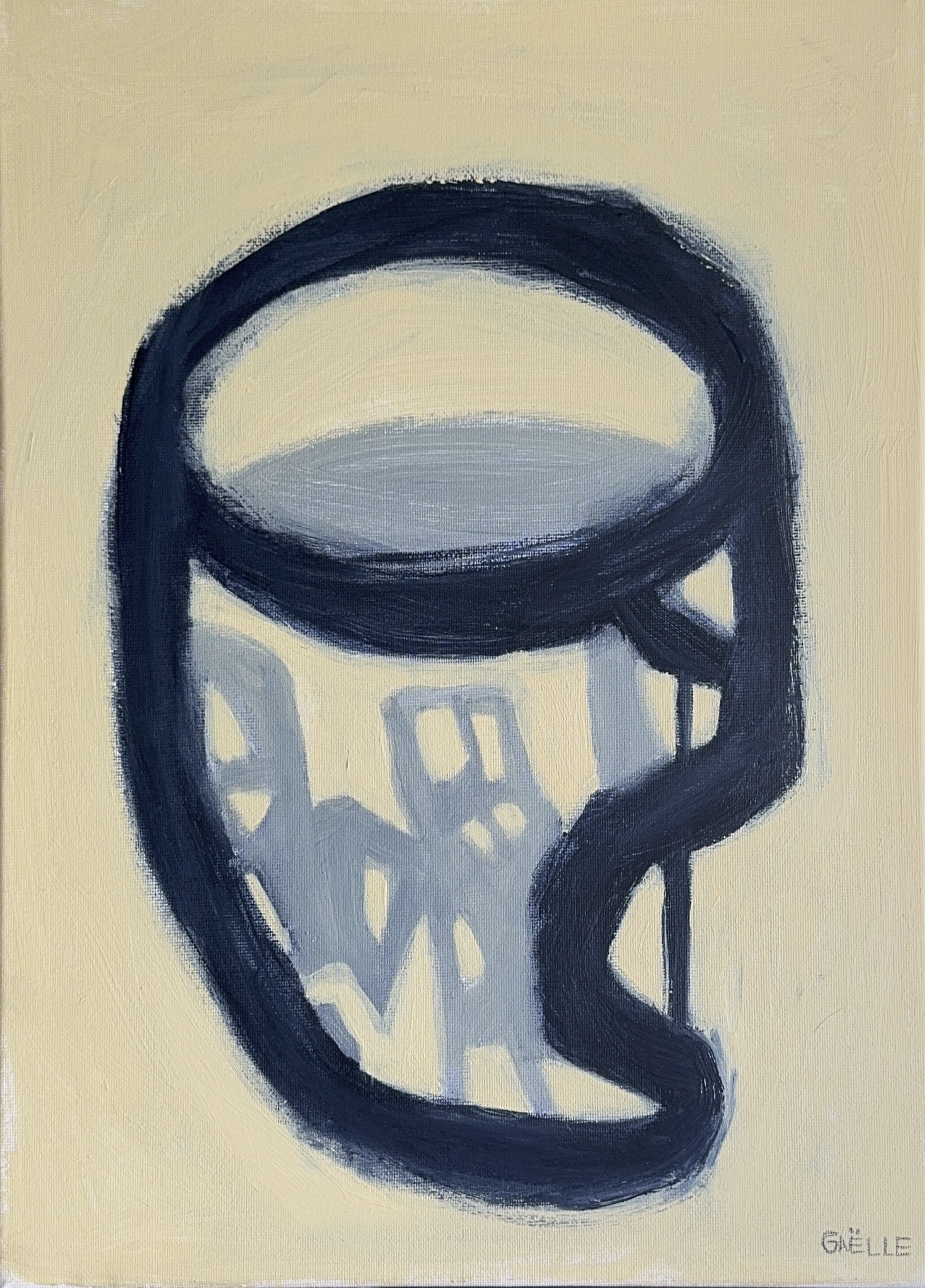
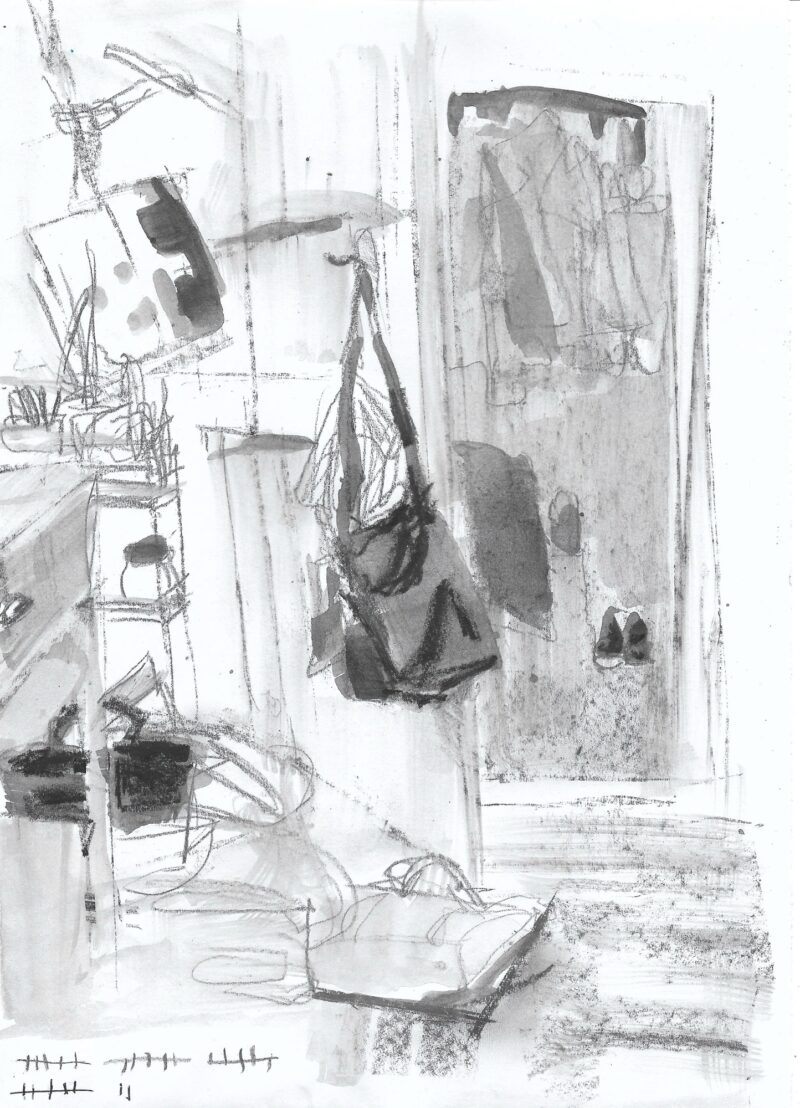
I did a quick sketch of my mug in my sketchbook which I photographed and projected on a 40 x 30cm canvas. I outlined the shape in charcoal, applied fixative and used two tone of acrylic to render the image. It was not as easy to be gestural because the canvas was too small to allow arm length movement, the paint I had was too “sticky” and transparent and I only have water to make it more fluid, no medium. Still the process created an interesting image and I enjoyed, again, reflecting on the fast and slow painting process, layering vs. single mark. I also found this Youtube video discussing how Robert Motherwell also created black and white paintings which appeared gestural and intuitive but were in fact the result of meticulous preparatory drawings as in Preparatory drawing for In Memory of My Feelings (1967).
References
Anfam, D. (2003). Kline, Franz. Grove Art Online. Retrieved 23 May. 2026, from https://www-oxfordartonline-com.libezproxy.open.ac.uk/groveart/view/10.1093/gao/9781884446054.001.0001/oao-9781884446054-e-7000046894.
Kline, Franz. (2022). Benezit Dictionary of Artists. Retrieved 23 May. 2026, from https://www-oxfordartonline-com.libezproxy.open.ac.uk/benezit/view/10.1093/benz/9780199773787.001.0001/acref-9780199773787-e-00099390.
Cohen, P. (2000). Kline, Franz (1910-1962), painter. American National Biography. Retrieved 23 May. 2026, from https://www.anb.org/view/10.1093/anb/9780198606697.001.0001/anb-9780198606697-e-1700487.


1 Comment
Add Yours →[…] to involve the whole arm rather than the wrist. That question feels connected to my research log on Franz Kline, and the relationship between bodily movement and mark. In fact, I was thinking there is scope to […]