Exercise brief
Aim
As you are working through ideas about composition, you will be starting to consider what you find most interesting about your subject and what elements you would like to emphasise. In drawing and painting, it is often about creating a balance and a sense of rhythm within the composition, and sometimes a focal point is used to lead the viewer into the world the artist has created. This can be done with varying degrees of subtlety, and is sometimes ambiguous or less easy to discern. But it can be an interesting area to explore as you learn about organising and arranging the important elements of a painting.
For this exercise you will be developing earlier sketchbook studies into larger pieces of work, concentrating on contrast and emphasis to add visual interest.
Method
- Have a look through all the sketchbook studies and experiments you have completed since the start of the course. This could be from project exercises, or your own sketches you have been making alongside the course material. Which of these could be developed further? Consider the arrangement of forms, balance and harmony within the composition.
- Select two sketches of the same subject that have a strong composition, but with a different focal point. It might be that you choose studies from your sketchbook walk in project 3, where perhaps you made a close-up study of a tree in one sketch, but in another a view looking towards a railway bridge. Or you might want to revisit your studies of interiors and different sections of the room. Make sure that either the sketch has enough information, or that you have supporting photographs, or the object itself if you are working with still life or interiors.
- You will be making two drawings that are approximately twice the size of the original sketch, using soft pencils, ink or watercolour.
- While you are making the drawing, consider what you want to emphasise in the composition. For instance, the soft folds and patterns of a coat hanging in the bedroom might be suggested in more careful detail than the table and wardrobe. Or the texture of some rocks next to the river could be described with more direct marks and greater contrast than the water. It will help if it is something you will really enjoy describing, perhaps because it is an object you find beautiful or intriguing in some way.
Reflection
What was the effect of having a focal point in the drawing and did this help you add coherence to the work? Was this a useful way for you to discover more about what you find interesting? How was mark making employed to add emphasis? Make notes in your log.
Drawing no. 1
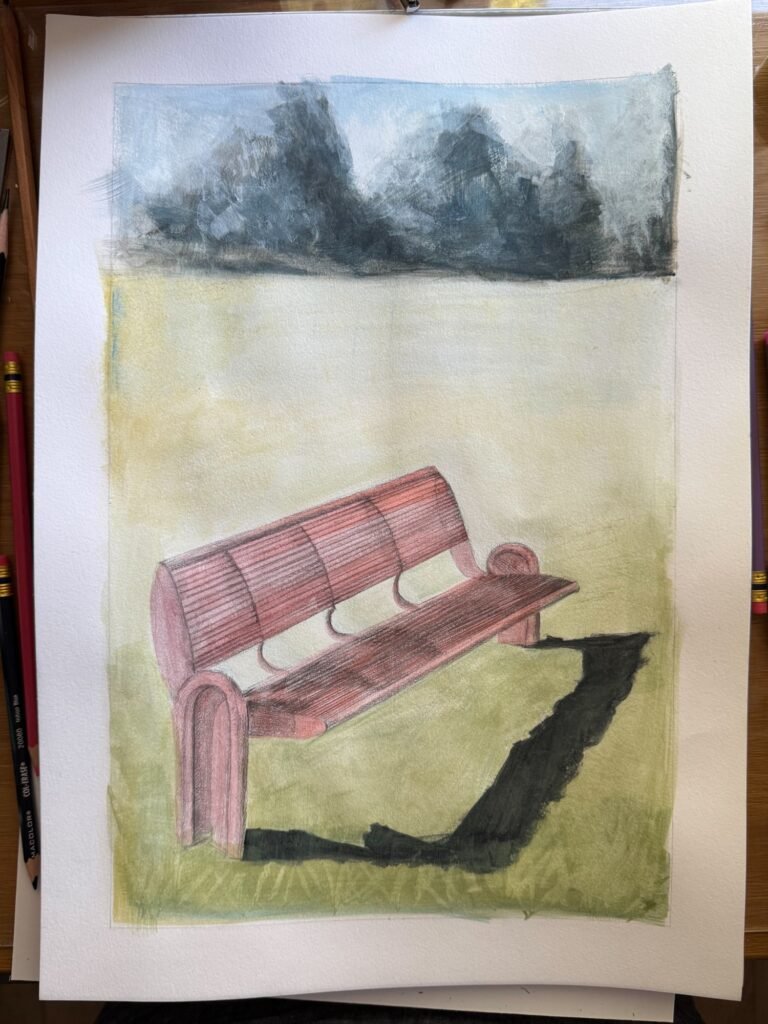
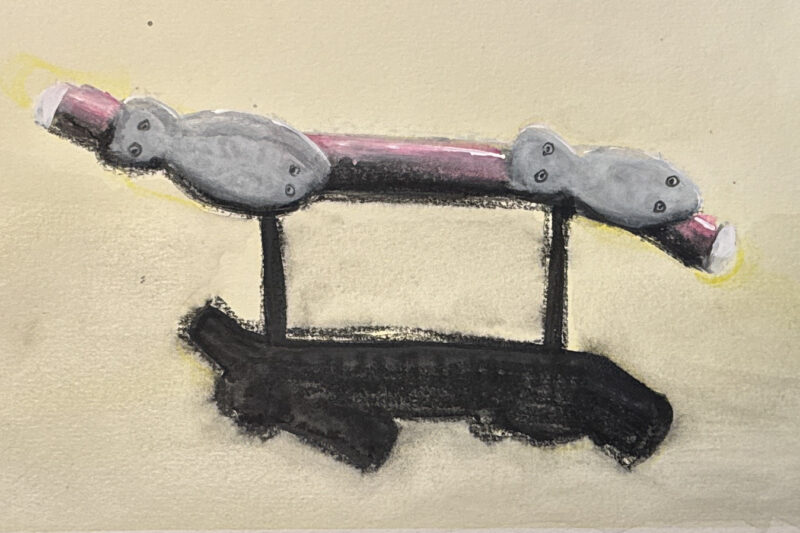
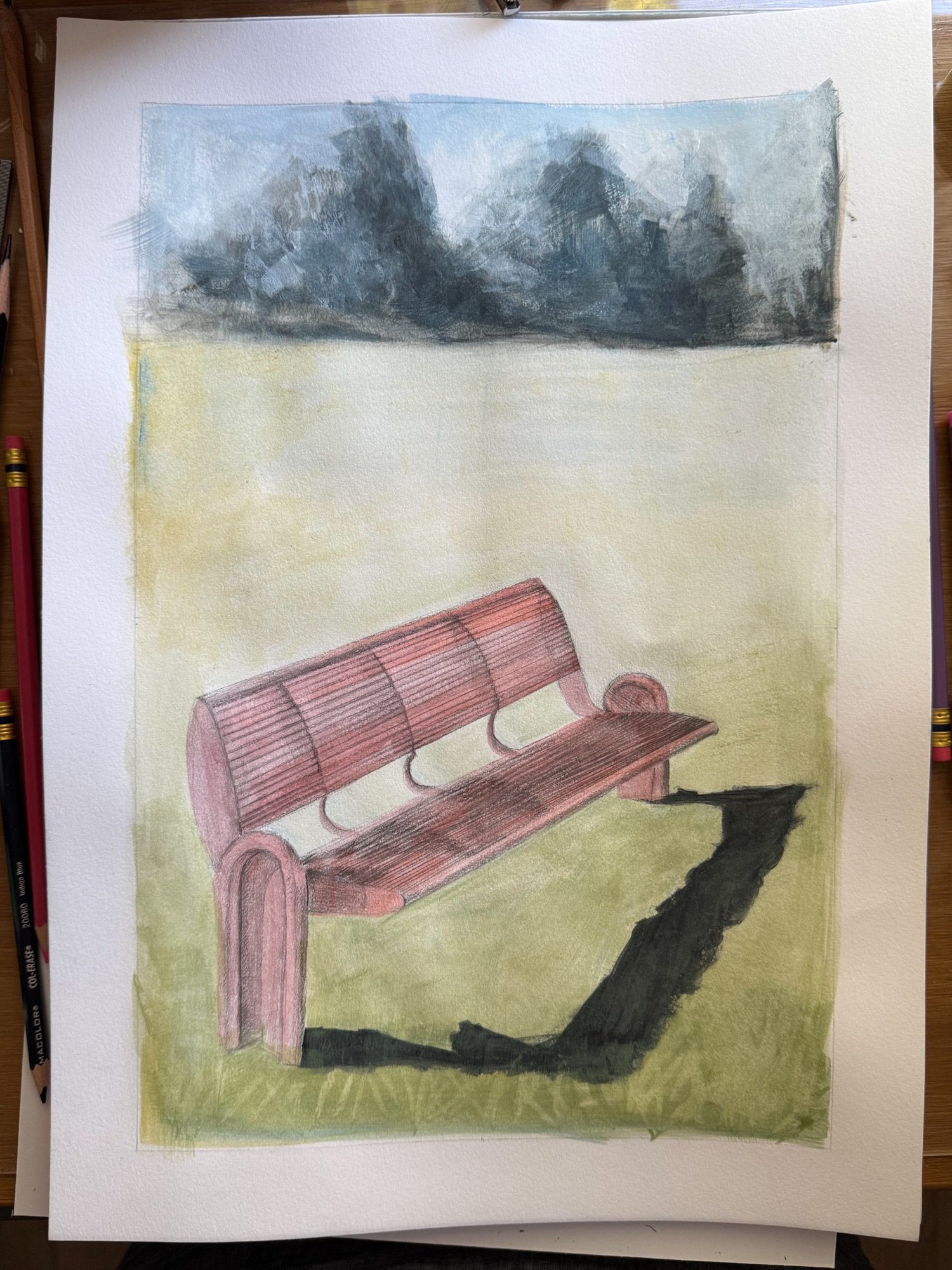
I’m not sure I managed to have a focal “point” in this drawing. I picked the bench from my park series. I simplified the background and purposely made the bench more detailed in the foreground. I first drew it using an HB graphite, I applied fixative and layered diluted acrylic paint. I was trying to contrast the texture to make the bench the focus of attention, the main character of the page. I tried to make the background grass lighter and the background trees bluer. I am pretty satisfied with this study! I was thinking perhaps I should try a medium rather than water next time although I’m not sure why, just to see what difference it make I guess. I could imagine a series of benches like this. They are interesting and overlooked sculptures in our environment.
Drawing no. 2
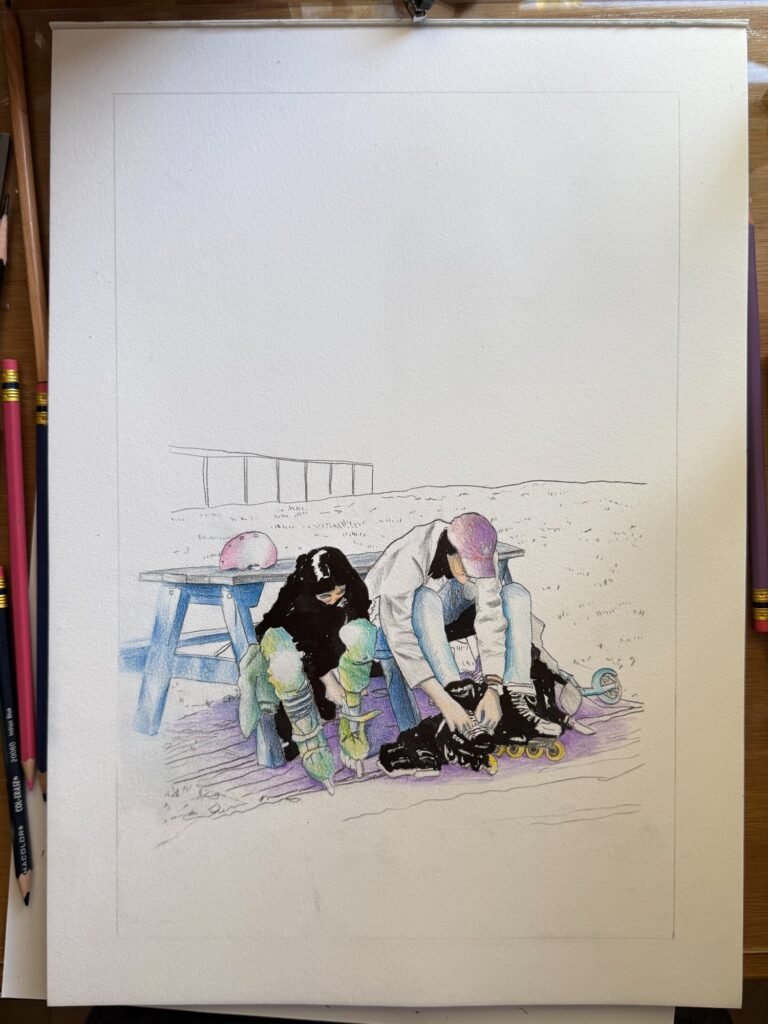
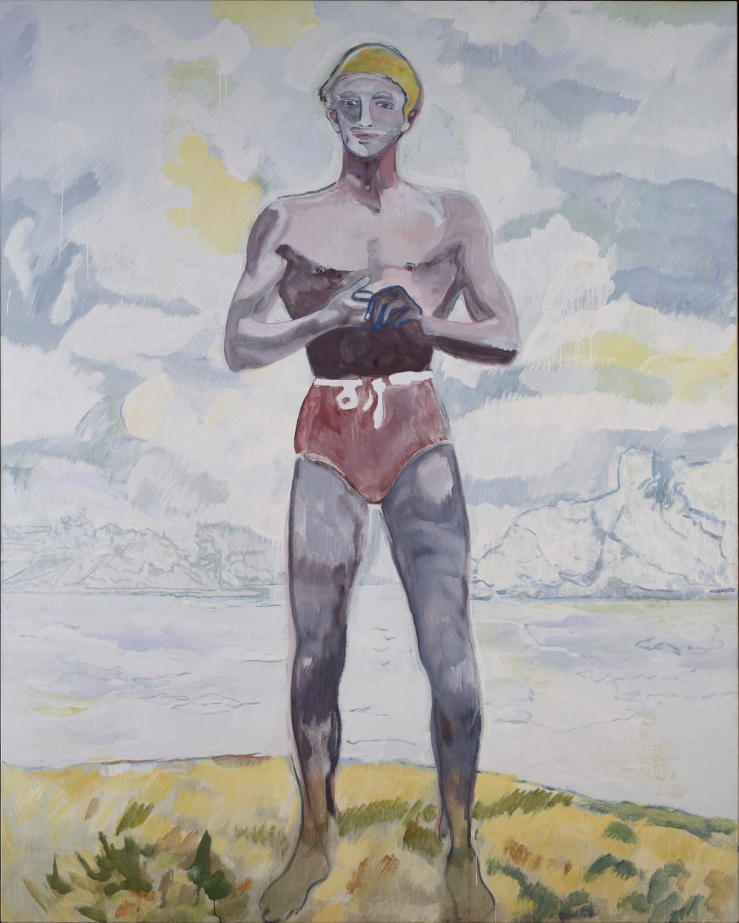
In the drawing I revisited an earlier sketch and was aiming to focus on the two main characters. I used carbon paper to trace the image first and was trying to simplify it. I really enjoy shading and varying the values. I used Indian ink to push the blacks to create contrast with the softer hues of the colour pencils. I also aimed to harmonise the colours rather than be faithful to the original colours of the picture. The tracing allowed me to be more precise and accurate. I think this image is more successful in conveying the subject than my original sketch.
Final reflections
I feel my drawings are balanced and I was happy with the colours. I prefer the feel of the bench. The second drawing was harder to simplify. Overall though I think I was surprised by the results. There is a sense in which I’m thinking and planning but, at the same time, I’m not quite sure how or why I ended up where I ended up. I guess that’s what makes art making fun (and also a little bit uncomfortable!)
Another thought is that I should start with a flat wash with a gradient for the grass. I know this but I didn’t know I would end up needing this before starting. I’m beginning to see how the projects build up to a creative process which helps being more planful as we go along! It’s not about whether a drawing is “good” or “bad” but rather whether it’s is useful in highlighting what to do next to improve it.