Task brief
Contemporary artist Sarah Pickstone made a series of drawings and paintings inspired by women writers who have walked the parks of London in search of ideas for their stories. Combining the ghostly faces of these writers with elements of cultivated landscape, Pickstone constructed shifting narratives. Have a look at Sarah Pickstone’s website, particularly The Writers series and consider the relationship between her process and the subject matter. How does her use of fluidity and layering relate to her ideas?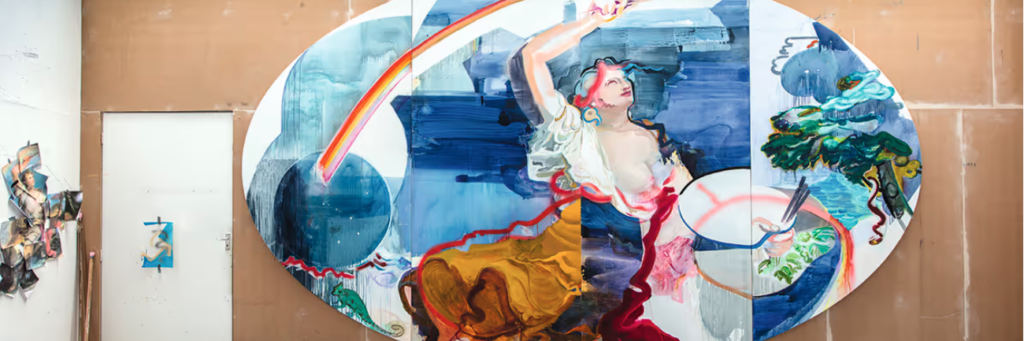
Introduction
Sarah Pickstone (born 1965, Manchester) is a British painter working primarily in watercolour and oil at large scale. She studied at the University of Newcastle, the Royal Academy Schools and the British School at Rome, where she held the Rome Scholarship in Painting (1991–92). In 2012 she won the John Moores Painting Prize, the first woman to do so in over thirty years (Wikipedia, 2025). Her work has explored the relationship between women’s creative practice, landscape, and the act of making itself.
The Writers Series
The Writers Series (2010–14) is a body of paintings inspired by women writers who walked and worked in and around Regent’s Park, London. The series acknowledges a lineage of women writers, including Virginia Woolf, Angela Carter, Katherine Mansfield, George Eliot and Sylvia Plath, all with literary connections to Regent’s Park (Southwark Park Galleries, 2017).
Pickstone describes the project as a form of invocation: a chance to imagine and explore how these writers drew on the landscape for their courage, insight and vision (Archeus Post-Modern, 2020). The subject of the work and its method are intermingled. She walks the park, draws there, reads these women’s words, and holds all of this in the same process. The paintings are not illustrations of the writers; they are the accumulated residue of sustained, shared attention to a place.
The series was first exhibited at the New Art Centre, Salisbury, in 2013, and later included in the larger solo exhibition Other Stories at CGP London in 2017 (Southwark Park Galleries, 2017). In 2014, Daunt Books published Park Notes, an anthology of the paintings alongside collected writing (Royal Drawing School, 2017).
Fluidity, Layering, and Meaning
Pickstone works in watercolour with oil, often at very large scale (Royal Academy of Arts, n.d.). The choice of medium is not incidental to the subject. Watercolour is transparent; successive layers do not fully conceal what lies beneath. Light passes through the paint rather than reflecting off an opaque surface. When Pickstone overlays a ghostly face onto a painted landscape, the figure and the place are dissolved into one another, not one painted over the other. The fluidity is doing conceptual work: the writers are not separate from the park; they are absorbed into it. The watercolour also gives an air of ephemerality, and movement.
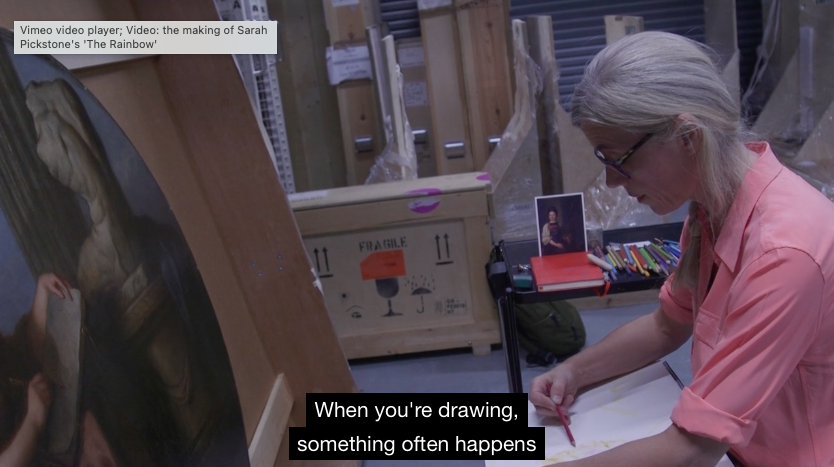
Her working process reflects this logic. In the video “The making of Sarah Pickstone’s ‘The Rainbow'” she says how she uses watercolour as a “fugitive mark, it’s moving and it isn’t fixed.” She also describes returning to a stack of drawings for reference, with studies worked first in watercolour with a large brush, then scaled up if the study succeeds (Royal Drawing School, 2017). She is not illustrating a fixed idea; she is discovering the image through accumulated mark-making, layer by layer.
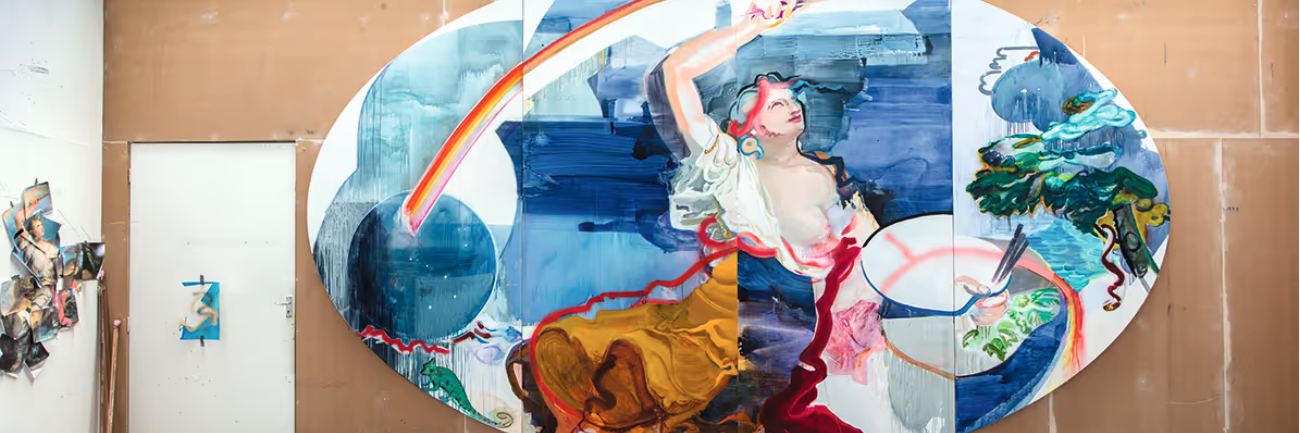
I was fascinated to see the long process through which she went through to create Rainbow. From sketching in front of the original roundel Colour from Kauffman’s Elements of Art through to using these sketches to create other studies, and sketch the figure in actual proportions. The stick she used to transfer the mark. Her mastery of drawing but also the freedom with which she draws accurately is quite inspiring!
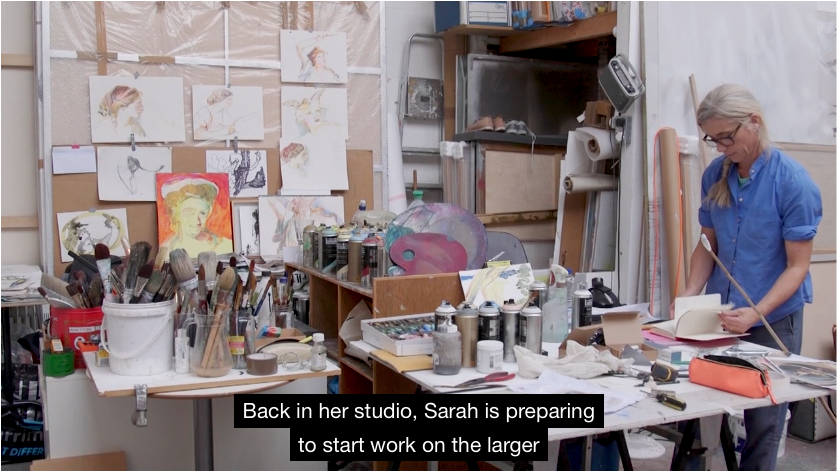
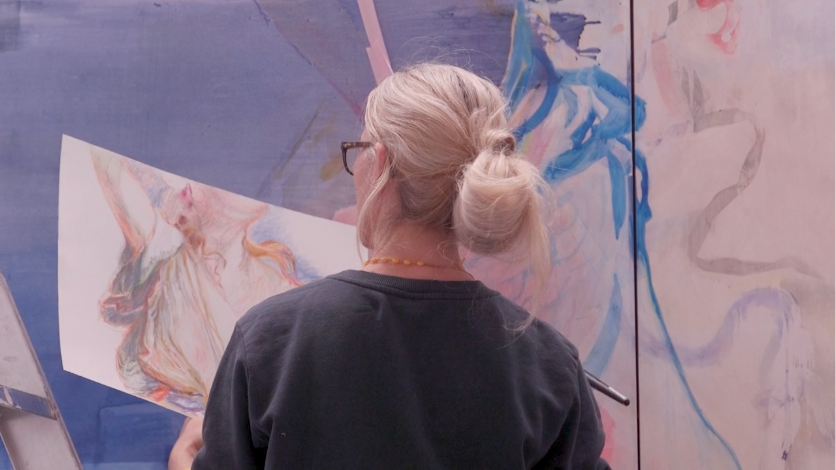
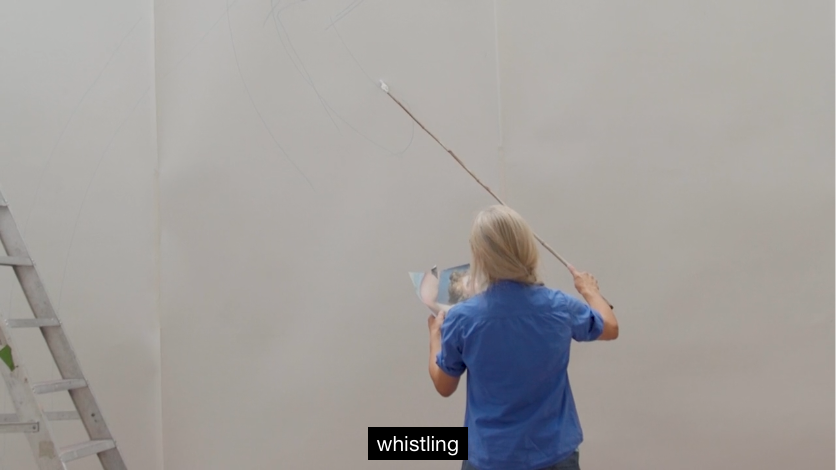
The recurring motifs across her series seem to function like memory: returning across multiple paintings in slightly altered form, always the same and never quite the same. She describes allegory as having contemporary resonance precisely because it is able to hold more than one idea or story at once (Royal Academy of Arts, 2018). Her technique seems to echo the concept of allegory. Layers do not resolve into a final, unified surface. They remain in productive instability, multiple temporalities coexisting: the park now; the park as Woolf or Mansfield experienced it; the act of drawing; the act of reading; the act of writing. In Rainbow, the original painting, the intermediary sketches, the fugitive watercolour marks, the colours in the painting, the painting about the colours.
Implications for practice
I can see several points of contact with Project 3 and my current preoccupations.
Gathering as method
Pickstone treats the walk, the reading, the drawing and the research as a single continuous act. This mirrors the broader structure of Drawing as Gathering. The research task is not separate from the creative act. Although I realise now that I have approached the exercises quite independently but they could all be related to one theme, like the Writers series or Rainbow (responding to past artworks).
Holding multiple time frames
In Exercise 5 (Memory of Place), I noted that free-roaming memory produces collage: multiple moments, perspectives and fragments assembled into a single image rather than a single viewpoint. Pickstone is doing this structurally, holding the writers’ historical presence inside the contemporary painted park. It made me think I could use layering of things to convey the idea of multiple timeframes.
Intuitive first, analytical second or vice versa
Pickstone’s process, starting with loose watercolour studies and scaling up only when something works, echoes my inquiry into starting points (intuition, loose marks, a photograph, a lived experience). The discovery happens in the making, not before it.
Technical thoughts…
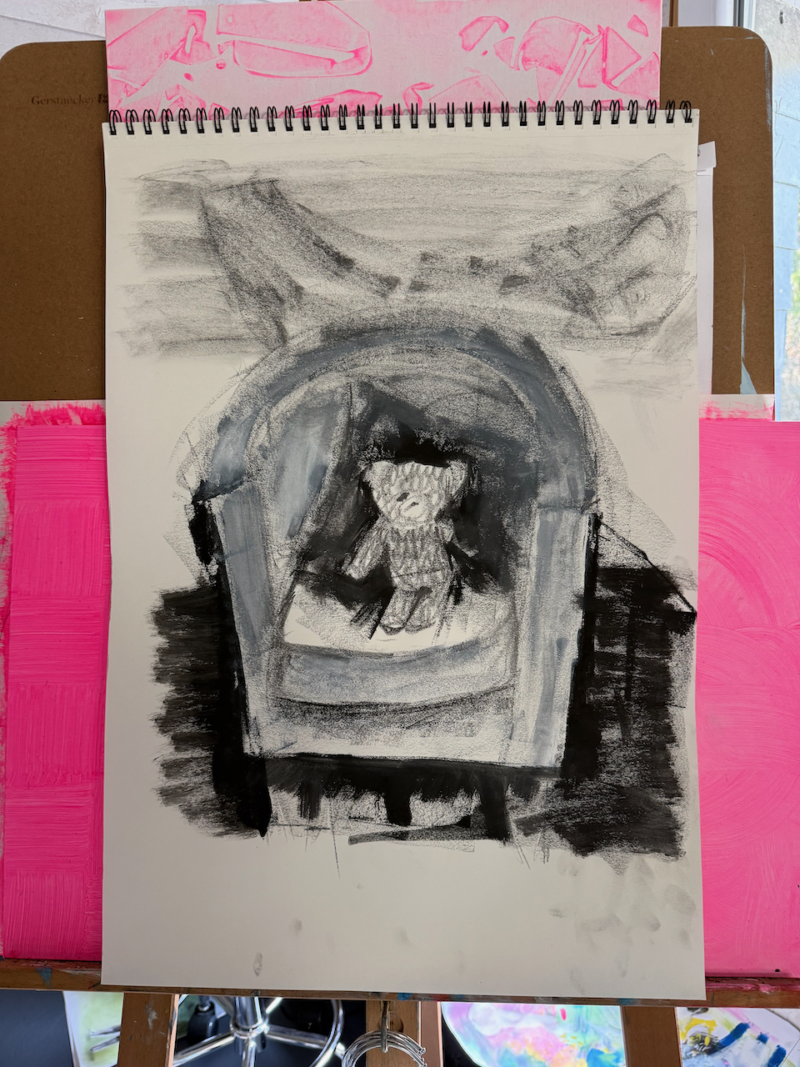
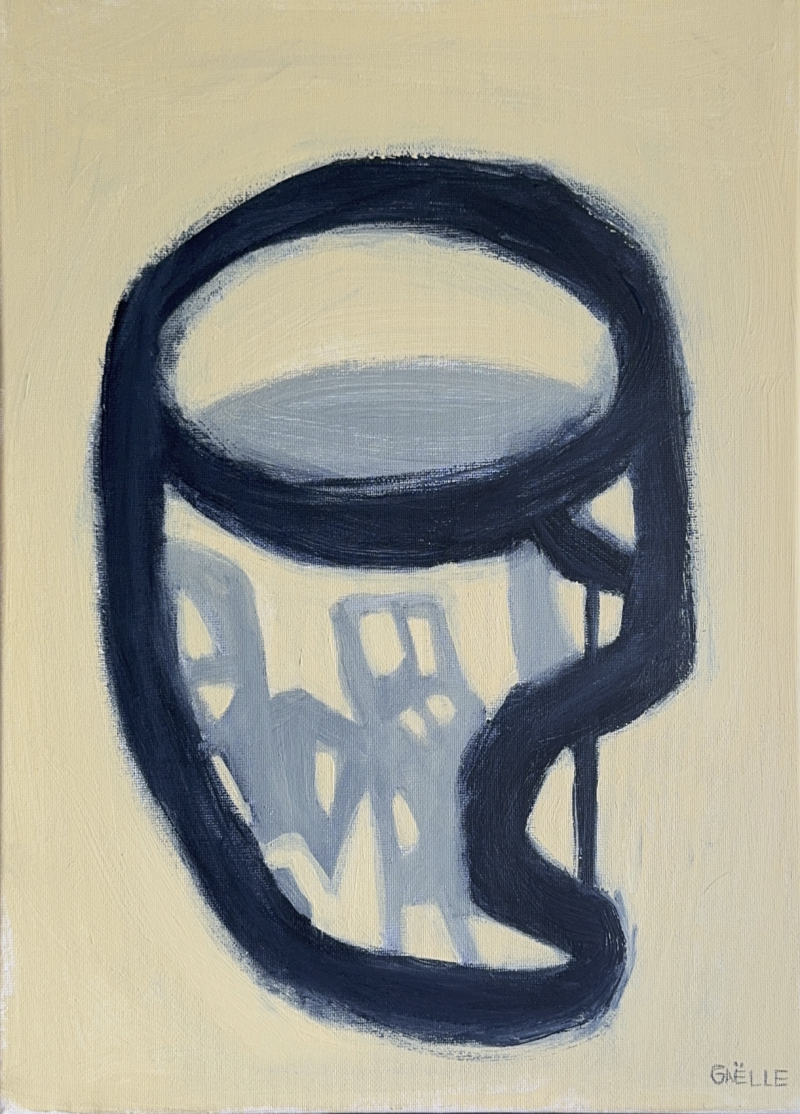
In Stevie Smith and the Willow, the face actually reads as a face and as a willow. It is not a realistic face. It echoed the feedback I received from the group tutorial to think about how much to show and how much to suggest and how to leave some ambiguity in the drawing to let the viewer feel and fill the image. How much resolution does a mark need before it becomes a fixed form? What is the threshold between trace and figure?



2 Comments
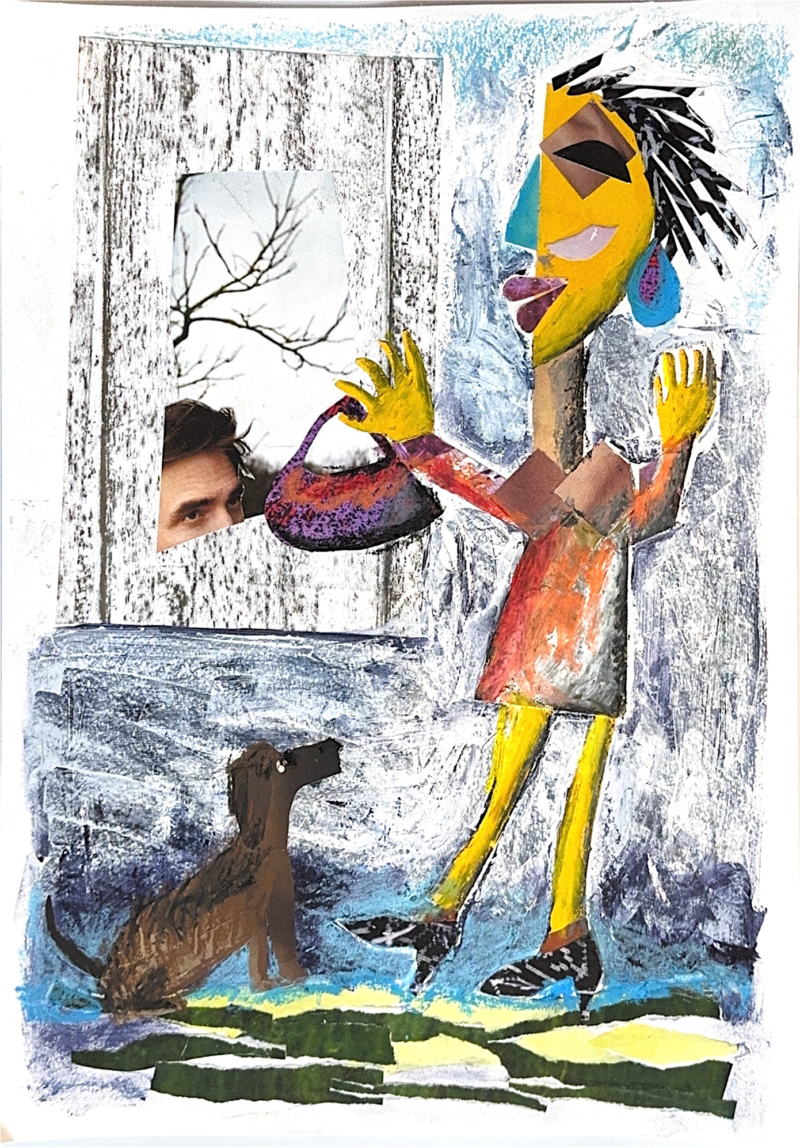
Add Yours →Thanks Gaëlle. I appreciate your description of process and of sinking into places writing paintings . Maybe the unconscious can re synthesise some parts and the artwork is letting it come through into ‘something’.
Don’t know if that means anything to you?
Thanks for your thoughts Bar! It does… perhaps it could be in terms of one’s unconscious (although my scientific mind has difficulty embracing that concept!), or perhaps in terms of a shared conscientiousness: if I leave something unfinished, I am inviting others or my future self to fill in the gaps. I don’t have to ‘decide’ everything at any point in time?