To better understand Alexandra Blum’s art practice, I explored her website, listened to her artist’s talk as well as the review of her work by Graham Crowley.
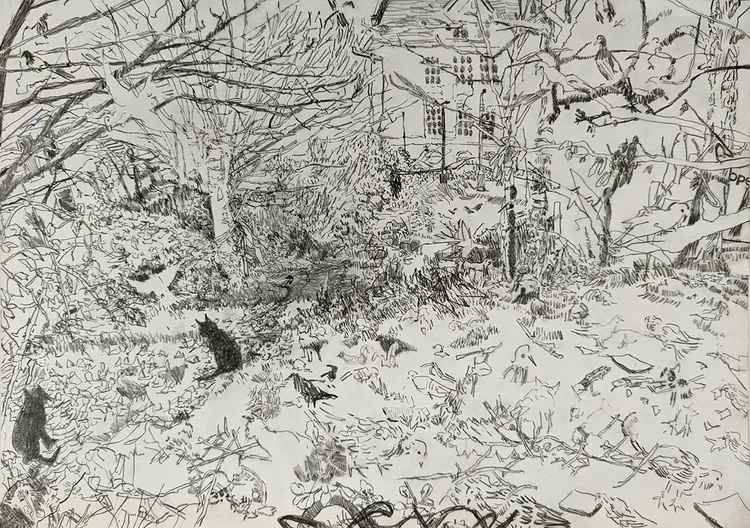
Alexandra Blum’s drawings don’t represent urban space, they put it on a stage. They feel less like a record of what was seen and more like an imprint of the act of looking itself.
The most striking thing about her practice is that she doesn’t treat interior and exterior as opposites with a clear boundary between them. In the Dalston Square work (Part 2), the construction site and the street exist in the same field of attention. In the lockdown drawings, the domestic interior and the city beyond the window are held together without hierarchy. What interests her is the threshold, the edge where one space bleeds into another. The viewer has to piece that space together gradually, moving through the image rather than reading it at once. She describes Early Netherlandish painting, particularly the Entombment attributed to Robert Campin (c.1425), as a key influence: its multiple viewpoints and precisely placed details “encourage our eye to start roaming around the space, so that we piece together our understanding of the space gradually as we move through it, which in turn builds a feeling of duration into the image.” The experience of looking at her drawings is close to this. Like a Where’s Wally image, there is no single focal point, no hierarchy of importance; every corner holds something, and the eye keeps being pulled back.
The method that produces this effect is what she refers to as wayfaring, drawing on anthropologist Tim Ingold’s concept of moving through a landscape whilst maintaining active engagement with what opens up along the path. Blum draws the way a walker moves: not from a fixed viewpoint with a pre-planned composition, but from within the space, discovering it as she goes. The drawing begins with a first point of attention, a crow landing on a column, a crane at the end of the street, and grows outward from there, following wherever looking leads.
The technical shift that makes this possible is her move away from outline drawing toward relational marks. Rather than drawing one form completely and then the next, she makes an observation, makes a mark in relation to it, then turns to a neighbouring form and makes the next mark in relation to both the new observation and the previous mark. The result is that the space around things becomes as constructed and as expressive as the things themselves. As she puts it, “the relationship between forms and the relationship between a form and the surrounding space become completely interwoven. One quite literally couldn’t exist without the other.“
A second layer of meaning comes from drawing speed. Blum deliberately mixes fast and slow mark-making within a single image as “an intuitive response to the varied paces of change and movement.” This is a formal decision with real consequences: a drawing that holds different speeds can hold duration, not just a frozen instant. It can carry memory and anticipation inside a present moment.
Implications for my practice
I liked both the idea of using relational marks and varying drawing speed and I made a note to try and experiment with this more explicitly in my own practice. Technically, the difficulty is to render the different focal points without distortion… but perhaps I will not worry about this for now and simply try not to pursue of a pre-seen whole (as in a photograph) but instead draw what I see as time passes. This connects to something I noticed in my own interior studies during Exercise 1 and 4: whether I am most free when I work intuitively first and analytically second or vice-versa.
The sketch below is an example of a drawing I did on a train journey, picking something I saw each time I looked at the window.
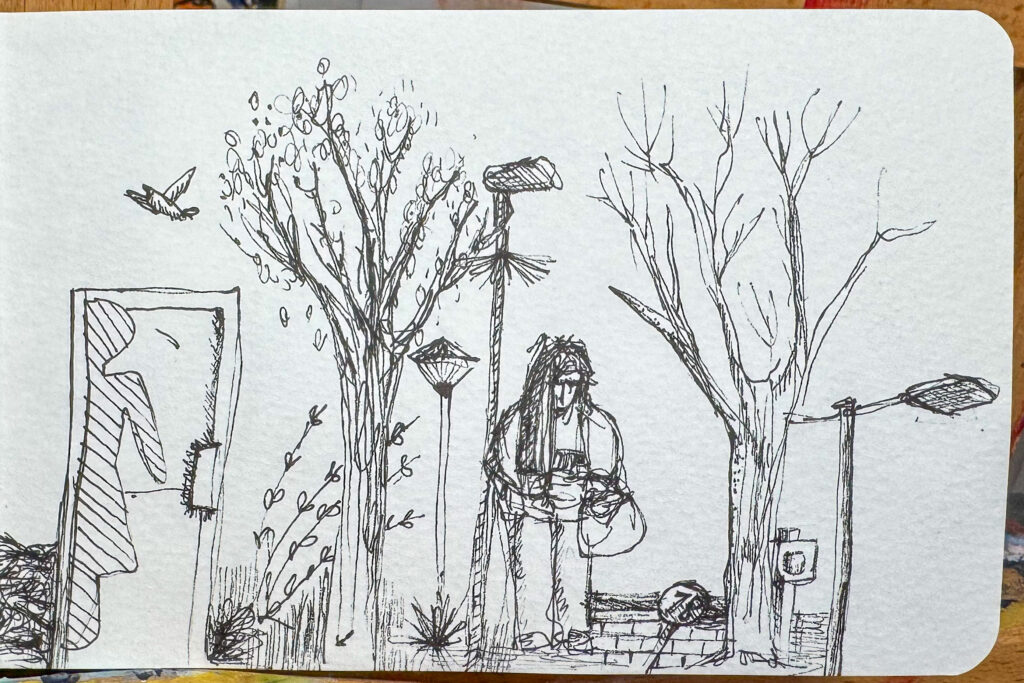
I realise it is more a collage than a drawing from Blum’s approach but it helps me reflects on how it is interesting to hold multiple viewpoints at once in a drawing. This also reminds me of David Hockney‘s Pearblossom Highway “joiners” photo collage using multiple viewpoints of the same scene, creating time-based and role-based narrative (from the passenger vs. driver seat). So perhaps what most resonated was this idea of capturing movement and life passing by in a drawing or painting.
Task brief
Alexandra Blum makes drawings that explore positive and negative space in response to the urban environment. Using Alexandra Blum’s website, have a look at the ways she investigates the boundaries between interior and exterior space, and how she is manipulating media to convey her ideas.