Background research
Before you embark on your BA studies proper, the OCA invites you to engage in a series of creative challenges. This particular challenge invites reflection on how you tell a story in a limited space, such as a postcard. How do you explain the key messages around a theme?
This made me wonder about how do you decide what a “key” point is? It’s something I struggle with my neurodivergent brain! I tend to either find everything interesting or everything boring. Prioritising is a challenge and I know it will be my biggest struggle to keep up with the course in this imminent learning journey.
The theme for this challenge is the rise and fall of pirate radio.
First things first (talking about priorities!), I started by exploring the topic. The prompt suggests looking at the cultural and human impact of pirate radio and the perception of pirates in the media ans the wider society at its peak.
I knew nothing of pirate radio so I thought I’d start by learning a little more about it and searched for a podcast I could listen to on my commute.
My first find was this podcast series, from DJ and radio producer Tayo Popoola on the Barbican website.
What was striking in the first episode was how instrumental pirate radio was in introducing underground culture and black music, which no one was playing at the time, on mainstream radio. Pirate radio broadcasts such as Radio Invicta gave a voice to those who had been silenced until then. This was achieved by people who were inspired by, and passionate about soul music, against a backdrop of government chasing the transmitters to seize the equipment without managing to put a stop to the enterprise. It reminded me of the pink panther!
It made me think how nowadays, when anyone can broadcast anything from anywhere over the internet, we have also lost something in the process. I find the voice of the dissenters are harder to hear in the cacophonous era of YouTubers, Instagramers and TikTokers. Pirate radio is obsolete and perhaps, despite the apparences, it’s those who seek to control what the masses hear and think who truly won the battle, not through regulation but through algorithmic control. If everyone is broadcasting, who is listening?
This reminds me of a fantastic book by Giuliano da Empoli’s Les Ingénieurs du chaos (The Engineers of Chaos) where he describes how we transitioned from a centripetal society to a centrifugal one (bear with me, I will try to explain this next).
In a centripetal society, you have a political party or leader who seeks to occupy the centre of the political spectrum to win power. This is a society where politicians are broadcasting their views from the top, with the goal of attracting diverse voters inward towards a moderate consensus. In this world, ideas are debated, and those in power seek to silence alternative voices. This is a world where pirate radio broadcasters are persecuted.
Now, da Empoli explains, we live in a new world where politics has become centrifugal. The aim is no longer to draw people to a central, unifying message. Instead the aim is to target the specific emotional appeals and grievances of niche groups with the aim of pushing them to the extremes and mobilising them around a discourse of denunciation. These new politicians are political engineers who tailor messages to their audiences and reach them in the privacy of their social media feed. They are not interested in debating ideas, they don’t fight for values, they only use messages as a tool to “win people over”. In the UK, during the Brexit campaign, millions were spent to target animal lovers on social media with messages highlighting how the EU was protecting hunters while hunters were targeted with ads highlighting what the EU was doing to prevent hunting from taking place (Serefas, 2018).
So we don’t have pirate radio broadcasters transmitting from a small flat with make do equipment, we have private “spin doctors” acting in the shadows of social media with millions of funding. Everyone gets to hear what they want to hear, even if, for these modern pirates, it means telling one person one thing and another person the opposite. The goal is no longer to debate what is right or wrong. The goal is to say privately whatever it takes to bring people along to their side. We may feel we are freer than ever but in reality we are in danger of becoming a global society of puppets. We desperately need a new generation of pirates, and I think our best hope lies with the artists. Now more than ever we need Art to open people’s eyes.
Art making
At this point I had a few things to say about the theme, and the challenge called for experimenting with multiple media, and see how they affect the way in which I present information.
I thought I could have say three different postcards representing different elements of my exploration.
I have several ideas popping in my head:
- I could use paint to represent centrifugal and centripetal movement, mixed with collages of actual boats broadcasting pirate radio stations. YouTube’s and social media logos in the sea of information. I will need to explore how these physical movements are represented.
- Perhaps it’s a 1-minute animation film from my drawings show the rise and the fall of the pirate radio ship from the sea, chased by the agency and ultimately engulfed by a sea of social media icons.
- Or it’s a collage of words, perhaps key quotes from the podcast that synthesise the story they are telling.
Now generating ideas is the easy part. Turning them into a reality is another kettle of fish! I’ve been thinking about idea no. 2 a lot. I really like animation as an art form, especially animated drawings and collages.
While scrolling on instagram, I came across a new campaign by Hermes which celebrates craft and handmade drawings and commissioned artists to create hand drawn animations. I was really inspired by the animation style of visual artist Lee Kyutae, known as kokooma_.
There was my creative challenge. To create an animated drawing of one minute to tell my story of the rise and fall of pirate radio. My biggest hurdle was to plan what the animation will do. I found useful advice in a short tutorial on how to make a flip book: plan the start, middle and end.
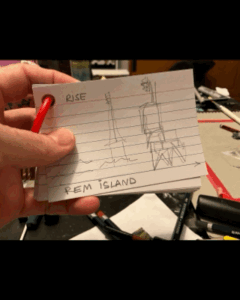
I started by sketching the sequence very loosely on index cards.
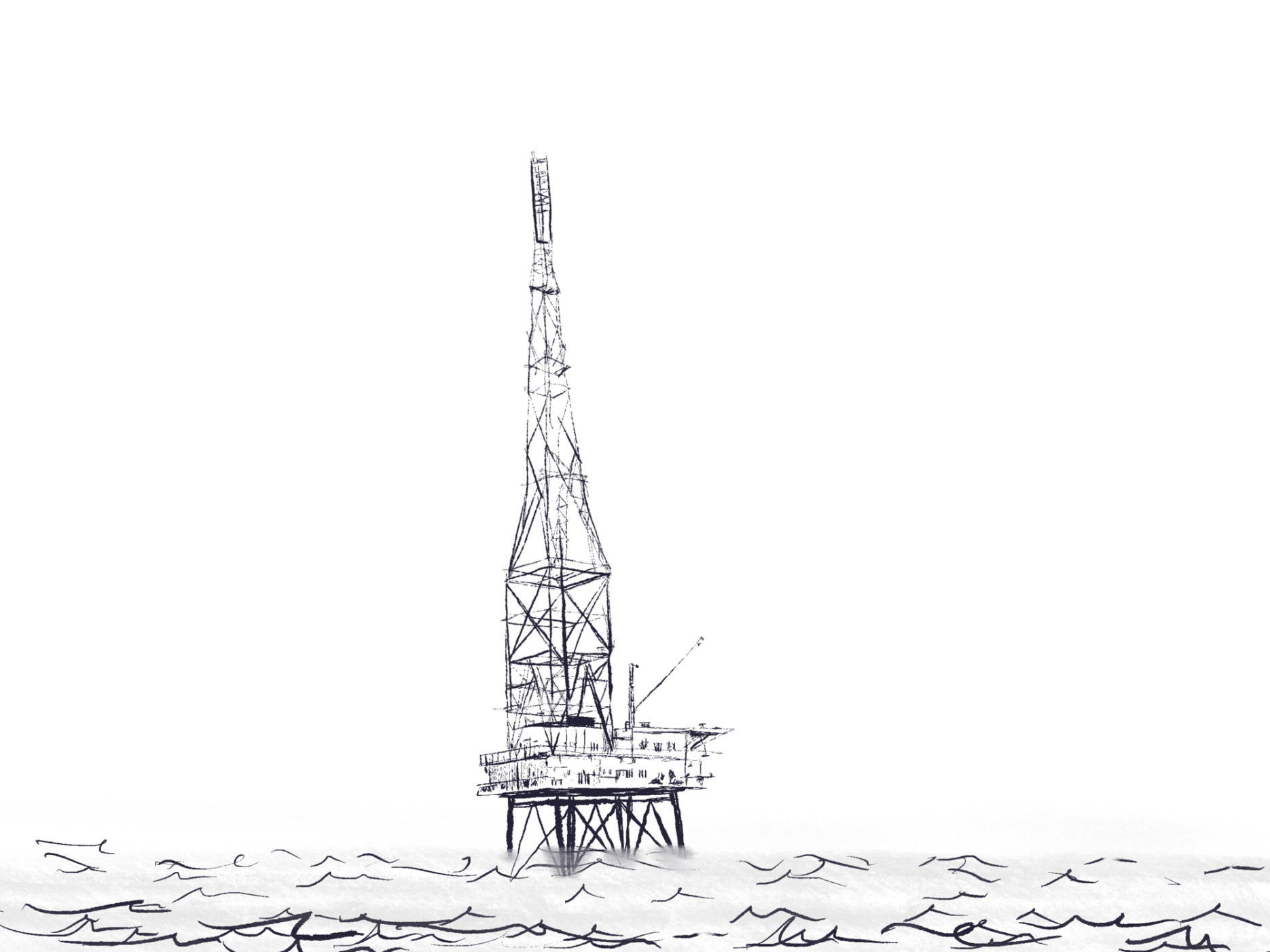
Then I searched for raw materials and found this picture of REM Island on Wikipedia.

REM Island was a platform off the Dutch coast used as a pirate radio station in 1964 before being dismantled by the Netherlands Marine Corps. Source: Wikipedia
First I tried using Procreate to create the animation but I felt limited to animate different parts of the picture.
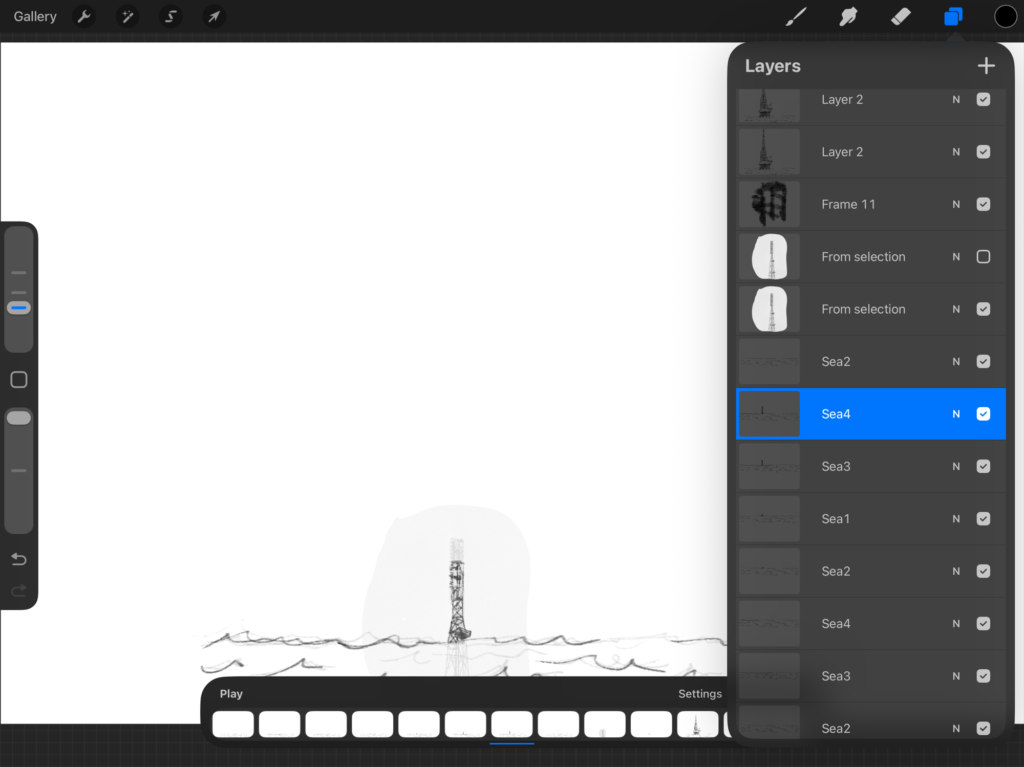
Then I remembered I also had purchased Procreate dreams but had found it too complicated. I thought I’d give it a try and realised it had been updated to a new version with a “flipbook” mode which turned out to be very intuitive.
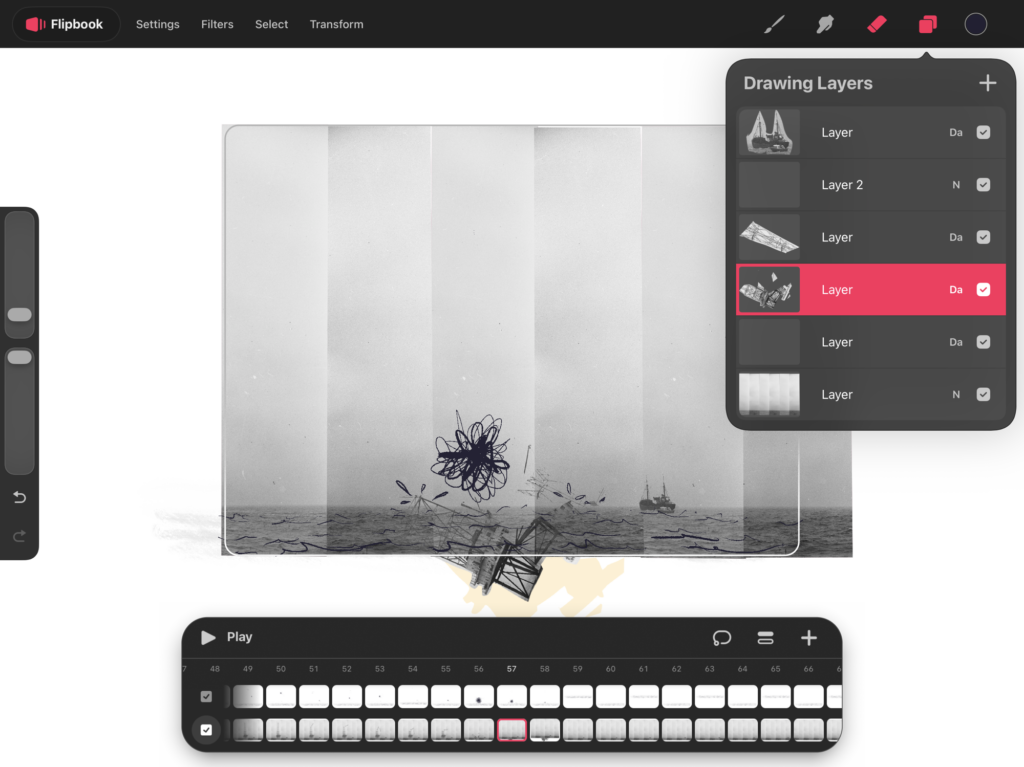
At first I wanted to use only drawing but it took me many hours to redraw each frame and even if I was trying to be efficient with copy and paste, the work required quickly spiralled out of control!
So in the end, I had to make decisions to manage to complete something by the weekend. Towards the end of the animation I worked with cutouts of the photographs only with drawing marks on top of the pictures.
I enjoyed creating the story and in the end, still to be efficient, I decided to cut out the commentary on social media and instead have a more optimistic ending (if you side with the pirates, that is!).
For the final touches, title, credits and and the music, I used the Stop Motion app. The music and and the sound effects are a sample from the App Library but I was quite happy with the results.
I did fiddle a little with the various video formats: YouTube shorts, YouTube videos, Instagram Reels… If I were to redo it, I’d probably spend some time deciding what format I want to use.
Final thoughts
I enjoyed going through the steps to create this little animation. It reminded me that my biggest pitfall is and always will be time.
I had enough ideas for three projects but not enough time to complete them. Although I also was reminded that a challenge like this is an exercise, a study. It doesn’t have to be a complete artwork.
Another thought was about repetition. When you work on an animated drawing you have to redo the same drawing many times with small changes. In my foundation, I have found working on a series on similar works the most difficult part. Perhaps I should think of it as an animation project instead.
To conclude, I love painting and also I keep returning to video art and moving images. I don’t know how or if I will mix the two together in my work, but it’ll probably return.
If you read this through here, thank you for your time. Drop me a line and share some of your own work or ask me a question. I’d love to connect!