Quick Facts
- Born/Died: b. 1975 –
- Nationality: American
- Key Period: 2000s – Present
- Main Medium: Uses spray paint and lays the painting flat and paint with heavily watered down acrylic paint.
Visual Notes
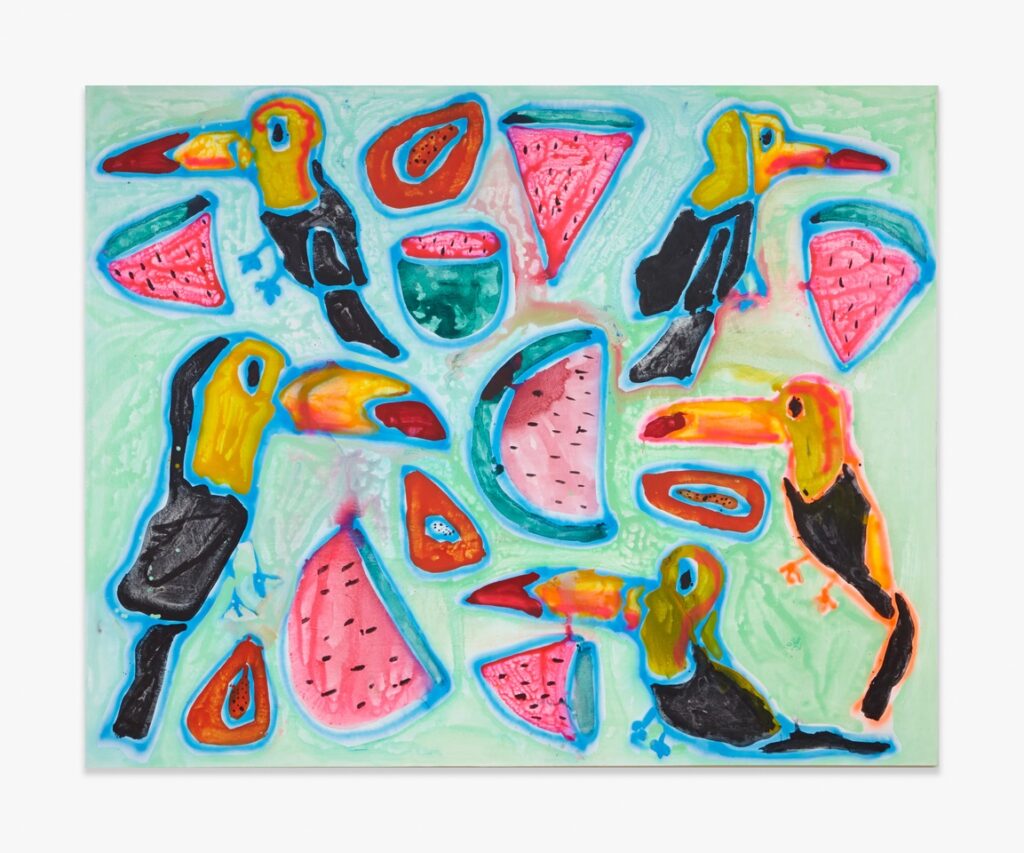
Work 1: Jungle food, 2015
- What I see:
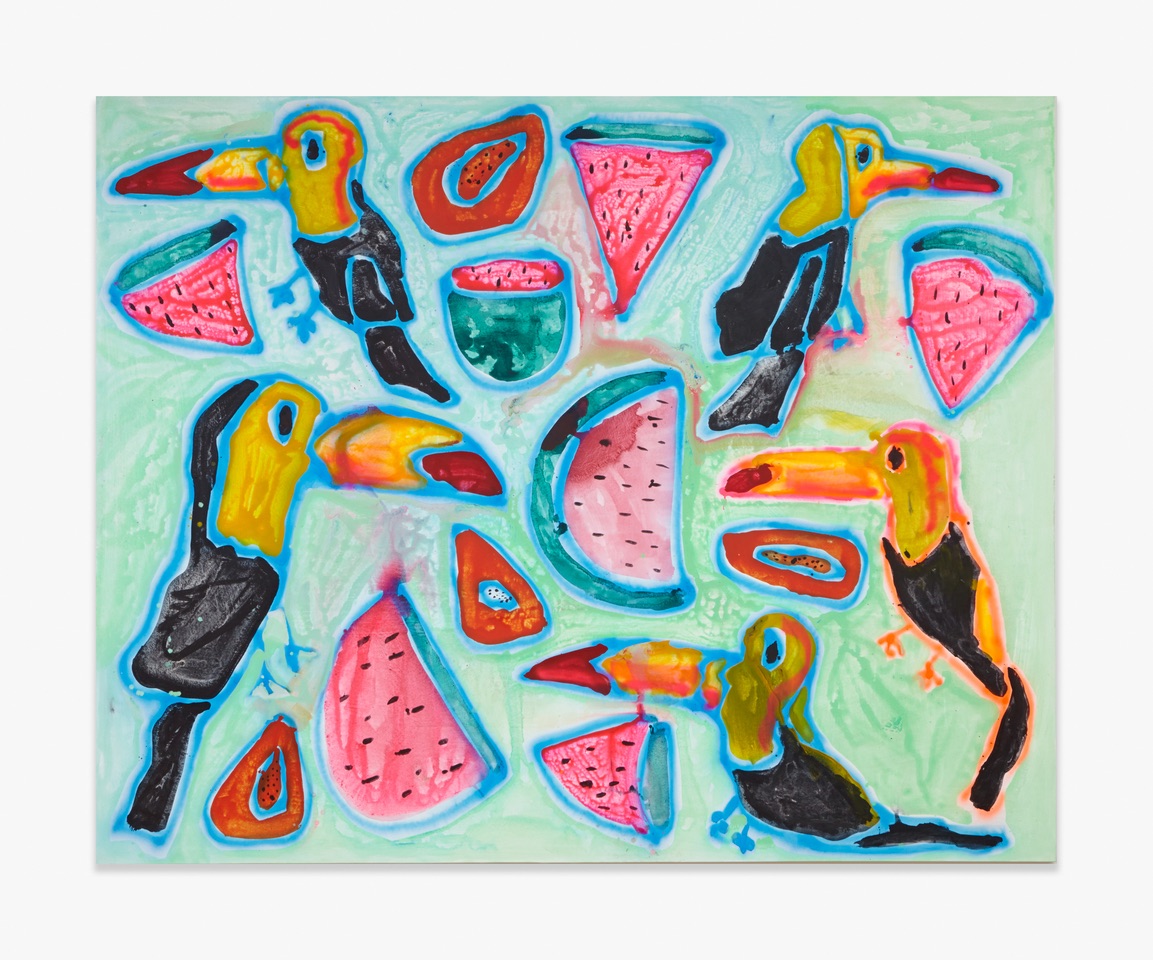
I see repeated patterns of toucans, watermelon slices and papaya. I can see the outlines of the objects in cyan blue and the bright colours are dripping out and mixing on on the canvas. Louise Elderton describes it as a “colourful, electric neon saturation of colour” - Materials/technique:
This appears to have been done in her characteristic process, starting with fluid, energetic lines in spray paint and then filled in with highly saturated watered acrylic colours. - Why this matters:
I find the pattern painting striking, I like the rhythm of it. I like that the repetition without proper repetition. I also like the vibrant colours, the warmth of it. But, I think above all, I like the freedom it exhudes. This painting is saying be yourself, it does not matter. Let go, mess up, let it happen. It will still be OK. I also like the message of the painting. In the context of the overlooked, I find the painting is asking about why are these things so abundant we take them for granted yet they are arbogeneous. They are familiar but we forget their familiarity is out of context. They’ve been extracted from their environment for our pleasure and perhaps they lost a little of their soul in the process.
Work 2: Fungi Bathing, 2022

- What I see:
A pop bright pink panther, immediately recognisable icon from the 1980s (I grew up watching it) in an enclosed tiled bathroom and surrounded by mushrooms. The colours are electric and the juxtaposition is sometimes jarring (the green and the orange). The mushrooms are leaking their blue onto the pink panther creating ambiguity (is it clean or dirty?). - Materials/technique:
This painting uses the typical process starting with loose spray paint to provide structure and water-downed acrylic painting to fill in the colours. There is still repetition but the space is delimited through the lines although the perspective is distorted. - Why this matters:
The picture is not really aesthetically pleasing. The jarring colours, the panther and the mushrooms together look a little repulsive with the painting mixing into muddy colours but this is what makes the picture arresting. It invites a reflection on our “shiny consumerist culture”. Where do those icons go when they fall out of fashion?
Key Ideas
- She depicts products of daily life, “quotidian detritus that is throwaway or imposes itself upon us” (Elderton, p. 30)
- “Bernhardt’s process is improvisational and loose, at times inviting accident and chance into the works, as well as asserting an equal relationship between artist and material.” (David Zwirmer, 2021)
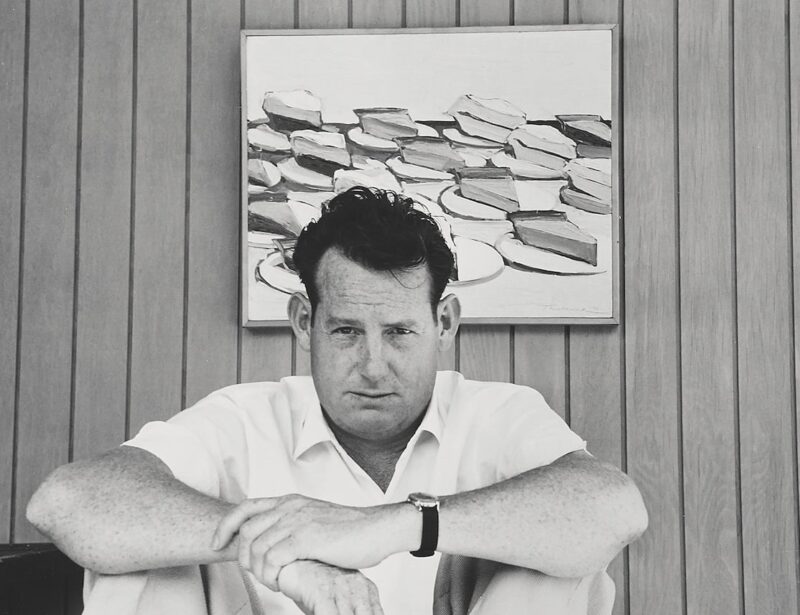
- Like Wayne Thiebaud, drawing is integral to her practice and while his drawing-paintings were inspired by the paraphanelia of his youth in the 1950s, Bernhardt draws inspiration from then and now. In Jerry Saltz’s (2020) words, commenting on an exhibition of Lockdown Art featuring Bernhardt’s neon-colored images of cigarettes and Xanax “as with all great art, the very deep content of right now, of the artist’s time, is embedded in all of this work”.
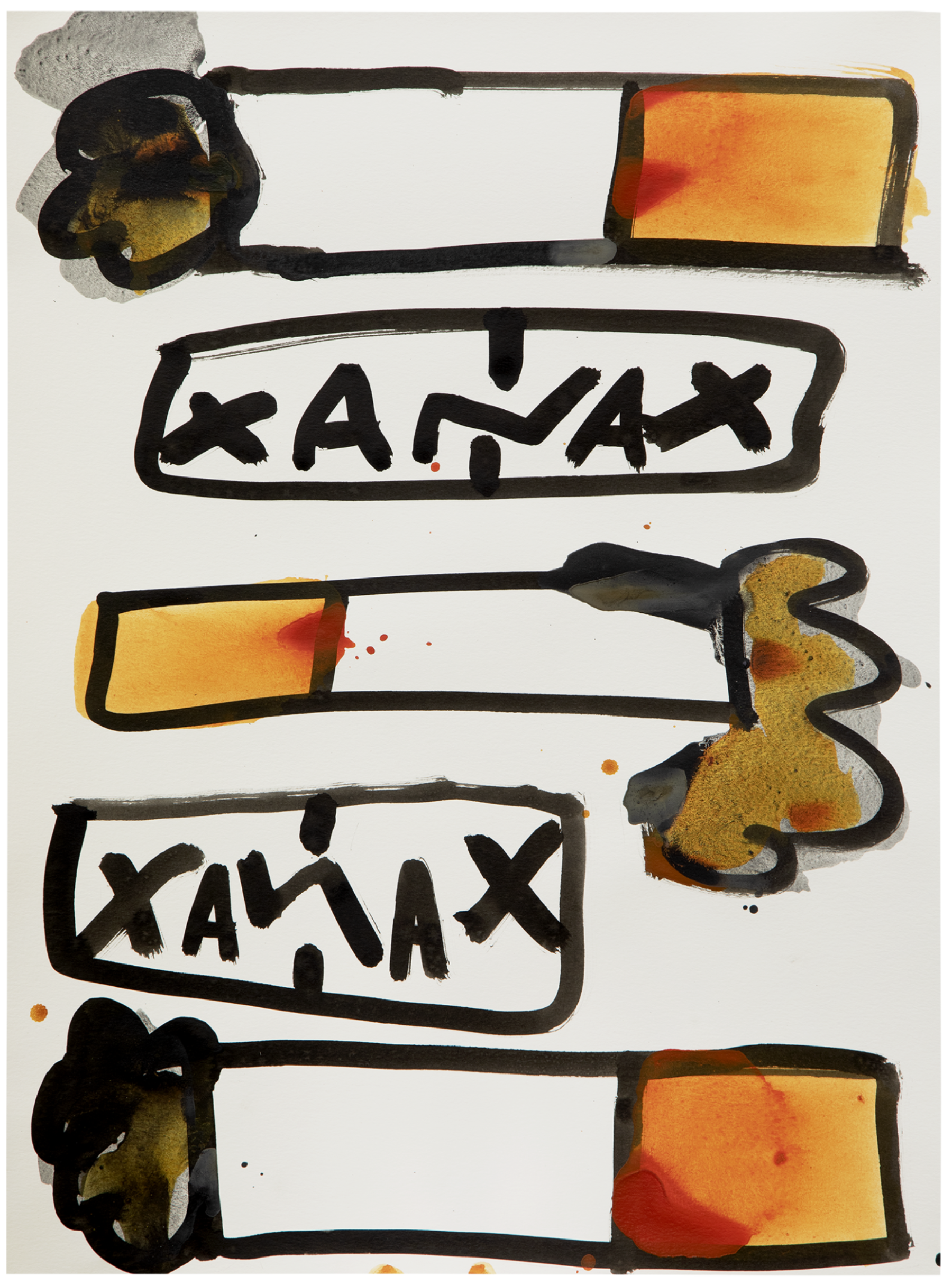
Katherine Bernhardt, Untitled, 2020, Acrylic and watercolor on paper, 24 x 18 inches (61 x 45.7 cm). The Drawing Center.
Quotes Worth Keeping
“I’m always trying to find something very obvious in everyday life that I’m overlooking.” – Katherine Bernhardt, Temple magazine Interview, July 2025
“With a colourful, electric neon saturation of colour, Bernhardt’s paintings are both gauche and sumptuous.” – Louisa Elderton, Vitamin P3
Connections
- Similar to: Michel Basquiat (1960-88), Philip Guston (1913-80)
- Contrast with: Wayne Thiebaud
- Influences: Peter Doig, Chris Ofili, Henri Matisse, Pattern and Decoration Movement
- Influenced: ?
Questions I Have
- I want to explore the Pattern and Decoration Movement more, not necessarily as a decorative aspect of art-making but as it relates to the concept of “repetition without repetition” in ecological psychology (Renshaw et al., 2022)
Relevance to My Practice
- I like the freedom of her lines and approach. Seeing her work authorises me to “let go” and practice drawing and painting more freely without talking myself down for it.
- Her focus on the “overlooked” objects and paraphanelia resonates with what interests me for several reasons, some intellectual, some very personal. Her work encourages me to continue to explore this interest further.
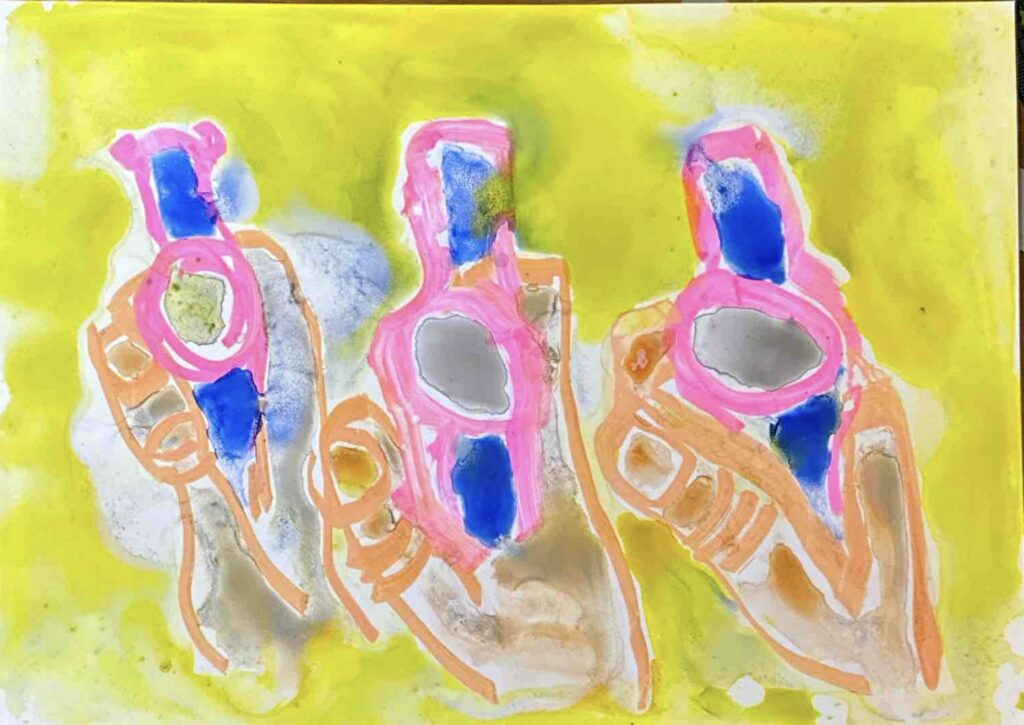
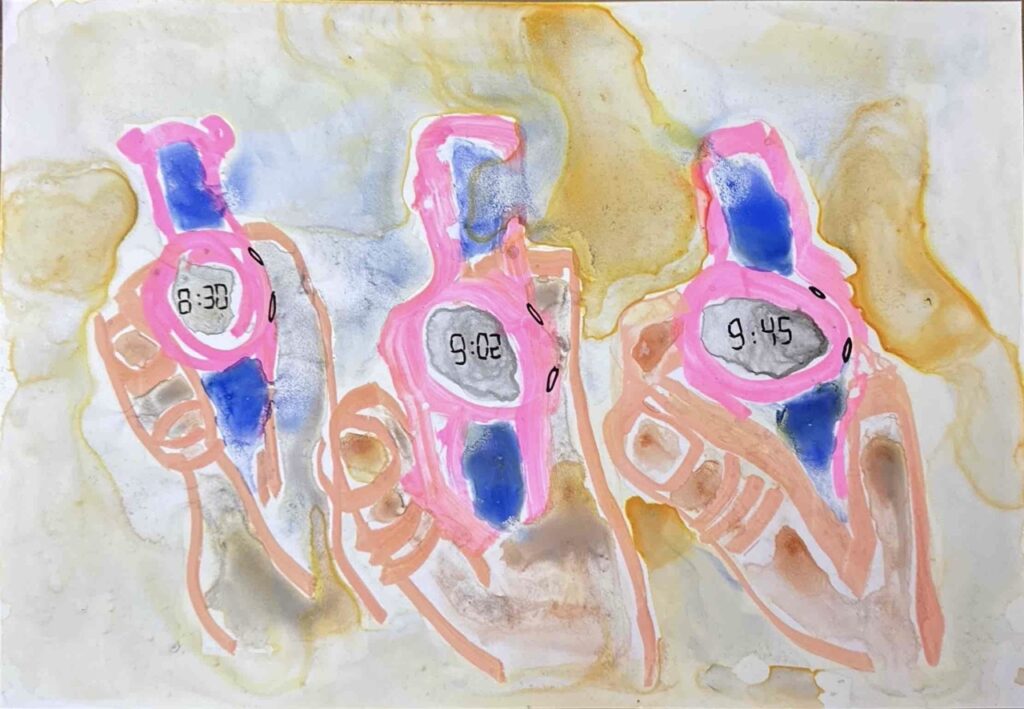
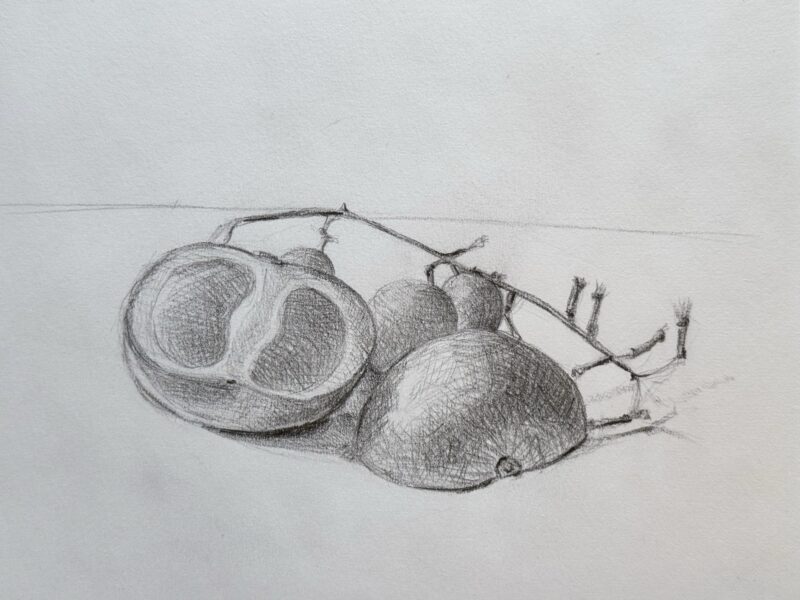
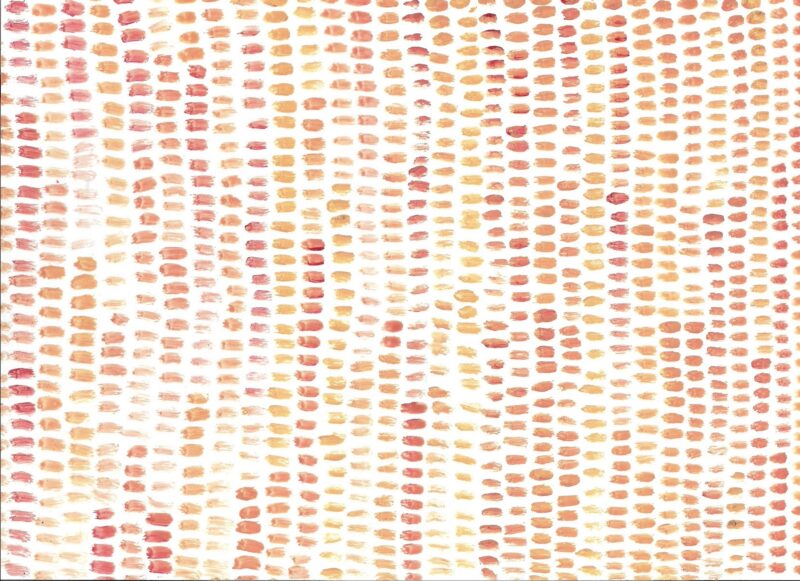
The dried version lost it’s saturated colour and glossiness… I need to experiment more!
Sources
- David Zwirner (2021, July 2) ‘David Zwirner to represent Katherine Bernhardt’. Available at: https://www.davidzwirner.com/news/2021/david-zwirner-to-represent-katherine-bernhardt (Accessed: 8 February 2026).
- David Zwirner (no date) Katherine Bernhardt. Available at: https://www.davidzwirner.com/artists/katherine-bernhardt (Accessed: 8 February 2026).
- Elderton, L. (2019). Katherine Bernhardt in Vitamin P3: new perspectives in painting (pp. 30-31). Edited by R. Morrill and T. Melick. Phaidon.
- Renshaw, I., Davids, K., O’Sullivan, M., Maloney, M. A., Crowther, R., & McCosker, C. (2022). An ecological dynamics approach to motor learning in practice: Reframing the learning and performing relationship in high performance sport. Asian Journal of Sport and Exercise Psychology, 2(1), 18–26. https://doi.org/10.1016/j.ajsep.2022.04.003
- Saltz, J. (2020) ‘Jerry Saltz on the Drawing Center’s Lockdown Art’, New York, 31 August. Available at: https://libezproxy.open.ac.uk/login?url=https://www.proquest.com/magazines/jerry-saltz-on-drawing-center-s-lockdown-art/docview/2466152838/se-2?accountid=14697.
- Temple magazine (July 2025) Katherine Bernhardt. Available at: https://www.templemagazine.co/projets/katherine-bernhardt/ (Accessed: 8 February 2026)
- The Drawing Center (2020) 100 Drawings from Now. [Exhibition]. New York: The Drawing Center, 7 October 2020 – 17 January 2021. Available at: https://drawingcenter.org/exhibitions/100-drawings-from-now (Accessed: 8 February 2026).